



New report shows linear TV is losing the battle of the box to streaming
Two-thirds of Australians now prefer streaming to watching TV, and the VFC’s first report says ad dollars should follow suit.

The couch has picked a side.
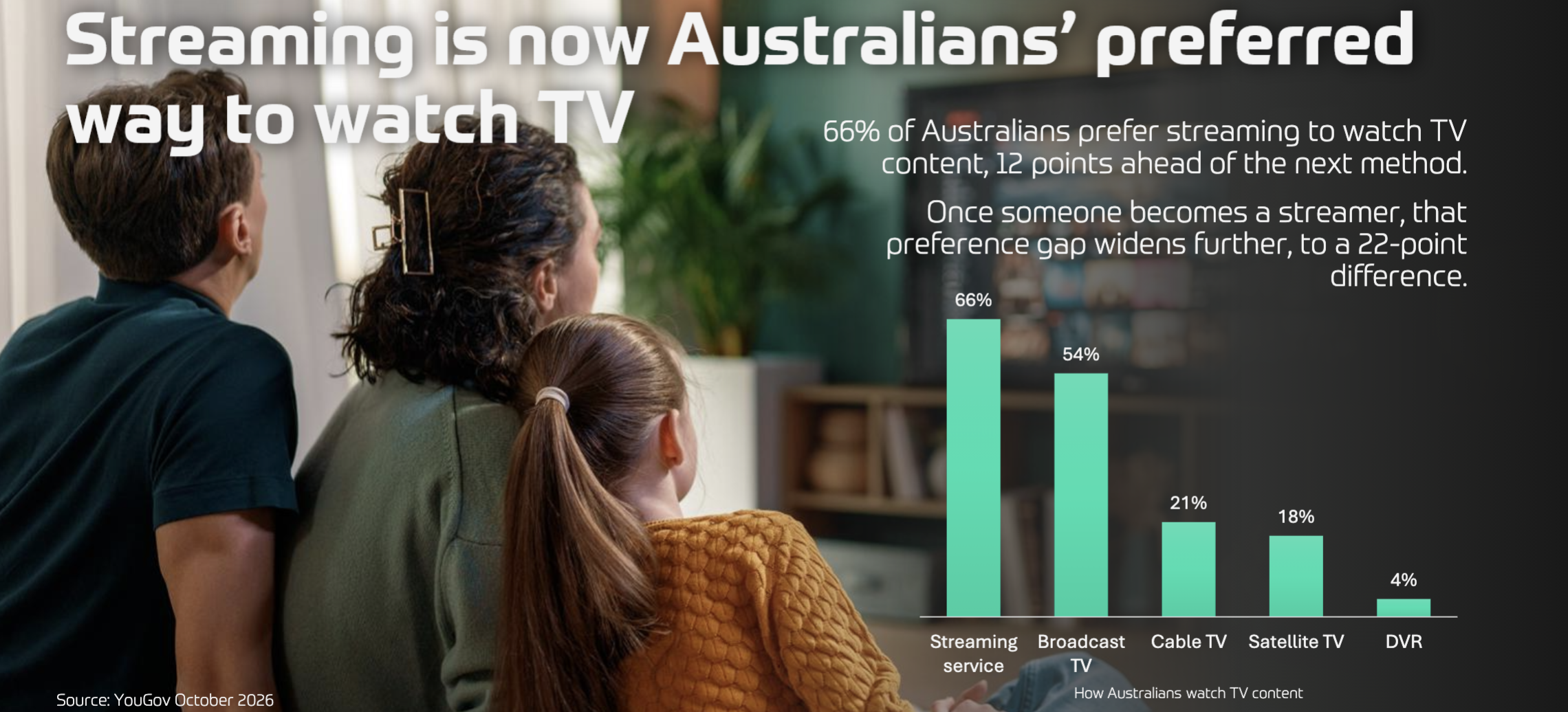
Two-thirds (66%) of Australians now prefer streaming to any other way of watching TV, according to the Video Futures Collective's (VFC) inaugural State of Streaming report. That puts it 12 percentage points ahead of broadcast TV on 54%, with cable (21%), satellite (18%), and the humble DVR (4%) trailing well behind.
Once someone becomes a streamer, the report finds, the preference gap widens to 22 points. Nobody, it seems, misses the program guide.
The report pulls together research from YouGov, IAB Australia, WPP Media, Zenith, Samsung Ads, the Australian Communications and Media Authority (ACMA), Amplified, Adgile, and Analytic Partners. Its data is current as at October 2026.
“Streaming has become the way Australians choose to watch TV, but reach alone doesn’t tell the complete story,” said Toby Dewar, CEO, Video Futures Collective.
“The inaugural State of Streaming report brings the latest research together to show who these audiences are, how they behave and what makes them valuable to advertisers.”



The leading media trade publication in Australia.
Get our top stories straight to your inbox daily by signing up to our Newsletter
By providing your information, you agree to our Terms of Use and our Privacy Policy. We use vendors that may also process your information to help provide our services.
Follow the money
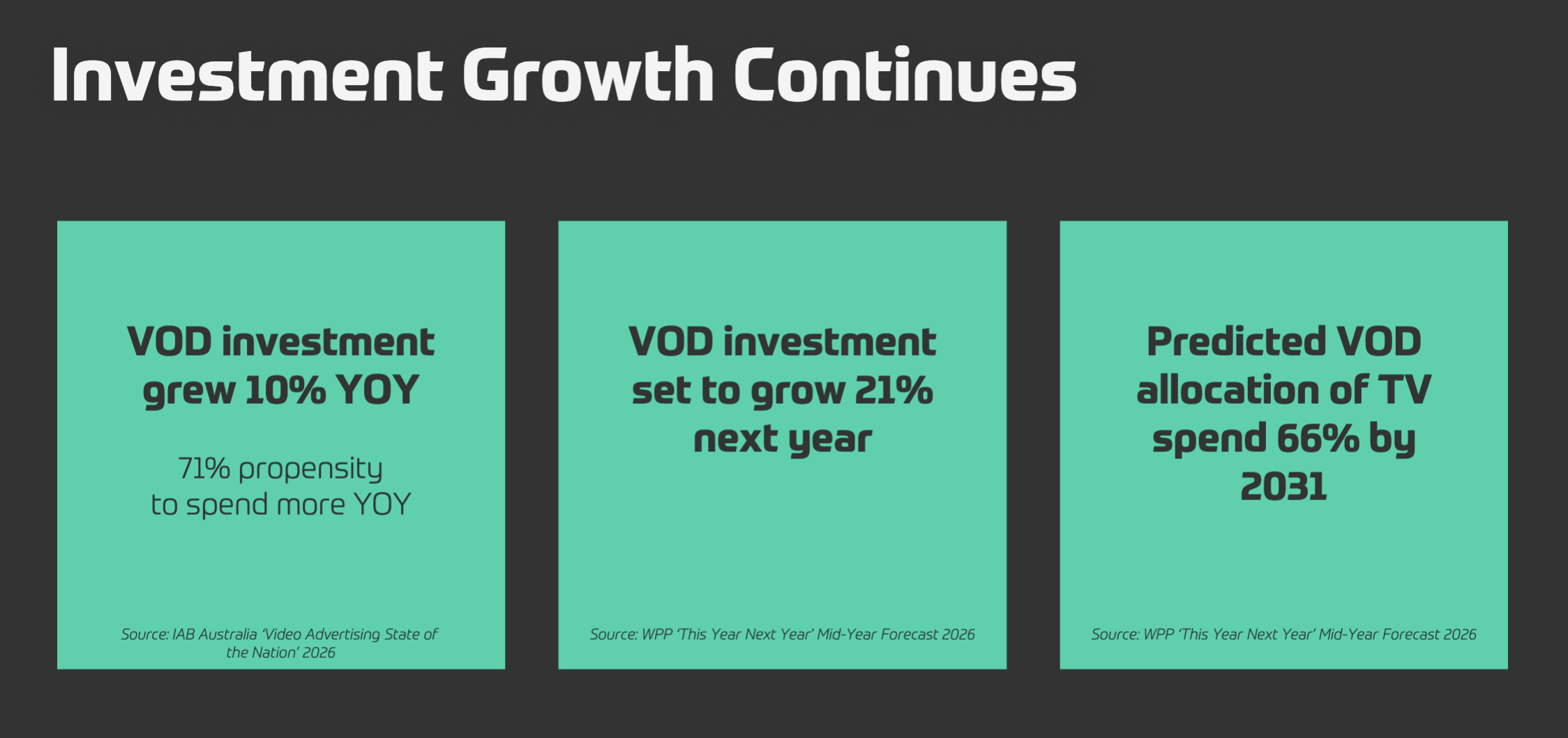
The report’s three opening numbers make its purpose clear. IAB Australia’s Video Advertising State of the Nation 2026 found VOD investment grew 10% year-on-year, with 71% indicating a propensity to spend more. WPP Media’s This Year Next Year mid-year forecast tips another 21% growth next year. By 2031, it predicts, VOD will take 66% of TV spend.
The audience side shows a similar shift. In Samsung Smart TV households, streaming accounted for 73% of viewing in Q3 2026, against 27% for linear free-to-air and subscription TV. Streaming viewing rose 2% year-on-year while linear fell 5%. One caveat: these households have already bought a smart TV, so they aren’t a neutral sample.
The wider picture comes from ACMA, which found 91% of Australian adults used an online service to watch video in a given week. Zenith’s Imagine Consumer Panel puts weekly SVOD use among Australians aged 18+ at 75%.
Why viewers stay
Viewers say they choose streaming mainly for control. More than half (57%) cite being able to watch whenever they want, 42% point to shows unavailable on traditional broadcast, 33% say it’s easier to find what they want, and 18% say the viewing experience is better.
The report’s “Streaming Now” slate shows how wide the content net is cast. It runs from Summer H. Howell drenched in blood in Carrie on Prime Video to The Kardashians Season 8 on Disney+, Kerry Washington and Ben Affleck in Animals on Netflix, The Jury: Skeleton in the Garden on SBS On Demand, and Luke Nguyen’s World on Samsung TV Plus.
The attention numbers are the report’s boldest. Amplified’s 2025 study of 15-second ads in Australia found streaming video on connected TV (CTV) delivers 41% more active attention than any other medium except cinema, which edges it by 5.6%. Against TikTok, Instagram, and Facebook, streaming averaged 123% more attention. Linear TV came in 80.2% behind, a number the free-to-air networks will no doubt want to discuss.
Who’s watching
Ad-supported streamers are more likely to be aged 25–54, university-educated, working full-time, on a high income, and to own their home. Of that group, 44% work full-time, compared with 19% of the comparison group.
That comparison group needs some explaining. “Ad-free or non-streamers” puts people paying for premium ad-free tiers in the same bucket as people who don’t stream at all. It skews retired (36%), and 57% are aged 55+. Even so, the largest single age cohort among ad-supported streamers is also 55+, at 36%. Grey nomads count too.
On spending intent, ad-supported streamers outpace the comparison group across every category measured. They lead on paid accommodation (+26%), flights (+22%), non-alcoholic beverages and travel and leisure (both +20%), quick-service restaurants (+18%), alcohol and personal care (both +16%), and sports betting (+14%).
The ROI pitch
On effectiveness, Adgile’s 2025 analysis found streaming took 28% of spend but delivered 46% of outcomes, which the report describes as “almost twice as efficient”.
Analytic Partners’ commercial mix modelling found that adding streaming platforms lifts return. Two channels improved ROI by 11% on a single-channel baseline, three by 33%, and more than three by 56%. The gains do taper: going from four platforms to six lifted response by 5%.
“The ambition of the VFC is to build the evidence base that enables advertisers and agencies to plan, measure and optimise streaming video with confidence,” said Jo Moses, Head of Research, Video Futures Collective. “This quarterly State of Streaming report is a significant contributor to this evidence base.”
The next edition is due in three months. Linear TV will hope the next report includes fewer charts about it.
More from Mediaweek
The leading media trade publication in Australia.
Get our top stories straight to your inbox daily by signing up to our Newsletter
By providing your information, you agree to our Terms of Use and our Privacy Policy. We use vendors that may also process your information to help provide our services.


