



Beware false idols: Why the cult of Mel Robbins is starting to crumble
Mel Robbins built her empire on two words. Now her podcast is sliding, and the Let Them theory faces its toughest tests.

They say there is no such thing as bad publicity. Mel Robbins may be testing the limits of that theory.
The self-styled guru has built one of the most commercially potent personal-development brands in the world. Her voice reaches millions. Her advice gets clipped into social videos, quoted in group chats, and repeated by friends and family (even strangers), dispensing wisdom of their own.
Ever had someone tell you to just "let them" after you described a situation that left you feeling powerless, hurt or angry? Indeed, her influence has taken hold in the culture and has only continued to metastasise.
That said, her grip, at least on the podcast side, appears to be slipping.
US podcast data compiled by Edison Research showed that in Q3 2025, The Mel Robbins Podcast dropped out of the Top 20 to #23. Come Q4, it rose slightly to #19 before reaching #16 in Q1 2026.
By Q2, it had fallen to #27.
From podcast host to self-help industrial complex
Robbins ended 2025 with The Mel Robbins Podcast named the most-followed show of the year on Apple Podcasts. It was also Apple's third-most-popular US show by listenership and produced the platform's most-shared individual episode.


The leading media trade publication in Australia.
Get our top stories straight to your inbox daily by signing up to our Newsletter
By providing your information, you agree to our Terms of Use and our Privacy Policy. We use vendors that may also process your information to help provide our services.
In Australia, her performance is harder to judge through the industry's main commercial benchmark. The podcast no longer appears in the Australian Podcast Ranker after its parent company, SiriusXM, withdrew its shows from the measurement system, so its absence shouldn't be mistaken for an audience collapse. Spotify still lists the show as a leading Australian title in the education category.
Yet for those who've followed Robbins' ascent, the softer US ranking arrives amid something more consequential than chart movement.

The problem with 'Let Them'
The largest controversy surrounds Robbins' blockbuster book, The Let Them Theory.
Published in late 2024, it expands a simple instruction into a broader philosophy: stop trying to control what other people think, feel or do, and concentrate instead on your own response.
Clean. Catchy. And, according to many, plagiarised.
Writer Cassie Phillips has accused Robbins of drawing from a poem Phillips wrote and circulated online years earlier. Phillips' poem, also titled Let Them, went viral in 2022 and carried a similar message of release, acceptance and personal agency.
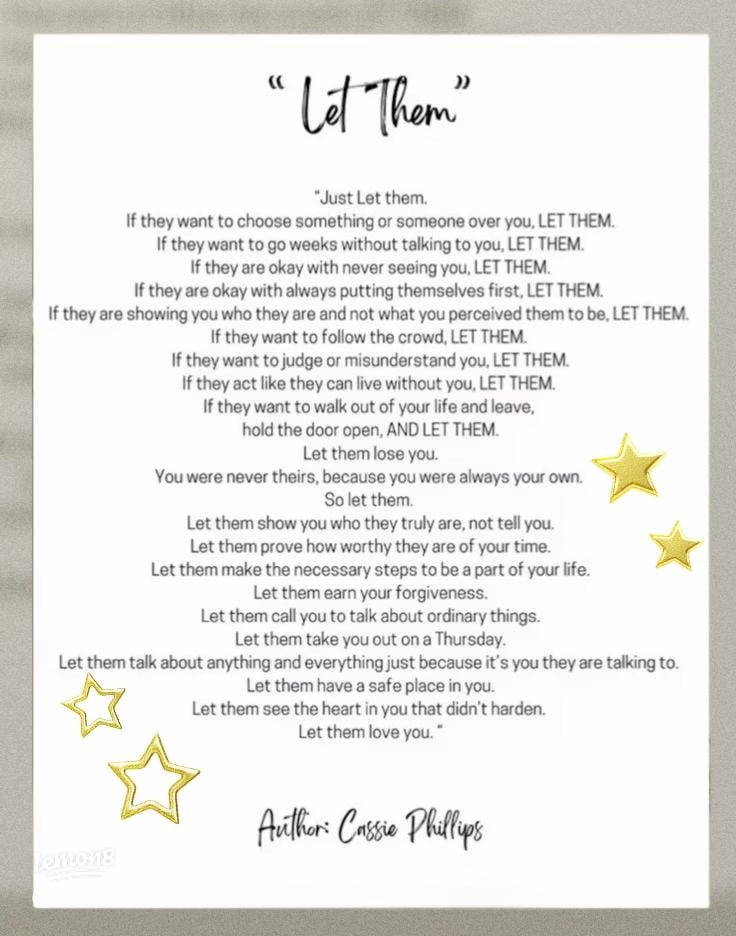
The timing raised questions.
In a May 2023 social media post, Robbins told followers she had "just heard about this thing called the 'Let Them Theory'" and loved it. By the end of the following year, The Let Them Theory had become the title of her book and the centrepiece of an expanding commercial brand.
Phillips has argued that Robbins' work sits uncomfortably close to her viral poem and that, at minimum, the earlier work deserved acknowledgement.
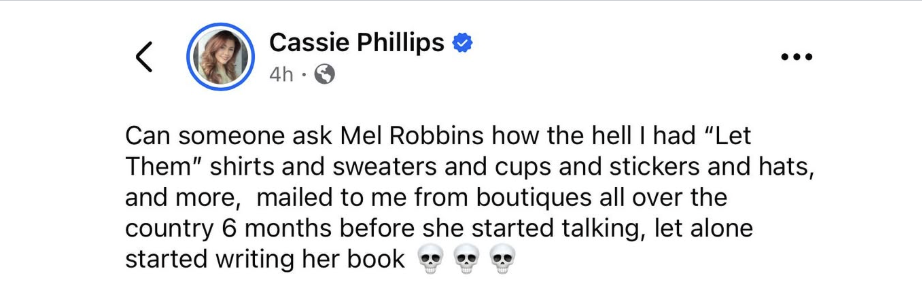
Robbins has firmly denied plagiarising Phillips. She says she never saw or read the poem, and that it wasn't the source of her book - pointing instead to Buddhism, Stoicism, the Serenity Prayer and other long-established traditions as the idea's intellectual roots.
Robbins also sought US trademark protection for "Let Them" across a range of commercial products. The US Patent and Trademark Office initially refused registration, describing the phrase as a commonplace expression carrying a familiar sentiment.
In other words: you cannot own this.
When the theory meets real life
The slogan's simplicity has also become its weakness.
During an appearance on Real Time with Bill Maher, Robbins insisted the theory could be applied to "everything." Maher tested that confidence with a darker example: should someone being sexually harassed at work simply "let them"?
Robbins rejected that reading, explaining that "let them" doesn't mean permitting abuse. Rather, she said, it means recognising reality before deciding what to do next - whether that's approaching HR, leaving a job or hiring a lawyer.
It was all very… world salad-esque.
Once the caveats, boundaries and corrective steps are added, "let them" starts to resemble the opposite of passive acceptance. It requires judgement, intervention and, at times, confrontation.
This is the central tension in Robbins' work. The appeal comes from reducing an unruly human problem to a phrase small enough to fit on a coffee mug.
The Microsoft Copilot backlash
That tension sharpened again when Robbins promoted Microsoft Copilot in sponsored social content aimed at women.
The campaign encouraged women to use generative AI to gain greater control over their finances; among the prompts was advice to feed the tool bank statements, debt statements, bills and income details so it could analyse their financial position.
The post cited research suggesting women adopt AI tools at lower rates than men, framing the technology gap as something women needed to overcome.
It did not go down well.
Dr Jen Gunter, a physician and bestselling author, warned followers against uploading sensitive financial documents to an AI platform, and criticised the use of women's lower AI adoption as a pressure point in sponsored content.
The criticism wasn't simply that Robbins had promoted a technology product; influencers promote products every day. It was that a trusted self-help figure had waded into privacy, financial vulnerability and technological risk while carrying none of the authority audiences might expect from a financial adviser or cybersecurity expert.
On the Canadian talk show The Social, journalist Kate McKenna put it bluntly: “Influencers are not experts. She is many things - she is a lawyer, a podcaster, a broadcaster. She is not a financial expert, so why are we treating her like she is?”
The business of borrowed authority
Robbins' skill has never depended on being the world's leading psychologist, financial planner, researcher or philosopher.
She is a communicator, and a very good one at that.
The problem begins when clarity gets mistaken for expertise.
Podcasting has helped blur that line across the wider media industry - hosts no longer just interview specialists; they inherit some of the authority of everyone who sits across from them.
The trust accumulates. So does the commercial opportunity. And look, Robbins is hardly alone in benefiting from that system; however, she may just be one of its most polished practitioners.
More from Mediaweek
The leading media trade publication in Australia.
Get our top stories straight to your inbox daily by signing up to our Newsletter
By providing your information, you agree to our Terms of Use and our Privacy Policy. We use vendors that may also process your information to help provide our services.


