



Why Kyle's rough first day is exactly what he needed
Ticker News founder Ahron Young argues that Kyle Sandilands' 'clunky start' is actually a blessing in disguise.

By Ahron Young, Founder, Ticker News
Kyle Sandilands' first day going it alone was messy, unpredictable and plagued by technical problems.
And it's actually the best thing that could have happened to him and the show.
Watching the launch of Kyle Sandilands Live, I found myself thinking back almost exactly seven years to when we launched streaming news network Ticker News.
The audience (in our case more business than tradie), publicity, scale and content are obviously very different, but going independent leads to a careful balance of professionalism (the environment the audience is used to seeing you in) and chaotic transparency - which reminds the audience that we're not in Kansas (aka broadcast TV or radio) anymore.
When you work inside a major television or radio network, there are entire departments responsible for making sure everything works, from lighting to sound. It's that polish which adds a veneer of establishment. When you go out on your own, suddenly you discover just how many moving parts are involved in producing something that previously appeared effortless.
When Ticker launched, I had only discovered the core live production software we would use the day before we went to air. We were in a rush to air because we wanted to be first to market, under the theory that "it'll work itself out in the end". But we also weren't charging people to watch.


The leading media trade publication in Australia.
Get our top stories straight to your inbox daily by signing up to our Newsletter
By providing your information, you agree to our Terms of Use and our Privacy Policy. We use vendors that may also process your information to help provide our services.
The studio was built between Thursday and Sunday, the equipment was there, and I had spent years working in television. But bringing all the elements of a control room together on a fraction of the budget was an enormous learning experience.
In that first week, we would finish streaming the live show, and I would immediately start trying to work out what had gone wrong, fix it, test it and get ready to do it all again. When something else would go disastrously wrong.
There is simply no substitute for going live.
And while you're judged by the tech problems, you're also trying to work out branding, content, timing and guests - and this whole new thing called "How the hell am I going to pay for all of this?".
Unlike most small business startups, the media is front and centre. There's no soft launch. It's open slather, and the criticism comes thick and fast. So too does the free advice.
My advice to Kyle is to be very, very careful who you listen to.
Even with the best planning, launch day usually goes wrong. I learned that lesson much earlier in my career when I was part of the launch of Russia Today in Moscow in 2005.
We had spent three months preparing, only for our satellite signal to apparently freeze as we tried to launch. I have always suspected the real problem was somewhere in the computer systems and simply hadn't revealed itself until the moment we actually went live.
That is broadcasting. And streaming is no different.
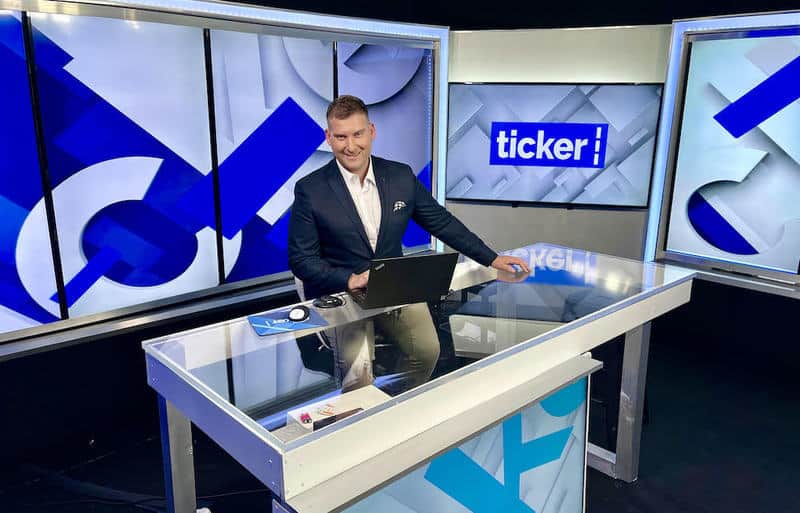
Technical problems are actually good publicity
So I wouldn't be overly concerned about the technical problems Kyle encountered on day one.
In fact, they generated an enormous amount of publicity for the new venture. People were talking about the show, sharing clips and watching Kyle react as things went wrong.
Mainstream media started posting about it; it's the top story on news.com.au - whereas "Everything went fine on the new Kyle show" isn't going to travel far on the social algorithm these days.
The one thing that really matters: audio and buses
But there is one technical problem I would make the absolute priority from here: audio and buses.
Buses are the things audiences don't hear but are crucial to the smooth running of a show. When the producer wants to talk to the host, they do so using the audio bus.
The same goes for guests.
It's a complicated process, and if you get it wrong, it all plays out on air.
Viewers and listeners will forgive glitches during the first few days but they won't pay for it long term. They will accept that cameras occasionally go somewhere they shouldn't or that a new system takes time to settle.
But if you can't clearly hear the conversation, you eventually switch off. For a product asking people to pay $99 a year, getting the basic experience right is essential.
Don't make it too slick
The smartest thing Kyle can do, though, is not pretend the operation is something it isn't.
One of the early tricks we developed at Ticker was putting a camera inside the control room pointing at the director.
If something went spectacularly wrong, I could put that camera to air myself and jokingly ask the director what had happened. Break down the fourth wall and have some fun along the way.
Suddenly the mistake became part of the program.
There is something wonderfully Wayne's World about independent broadcasting when it is done this way. The audience feels like it is inside the room watching something being built.
Kyle already seemed to understand that instinctively on his first show. His frustration with the technology became part of the entertainment and reinforced that this was not simply his old radio show broadcasting from another studio.
That authenticity could become one of the venture's biggest strengths.
I wouldn't rush to make it too slick.
Once something looks like a major network production, audiences begin judging it like one. Independent media has permission to be different, provided the fundamentals work.
The real challenge isn't tech; it's subscriptions
The bigger challenge for Kyle isn't the microphones, it's subscriptions.
For decades, commercial radio has benefited from having almost no barrier between a personality and their audience.
Someone gets into the car in the morning, turns it on, and the station they listened to yesterday is probably still there.
Kyle is now asking that listener to do something completely different.
They have to know the new service exists, decide they want it, download or access the platform, create an account, pay $99 and then develop a new habit of opening it.
Every one of those steps creates friction.
And acquiring paying subscribers can be extraordinarily expensive.
Look at some of the biggest buyers of outdoor advertising in Australia. Streaming companies spend millions trying to convince consumers to sign up for services costing $15 or $20 a month.
There is a reason they spend that money.
Getting somebody to enjoy free content is relatively easy; it's about being noisy. Getting them to reach for their credit card is much more complex.
That means marketing and distribution could ultimately matter as much as the show itself.
Kyle already has something most start-ups would dream of having: enormous awareness, a clearly defined personality, decades of audience recognition and the ability to attract major guests. His first program demonstrated that.
The question is how much of that enormous free-to-air audience can be converted into a direct paying relationship.
Building a new identity, not recreating the old one
There is also an interesting creative challenge.
For years, Kyle existed as one half of one of Australian radio's most recognisable partnerships. This new venture has to develop its own rhythm and identity rather than simply trying to recreate what existed before.
Being liberated from commercial radio's restrictions is clearly part of the proposition. If being more outrageous, unpredictable and unfiltered is what convinces people this is something they cannot get elsewhere, then leaning into that distinction makes sense.
But ultimately the content has to become something audiences believe is worth paying for, rather than merely something they are curious enough to sample. Free trials don't pay the bills, which is why Kyle doesn't offer one. The media reporting of the show is the free trial in that sense.
That distinction will determine whether this becomes a fascinating experiment or the beginning of something much bigger.
And I hope it works.
The bigger picture
Traditional broadcasters have spent years debating what happens as audiences fragment and personalities become less dependent on the networks that made them famous.
Kyle is now testing that proposition in real time.
Can one of Australian broadcasting's biggest personalities take his audience with him, build the infrastructure himself and convince enough people to pay directly for the relationship?
If he can, the significance will extend well beyond Kyle.
He could demonstrate a new pathway for broadcasters who previously believed leaving a major network meant leaving their audience behind.
The first day was never going to answer that question.
The audio will improve, and the technology will settle down. The team will learn which buttons to press, and which not to press.
I know from experience that those things can be fixed.
The much more interesting question is whether Kyle can turn independence into a sustainable business.
If he does, he won't just have built another radio show; he may have helped build a whole new industry.
More from Mediaweek
The leading media trade publication in Australia.
Get our top stories straight to your inbox daily by signing up to our Newsletter
By providing your information, you agree to our Terms of Use and our Privacy Policy. We use vendors that may also process your information to help provide our services.


