



Daily Telegraph editor Ben English on why the Bush Summit matters
The Bush Summit puts regional Australia in front of political and business leaders, with nowhere for the hard issues to hide.

Ben English doesn't want Australians to learn what the Bush is worth only once something goes wrong. That's the premise behind the National Bush Summit, which held its eighth edition in Dubbo, NSW, this week, bringing together more than 500 delegates, Prime Minister Anthony Albanese and a roster of state and territory leaders over two days of debate on the future of regional Australia.
“We are so critically dependent upon rural and regional Australia,” English, editor of The Daily Telegraph, tells Mediaweek.
"So the hope is that there is a broader awareness now of just how vital the Bush is, that in a sense, it's the lifeblood of everything that we do in Australia, particularly in terms of exports, but also all the other essentials that it provides."
That, he says, should change how the Bush gets valued.
"It also needs to be treated differently from a hardcore economic-rationalist approach. You need to acknowledge inefficiencies to service the Bush. And because of the intangible benefits it gives us, we need to make those allowances and give that latitude, if that makes sense."
English is candid that he's as guilty of looking away as anyone. "That's the main reason we do this, because I'm like every other Australian," he said.
"I don't think about it very much because I get caught up and immersed in my city life. And yet I'd have a very miserable city life if the bush wasn't functioning."


The leading media trade publication in Australia.
Get our top stories straight to your inbox daily by signing up to our Newsletter
By providing your information, you agree to our Terms of Use and our Privacy Policy. We use vendors that may also process your information to help provide our services.
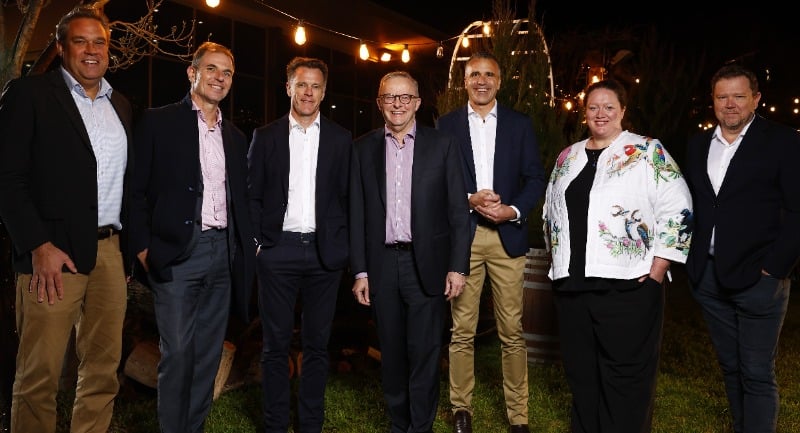
How the Bush Summit began
The Summit exists because that inattention has a cost. "I'm not from the Bush, and I'd only really just become Daily Telegraph editor when, coming across my desk time and time again, were just the most heartbreaking stories of, you know, farming families," English explained.
"There were mental health issues. There were suicides. And a lot of it was emanating from this debilitating drought. The Bush was on its knees. I started the Bush summit back in July 2019 out of that."
What began as a single Daily Telegraph event has since grown into a national News Australia platform, expanding this year into a broader format built around the people, industries and policy issues shaping regional Australia, with political, business and community figures appearing across the two-day program.
"We came across the dividing range, and we needed the Bush to see us, and we needed to see the Bush," English said. "And it resonated. It touched some sort of pulse across the hinterland."
Political heavyweights head to Dubbo
Minister for Agriculture, Fisheries and Forestry Julie Collins officially opened this year's Summit. Trade, tariffs and fuel supply were among the issues thrashed out by Assistant Minister Anthony Chisholm, Member for New England Barnaby Joyce and National Farmers' Federation President Hamish McIntyre.
English points out that Albanese isn't new to this: "He's been coming to every Bush Summit since 2019."
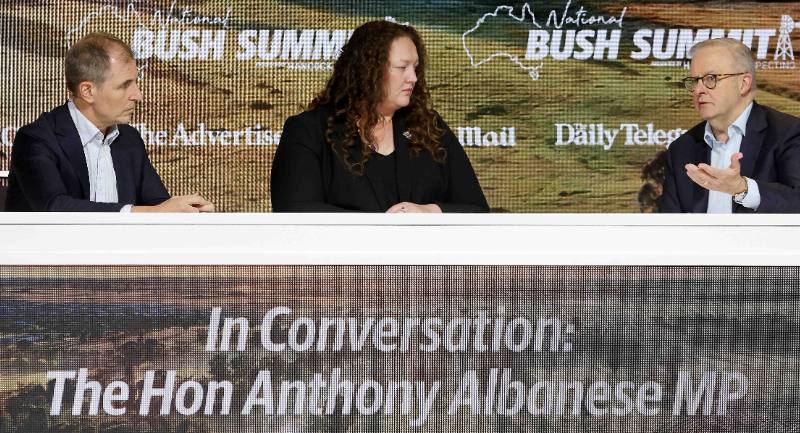
Why it works
The format only holds up, English says, because politicians can't fake their way through it. It comes down to simple physical presence: put someone in front of a crowd instead of a camera, and the performance drops away.
As English puts it, politicians are "sacks of meat and chemicals" just like everyone else in the room - and the room is full of farmers and community leaders who won't let them off easy. They're not an audience that can be spun; English says they carry "a very good BS detector," and the politicians know it. Faced with people who can see through the usual lines, "they have to be authentic."
That's the accountability English is chasing.
Politicians who show up don't just hear about what people in regional Australia are feeling - they see it in front of them, and have to answer for it in person rather than from a distance. It's a dynamic he says matters more than any panel discussion: having politicians "physically there, accountable, and eyeballing these people."
Why the big brands keep coming back
Hancock Prospecting and its S. Kidman and Co business returned as National Presenting Partner for a fourth consecutive year, Woolworths kept naming rights to the Bush Champions awards, and Toyota backed the Bush Summit Road Trip, alongside Ampol, AAMI, Qantas, Powerhouse Museum and Clubs NSW.
For Woolworths, English said, the Summit offers something rarer than sponsorship: a chance to correct the record.
Cast as "a bit of a punching bag" and a political "straw man" in the cost-of-living debate, the retailer gets a platform for a more sympathetic story - as one of the biggest employers, and biggest partners of producers, in rural and regional Australia. Ampol and Toyota, he says, are simpler fits: Ampol carries "a rich Australian history" of keeping the country moving, while Toyota has built a "very, very strong" presence in regional Australia despite its Japanese roots. Both, in English's words, are "totemic" brands where the association "makes sense emotionally and rationally."
It all comes back to the same question for English: does the Bush only get noticed once something's gone wrong?
He doesn't dodge it. "That's why we do this," he said. “To lift it above the horizon so people can say, hey, these people are critical to our welfare, and these communities are important.”
More from Mediaweek
The leading media trade publication in Australia.
Get our top stories straight to your inbox daily by signing up to our Newsletter
By providing your information, you agree to our Terms of Use and our Privacy Policy. We use vendors that may also process your information to help provide our services.


