



Experts issue urgent warning about high-risk smart glasses
Do you know what 'ambient' capture is, and the dangers it poses?

Written by Associate Professor Joanne Gray, Dr Benjamin Egliston and Professor Marcus Carter, for the University of Sydney.
Researchers at the University of Sydney have analysed a growing practice of ‘ambient capture’, in which smart glasses are being used by men to secretly record women in everyday settings and circulate the footage online.
The emerging global study, analysing hundreds of social media videos linked to pick-up artist communities, is finding that men wearing smart glasses approach women with the aim of winning their phone number or Instagram handle. They then share that online for audience engagement, entertainment and social proof.
Some of the women in the study were filmed at work, the gym, or the beach in swimwear.
Smart glasses, or wearable digital devices, are often indistinguishable from ordinary eyewear but can record video, audio and location data in real time. They may enable new forms of online harassment and gender-based harms that may not be recognised by current online safety or platform governance frameworks, the researchers found.
READ MORE: Meta launches AI smart glasses in Australia


The leading media trade publication in Australia.
Get our top stories straight to your inbox daily by signing up to our Newsletter
By providing your information, you agree to our Terms of Use and our Privacy Policy. We use vendors that may also process your information to help provide our services.
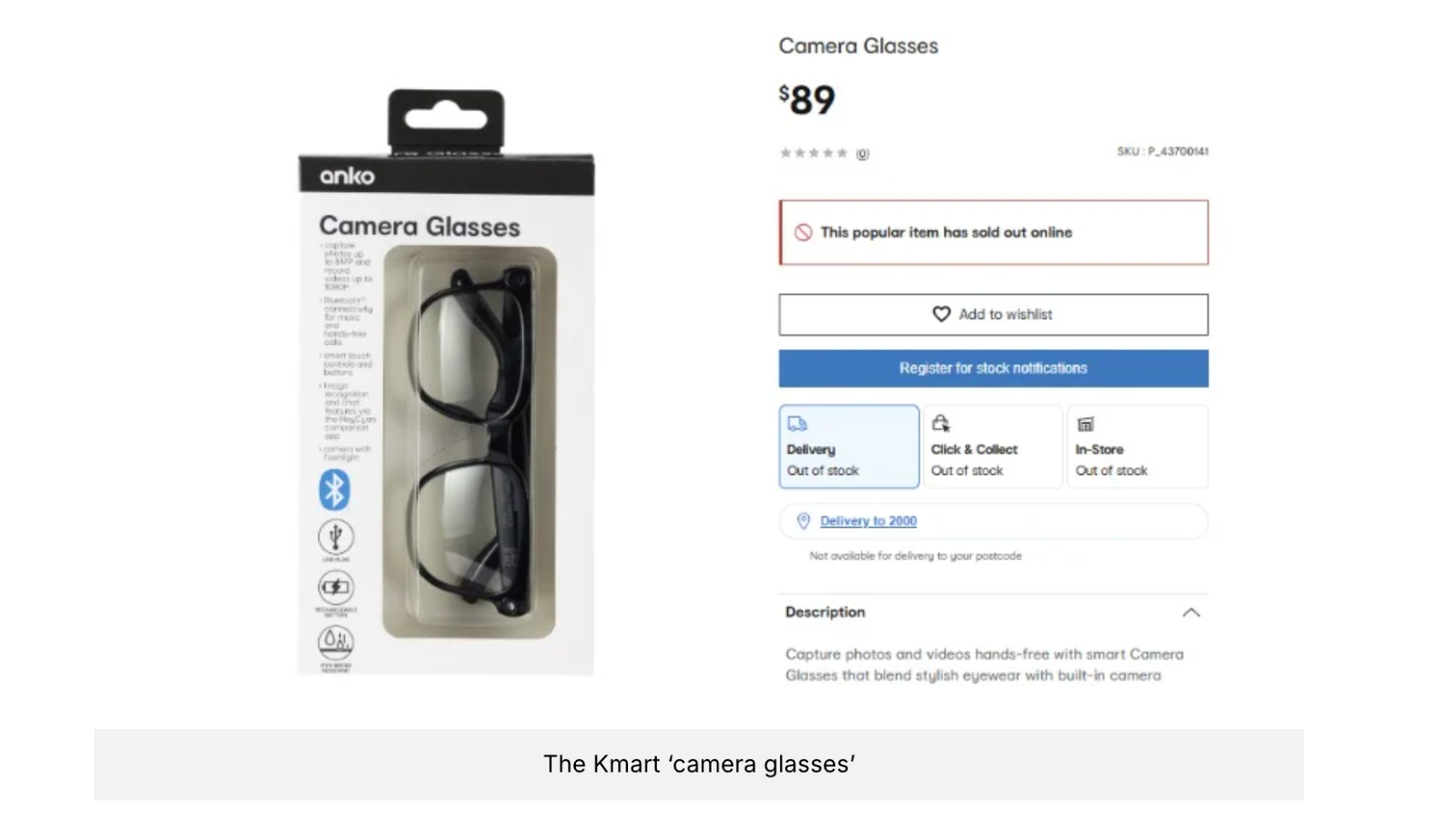
Kmart's camera glasses have recently caused much debate. Image: Kmart
“It's time for big tech to come to the table”
Dr Milica Stilinovic, a postdoctoral research associate in the Governing Immersive Technologies team at the University of Sydney, said the technology is outpacing safeguards designed to protect people.
“Tech is running at breakneck speed and regulators, a pace behind, cannot regulate harms once they’ve already manifested in the wild,” Dr Stilinovic said.
“It’s time for Big Tech to come to the table and slow down the release of more smart glasses so that regulation gets a better scope of what they’re dealing with.”
The doctor added, “Manosphere identity Andrew Tate often tells his army of pickup artists to ask for a social media handle because it appears less pushy. But unlike your phone number, a handle is global.
"You may block someone on your phone, but if they’ve shared footage starring you, someone in the comments might be able to sleuth and find out your handle, name, and location.
“You’ve basically handed your GPS tracker to the world.”
Harassment in person and online
The emerging research draws on analysis of 350 publicly available Instagram videos from around the world during 2023 to 2026, showing a shift to discreet, point-of-view recording that is difficult for bystanders to detect.
Unlike smartphones, smart glasses often provide no clear signal – apart from a discreet flashing light that can easily be concealed – that recording is taking place, limiting a woman’s ability to consent or opt out.
“Smart glasses adoption has accelerated significantly over the past two years, and new products are entering the market all the time,” said Dr Joanne Gray, Chief Investigator of the ARC Discovery Project Governing Immersive Technologies.
The early findings show that these videos frequently involve
boundary-pushing behaviour, including persistent engagement following signs of discomfort or refusal. In a subset of covert POV videos, around 60 per cent of interactions were classified as potential harassment, with many subjects displaying visible unease or attempting to disengage.
A key feature of this phenomenon is the integration of recording with social media platforms. Smart glasses allow users to upload or livestream content with minimal friction, meaning interactions can be rapidly transformed into widely distributed digital media. This creates a second layer of harm beyond the initial encounter. In around 43 percent of videos analysed, women were further exposed to abusive online commentary, some even revealing the woman’s personal details.
No more private spaces
The emerging study is finding covert filming is increasingly taking place in everyday environments where people would reasonably expect some level of privacy.
“Smart glasses have given pickup artists a new tool to further exploit women,” Dr Stilinovic said. “We call it ‘ambient capture’ because it is a state of play in which men might seem disarming.
"They will stalk and harass you in places of work, the stairwell of your apartment building, on the street, in the gym, and at the beach – places where you’d assume some sort of right to privacy.
“You don't know if you’re being filmed; that footage is then uploaded, exposing you to a wider web of harassment.”
We all deserve privacy
Chanel Contos, CEO and Founder of Teach Us Consent, said addressing privacy is a matter of urgency. “We all deserve privacy, even in public spaces – it's not just a right forfeited every time we leave the house,” Contos said. The Digital Duty of Care set up by the Australian Government to prevent serious online harms, must regulate wearable technology as soon as possible.”
Contos said smart glasses aren't just a foreseeable risk for women and children; they’re already creating harm in markets where they exist, like the United States. They are now available in Australia for under $100.
“At best, smart glasses normalise filming and sharing people without their consent, feeding algorithms designed to reward voyeuristic, rage-baiting content. At worst, they are used as a tool for the sexual exploitation of children, women and other vulnerable groups.
“Young people are asking the obvious question: 'how are these glasses even legal?' Right now, there is no existing legal framework in Australia that holds Big Tech to account for profiting from these technologies proven to cause harm.”
Calling for clearer consent laws
Researchers say current laws and platform moderation systems are not equipped to handle harms that are covert, context-dependent and difficult to detect. Existing platform moderation systems are primarily designed to detect clear, visible violations, such as explicit harassment, nudity, or threats.
“We already know the kinds of harms these technologies can enable – and so do the companies developing them,” Dr Gray said. “That means governments have a critical opportunity to act early, before these risks become normalised and widespread."
However, content produced through ambient capture often appears as ordinary social interaction on the surface, even when it involves non-consensual recording and visible discomfort, the researchers said.
“As a result, this material frequently falls into a borderline category that is unlikely to trigger enforcement, despite producing real-world harm,” Dr Stilinovic said.
From a policy and enforcement perspective, these findings expose significant gaps. Current privacy and harassment frameworks are not designed to address covert, continuous recording in public and semi-public spaces, particularly where awareness and consent are absent or cannot be established.
Many of these incidents fall outside clear regulatory thresholds, leaving limited grounds for intervention or response.
The research team is calling for clearer consent standards, stronger platform accountability and new design requirements for wearable devices to ensure people know when recording is taking place.
This research is funded by the Australian Government through the Australian Research Council (ARC). Associate Professor Joanne Gray, Dr Benjamin Egliston and Professor Marcus Carter are the recipients of an ARC Australian Discovery Project (project number DP250100343). The views expressed herein are those of the researchers and are not necessarily those of the Australian Government or the ARC.
More from Mediaweek
The leading media trade publication in Australia.
Get our top stories straight to your inbox daily by signing up to our Newsletter
By providing your information, you agree to our Terms of Use and our Privacy Policy. We use vendors that may also process your information to help provide our services.


