



Creative output up 121% since 2022 while campaigns grow 44%, Cape.io finds
Andy Gilroy: "We recommend that marketers start mapping their creative burden now by tracking a campaign, from brief to launch, and really examining each element along the way."

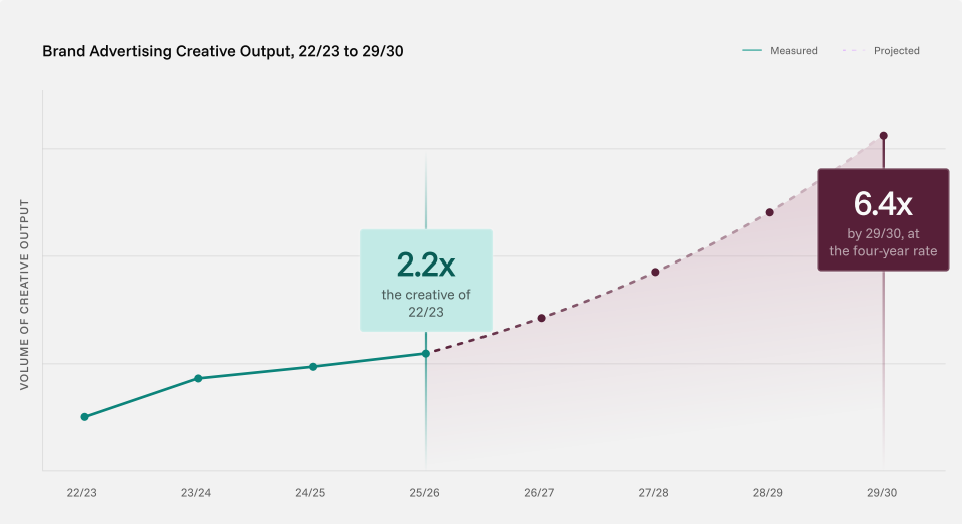
The volume of creative produced by the advertising industry has risen 121% since 2022, while campaigns grew 44% and marketing teams expanded by 2.5% to 5.5% annually, according to research by tech company Cape.io.
Cape.io’s inaugural Creative Burden Index 2026 is the first to measure global creative workload, including the APAC region. It draws on four years of production data from Cape.io, covering more than 700,000 creative files, 215,000 distinct creative variations and 54,000 campaigns created between 2022 and 2026.
The report says demand from platforms for creative content has outstripped both campaign growth and human production capacity, a gap it calls the “creative burden”.
The typical brand now produces more than twice as many individual creative files as it did in 2022. Files per campaign rose 58%, from 10 to 16, between 2022 and 2026. Static images account for the largest share of output at 3.9 times their 2022 volume, while video output has grown 3.4-fold.
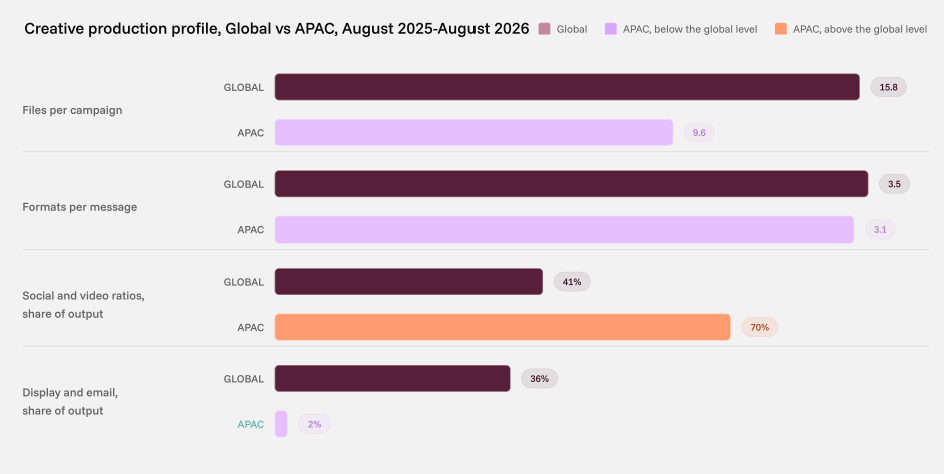
Australia and the broader Asia-Pacific region produce around 9.6 files per campaign, compared with 15.8 globally. Social and video content makes up 70% of creative production in APAC, against 41% worldwide.
In the region, the telco and media sector recorded the fastest growth in creative burden, with output quadrupling since 2022 and the sharpest rise in 2025/2026. Travel has risen 2.4-fold after steady annual growth.
For a typical brand doing the work manually, the burden now costs an average of $3.3 million a year, up from $1.5 million in 2022. The report projects this will reach $9.6 million by 2030, when brands are expected to produce 6,400 creative files annually, compared with 1,000 in 2022.


The leading media trade publication in Australia.
Get our top stories straight to your inbox daily by signing up to our Newsletter
By providing your information, you agree to our Terms of Use and our Privacy Policy. We use vendors that may also process your information to help provide our services.
It forecasts annual growth in creative burden of 13% to 30%, and warns demand could climb further if platforms make bigger changes in response to user behaviour.
Andy Gilroy, Cape.io Vice President for APAC, said: “Audiences are becoming savvier about advertising, and platforms are becoming increasingly smarter about how they reach them. Every scroll, pause and skip provides a signal that platforms use to optimise performance, driving demand from advertisers for more formats, ratios and creative versions to serve the right message to the right audience. To keep ads performing, brands need to continually feed the algorithm with fresh creative.
“Since 2022, the number of campaigns has grown by 44% and the number of creative files within them rose by 121%. That gap is the creative burden brands are faced with. The last four years explain how the burden arrived – but the next four tell us what needs to be planned for. The question isn’t whether the creative load grows, it’s how steep the slope will be and how production models will cope.
“As marketers increasingly adopt Generative AI to meet this exploding demand, the bottleneck is shifting beyond just creative production. Now, the challenge is no longer just producing the creative, but validating and trusting the creative before it goes live across 10 or more channels is critical as well. It’s therefore imperative that quality assurance is built in to address any compliance gaps before creative goes live.”
The report says brands now market across an average of 10 channels, and each platform change moves creative decisions from the marketer to the platform’s automation, leaving more creative options as the only way forward.
Gilroy added: “This gap is the creative burden that brands are now facing. The same campaign now delivers in more sizes, ratios and media types, with the workload growing at 5.5 to 13 times the rate of the teams producing it. Personalisation has exploded, but marketing teams and budgets simply haven’t kept pace with the growing demands,” Gilroy said.
“The question now isn’t whether the creative burden will grow, but how quickly, and whether a brand’s production model is built for it. Media, email and measurement were automated years ago, but creative production is still done by hand a lot of the time, one file at a time,” Gilroy said.
“We recommend that marketers start mapping their creative burden now by tracking a campaign, from brief to launch, and really examining each element along the way. Identify where the work repeats, and then prioritise automated, governed production where it will deliver the greatest return.
“Brands need to build a production model that integrates compliance controls. By doing this, teams can handle the creative burden upfront, scaling their output without placing unsustainable pressure on budgets.”
“Based on the global rate of change, APAC has between two and four years before it catches up. Brands need to spend time now identifying where their creative burden is coming from and building a production model that can scale with demand, improve efficiency, and support greater creative output, without placing unsustainable pressure on teams and budgets.”
More from Mediaweek
The leading media trade publication in Australia.
Get our top stories straight to your inbox daily by signing up to our Newsletter
By providing your information, you agree to our Terms of Use and our Privacy Policy. We use vendors that may also process your information to help provide our services.


