



Women hold just 13% of AI leadership roles despite salaries more than doubling
LinkedIn data shows women and workers without degrees remain shut out of many of the highest-paid AI roles today.

Women hold just 13% of C-suite roles at artificial intelligence companies across 27 countries, even as typical AI salaries more than double those of non-AI jobs, according to two reports published by LinkedIn's Economic Graph Research Institute in July and August 2026.
The reports, The Triple Penalty: Mapping the Gender Gap in the AI Economy and The AI Talent Divide: Strong Demand and Pay, Uneven Returns, draw on LinkedIn platform data, with the Triple Penalty report covering tens of millions of workers at medium-to-large firms across 27 countries, and the Talent Divide report analysing US job postings and hiring data from 2023 to 2026.
Together, the reports found AI hiring and pay are growing quickly, but access to that growth is skewed by gender and education, and to a lesser extent, age.
Women face an AI ‘triple penalty’
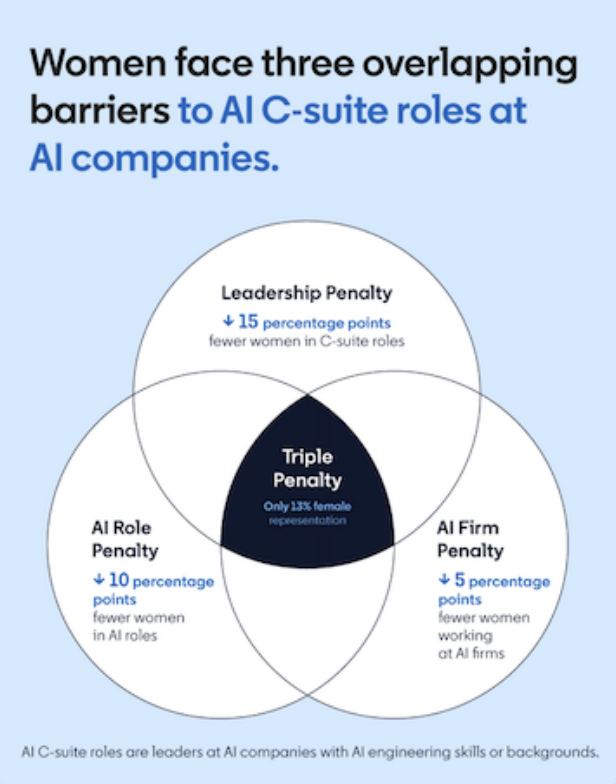
The Triple Penalty report found women hold just 13% of executive AI roles at AI companies across 27 countries, including Australia.
The researchers identified three overlapping barriers: women are about 15 percentage points less represented in C-suite roles than in non-executive roles, around 10 percentage points less represented in AI jobs than in non-AI jobs, and around five percentage points less represented at AI companies than at non-AI firms.


The leading media trade publication in Australia.
Get our top stories straight to your inbox daily by signing up to our Newsletter
By providing your information, you agree to our Terms of Use and our Privacy Policy. We use vendors that may also process your information to help provide our services.
The gap begins before workers reach the C-suite. Women account for 38.5% of Director-level and above positions globally, but only 31.2% of AI leadership positions.
The research found the gender gap in C-suite and AI roles across all 27 countries studied, while the AI company gap appeared in 24 markets.
The highest-paid AI jobs remain male-dominated
The divide becomes more pronounced when pay is included.
Women represent just 20% of Head of AI hires, 26% of Director of AI hires, and 18% of Member of Technical Staff hires.
At the other end of the market, data annotation is the most gender-balanced AI occupation but also among the lowest paid. Women make up more than half of hires in those roles, which typically have lower education barriers and are more likely to offer hourly, project-based or remote work.
LinkedIn found the pattern between gender and pay was significant. Across AI occupations, a 10 percentage point increase in the share of male hires was associated with roughly AU$63,527 higher median listed pay, rising to around AU$70,586 in 2026 alone.

Degrees remain a major dividing line
Education is another barrier to accessing the AI pay boom.
Around 91% of AI roles are held by workers with a bachelor’s degree or higher, with workers without four-year degrees more heavily represented in lower-paying roles such as data annotation.
The divide becomes even sharper at the top of the market. Among Head of AI hires, 98% hold at least a bachelor’s degree, while almost 70% have a graduate degree and around 20% hold a doctorate.
Gen Z finds an AI entry point
Younger workers are proving the exception to some of the access barriers.
Gen Z accounts for more than two-thirds of hires in both AI Engineer and Forward Deployed Engineer roles, two emerging areas providing younger workers with an entry point into the sector.
But LinkedIn found age was a weaker predictor of pay than gender or education. While younger workers are gaining ground in technical and deployment-focused jobs, access to AI’s wage premium remains more closely tied to gender and education.
More from Mediaweek
The leading media trade publication in Australia.
Get our top stories straight to your inbox daily by signing up to our Newsletter
By providing your information, you agree to our Terms of Use and our Privacy Policy. We use vendors that may also process your information to help provide our services.


