



'It's getting worse': Darren Woolley warns creator budgets are being swallowed by agency margins
TrinityP3 says hidden agency costs could leave creators with just 35% of a brand’s total campaign investment spend.

TrinityP3 founder and global CEO Darren Woolley has warned that the growing creator economy is giving major agency groups another avenue to retain client money, with some content creators potentially receiving just 35% of a brand’s total campaign budget.
Speaking to Mediaweek, Woolley said the issue was not agencies charging for legitimate strategy, compliance and management work. It was the lack of visibility around how much they charged, particularly when creator services were bundled into a single fee.
“The more channel opportunities, the more fragmentation there is in the marketer’s budget, the more opportunities there are for agencies to find ways to increase the amount that they get paid and that is not passed through to others,” he said.
“It’s just getting worse and worse.”
The convenience premium
Woolley’s warning follows the release of TrinityP3’s Unmasking the Invisible Margin in Creator Marketing industry bulletin, which estimates that agency margins, technology mark-ups and internal profit centres could absorb as much as 65% of a creator marketing budget.


The leading media trade publication in Australia.
Get our top stories straight to your inbox daily by signing up to our Newsletter
By providing your information, you agree to our Terms of Use and our Privacy Policy. We use vendors that may also process your information to help provide our services.
The consultancy claims holding company agencies are increasingly routing creator briefs through their own divisions while packaging talent payments, technology, compliance and management into one unitemised charge.
For marketers, the pitch is attractive. Managing dozens, or even hundreds, of individual creators can be labour-intensive, complicated and difficult to scale. Handing that responsibility to one agency promises simplicity.
But Woolley said that convenience could come at a much higher price than advertisers realise.
“If it’s too hard for you to manage 100 creators or 50 creators, we’ll do that for you without saying, ‘And here’s the fee that it’ll cost you,’” he said.
“They’re saying, ‘Give us your $100,000, and we’ll manage it.’ What that means is more of it stays with the agency doing that than actually going through to the creators.”
The concern is not necessarily that agencies are making a margin. Agencies should be paid for strategy, administration, compliance and campaign management. The problem emerges when those charges cannot be isolated, examined or benchmarked.
Without itemisation, advertisers may know how much they spent without knowing what they bought.
Where the money goes
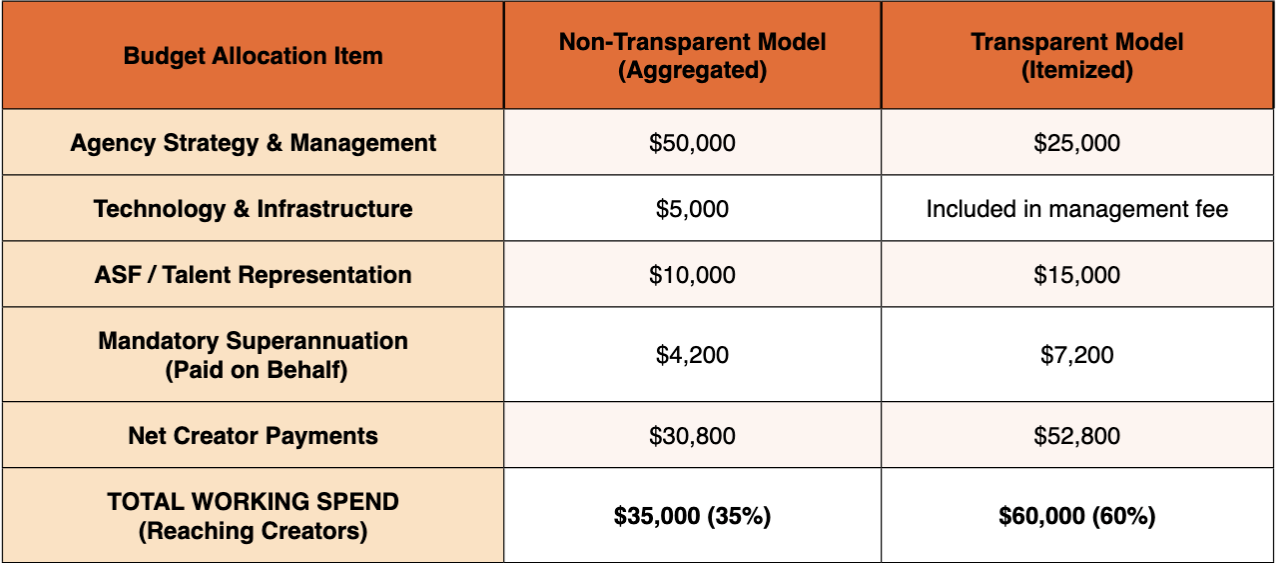
TrinityP3’s modelling suggests a $100,000 creator campaign run under an aggregated, non-transparent structure may produce just $35,000 in working creator spend.
Its estimate allocates $50,000 to agency strategy and management, $5,000 to technology and infrastructure, $10,000 to talent representation and $4,200 to compulsory superannuation. That would leave $30,800 in net creator payments.
Under TrinityP3’s proposed itemised model, $60,000 would go towards creator output and superannuation, including $52,800 in net payments and $7,200 in super.
Agency strategy and management would account for $25,000, while talent representation would receive $15,000. Technology expenses would be incorporated into the agency management fee.
Those figures are TrinityP3 estimates, not independently audited industry averages. Woolley acknowledged that agencies had not publicly disclosed a standard breakdown of their creator marketing charges.
“These are estimates that we’ve put together from the data we could get,” he said.
“No one’s come clean on this and said, ‘This is how much we’re charging.’ We’re just seeing this as the way budgets are being broken down with, again, a typical lack of clarity in where each of those amounts is going.”
TrinityP3’s modelling does not establish that every agency holding company retains 65% of creator budgets, but it raises a more fundamental procurement question: if advertisers cannot verify the allocation, how would they know?

Smaller creators carry the cost
Creator marketing has shifted from an experimental social tactic into a mainstream media channel commanding multimillion-dollar budgets. At the same time, advertisers are increasingly looking beyond celebrity influencers towards smaller creators with highly engaged communities.
Those creators may offer brands stronger audience relationships, but often lack the commercial leverage and representation available to the industry’s biggest names.
“We’re talking about this large group of content creators who have terrific followings, but they don’t necessarily have the commercial sway,” Woolley said.
“And so they’ve been chewed up in this process. Effectively, it’s going from 60% shared to them to 35%. So, what’s that extra 25%? It’s being taken away from the content creators out of the total budget.”
The risk for advertisers extends beyond fairness to creators. If too much of the budget is absorbed before it reaches talent, brands may end up with weaker creative work, a narrower pool of participants or campaigns built around whoever fits the agency’s internal commercial model.
It also raises questions about whether creators are being selected because they are right for the brief, or because they sit inside a supply chain that benefits the agency managing it.
Holding company practices under scrutiny
Woolley linked the creator marketing model to practices already seen in production and programmatic advertising, where agency groups have built internal operations that capture a greater share of client expenditure.
In creator marketing, TrinityP3 argues briefs may be directed into an agency group’s own specialist business without being tested in the open market. Independent creator agencies can be excluded, external price comparisons become difficult, and savings delivered through technology or artificial intelligence may remain inside the holding company.
There is nothing inherently improper about an agency using its own capability. Vertical integration can reduce duplication and make campaigns easier to execute. But when the same company recommends the service, supplies it, prices it and reports on it, transparency becomes essential.
Woolley said advertisers either couldn't see the full commercial structure or chose not to interrogate it.
“From the marketer’s point of view, they’re sitting there going, ‘Well, I spent $100,000,’” he said.
“From the creator’s point of view, less of that money is getting to them because more of it’s being taken up in the, in quotes, agency management fee to manage that process. And again, it’s this lack of transparency, or either that or the marketers are turning a blind eye to it.”

What advertisers should demand
TrinityP3 is urging marketers to require agencies to separate strategy, technology, talent representation and creator payments rather than approving a single bundled figure.
“First, mandate that they unbundle and itemise each individual cost. Don’t just bundle it up for convenience. Get independent verification,” Woolley said.
The consultancy also recommends that advertisers secure audit rights, introduce open-market benchmarking clauses and require large briefs to be compared with proposals from independent creator specialists.
Woolley said marketers should also examine the incentives agencies receive from social platforms.
“A lot of the agency networks and holding companies are doing deals with the TikToks of the world and Instagram to get incentives, basically kickbacks, payments for spending a certain amount of money,” he said.
“And again, like media, make sure that those are fully declared and passed back in full.”
Creator marketing may be a newer channel, but the commercial tension is old. Agencies want to protect and grow their margins. Advertisers want simplicity, scale and performance. Creators want to be paid fairly for the work audiences actually see.
Bundling can make the machinery run more smoothly. It can also make the money harder to follow.
More from Mediaweek
The leading media trade publication in Australia.
Get our top stories straight to your inbox daily by signing up to our Newsletter
By providing your information, you agree to our Terms of Use and our Privacy Policy. We use vendors that may also process your information to help provide our services.


