



Ad Net Zero puts a number on advertising’s carbon footprint
Advertising is a boardroom issue as new research quantifies ad marketing's share of upstream Scope 3 emissions.

Advertising accounts for more than 5% of Australian businesses’ upstream Scope 3 emissions on average, according to new research from Ad Net Zero Australia, with the figure rising to as much as 16% in some sectors.
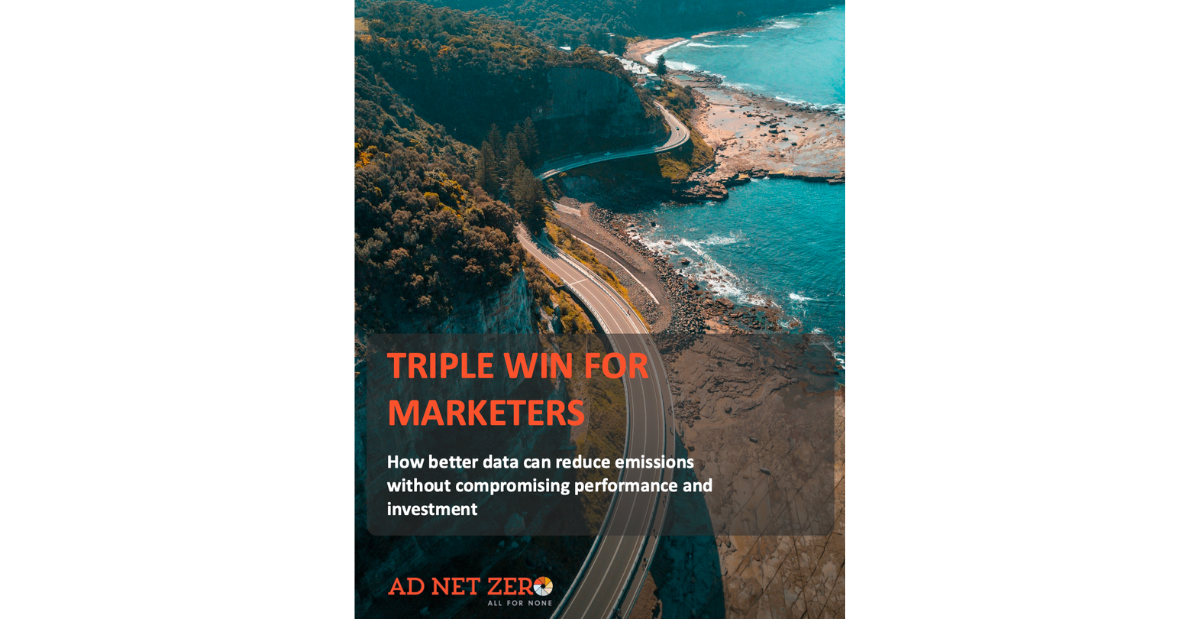
The findings form part of Ad Net Zero Australia’s first major whitepaper, Triple Win For Marketers, developed with climate and carbon disclosure specialist 2XE.
The report argues marketers can reduce emissions while maintaining, and in some cases improving, campaign performance.
“The triple win comes from addressing marketing’s carbon footprint - understanding where the emissions come from within marketing and how to address them,” Ad Net Zero Australia lead Arum Nixon told Mediaweek.
“The reason there’s a triple win is that previously there’s been this perception that carbon reduction and campaign performance were in conflict; it was going to cost more money or impact your campaign performance, which just isn’t the case.”
Advertising becomes a boardroom issue
The research found advertising represents more than 5% of upstream Scope 3 emissions on average, rising to 16% across sectors including government, infrastructure and public services.
The findings come as mandatory climate reporting under AASB S2 increases scrutiny of emissions across company value chains.


The leading media trade publication in Australia.
Get our top stories straight to your inbox daily by signing up to our Newsletter
By providing your information, you agree to our Terms of Use and our Privacy Policy. We use vendors that may also process your information to help provide our services.
“It’s now mandatory for all large organisations to report their carbon footprint. So that’s a business imperative: shareholders and investors are looking at this data, so it’s become very important at the business level. It’s obviously important for the planet, and thirdly, it’s important for marketers because they can reduce their campaign footprint and potentially improve performance at the same time by removing waste from the supply chain,” Nixon said.
Nixon said the increased focus on emissions reporting created an opportunity for marketers to play a greater role in conversations already taking place at board level.
“We want to ground this in something that is a big topic of conversation in boardrooms in Australia right now,” he said.
“This is a risk management issue for boards right now; shareholders and investors are looking at it very closely. So the topic is a big important topic for businesses. I think what’s been missing so far is marketers’ involvement.”
Nixon said the aim was to position emissions reduction as more than a compliance exercise.
“So what we want to do is show marketers that there’s a huge opportunity here for those that lean in and that it’s not just a compliance burden but that there’s an opportunity for them as well,” he said.

Advertising compared with other Scope 3 emissions
2XE co-founder and CEO Nick Palousis, who led the analysis behind the whitepaper, found advertising can sit alongside, and in some cases exceed, other Scope 3 emissions sources including waste and business travel.
The report argues advertising is also an area where businesses can make changes without significant capital investment or operational disruption.
Nixon said the relationship between emissions reductions and campaign performance differed between advertisers.
“All evidence is anecdotal because it depends case by case on each individual advertiser,” he said.
“So we can’t say there’s a universal benefit, but we often see benefits for marketers who have leaned into it. So we’ve included in the white paper a couple of examples.”
Australian Ethical cuts OOH emissions
Australian Ethical worked with Benedictus Media and oOh!media to reduce out-of-home emissions per dollar spent by 63% and emissions per thousand impacts by 82%.
The campaign used more targeted media buying, renewable-powered inventory, recyclable materials and energy-efficient creative.
The changes contributed to a 21% reduction in Australian Ethical’s overall paid media emissions, while the campaign delivered a 50% stronger uplift in brand awareness compared with its previous campaign.
Australian Ethical head of brand and communications Emma Grainge said reducing advertising emissions without affecting campaign performance formed part of the company’s broader decarbonisation strategy and efforts to future-proof the business.
SBS changes campaign delivery
SBS reduced marketing’s share of its Scope 3 emissions from 6% in FY22, based on spend-based measurement, to 3% in FY25 using a combination of spend, supplier and activity-based data.
For its recent Premium Drama campaign, SBS worked with Hearts & Science and used its Renewables Ad Engine to serve BVOD advertising when more renewable energy was available in the grid.
According to the whitepaper, the approach reduced the campaign’s carbon intensity by 24.6% compared with an SBS baseline campaign, without compromising audience reach.
SBS head of sustainability Abi Thomas said moving towards activity-based measurement gave the broadcaster a more accurate picture of its marketing emissions and helped identify areas for reduction.
SBS has set a goal of reaching 100% activity-based measurement.
Measuring campaign performance
Nixon said the definition of campaign performance would depend on an advertiser’s objectives.
“Performance could look like anything, like whatever’s most relevant to your campaign. So you might be able to reduce wastage and increase click-through rates or similar metrics,” he said.
“Or it might be reach; you might be able to maintain the same reach of your core target audience while removing wastage, emissions, or formats/sites that weren’t reaching your target audience. So it’s about understanding your business goals and then looking at them side by side with your emissions.”
The whitepaper outlines five steps for marketers: establish a baseline, improve data quality, adopt a consistent methodology such as the Global Media Sustainability Framework, incorporate carbon into planning decisions, and set targets with accountability.
Ad Net Zero launched in Australia in 2024, led by the Media Federation of Australia, IAB Australia, the Australian Association of National Advertisers and the Advertising Council of Australia, alongside 30 supporting organisations.
The new research puts marketing emissions more firmly into the broader Scope 3 reporting picture as Australian businesses face increasing pressure to measure and reduce emissions across their supply chains.
More from Mediaweek
The leading media trade publication in Australia.
Get our top stories straight to your inbox daily by signing up to our Newsletter
By providing your information, you agree to our Terms of Use and our Privacy Policy. We use vendors that may also process your information to help provide our services.


