

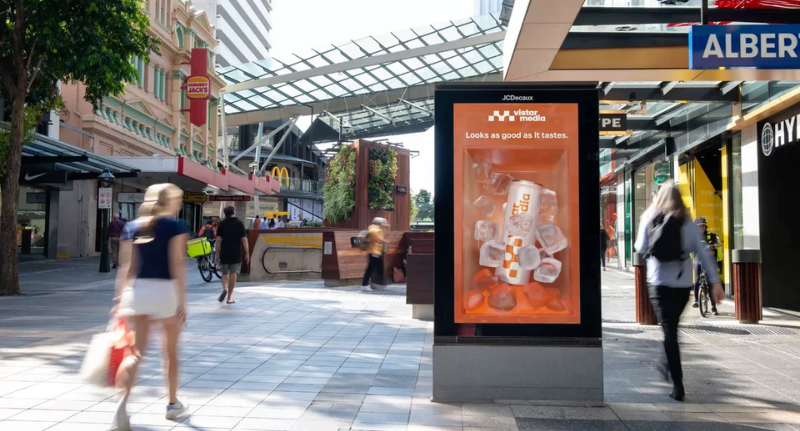
Vistar Media has released Science in Motion, a new research report examining the real-world impact of motion and 3D creative formats in digital out-of-home campaign performance.
The report, published in partnership with Omnicom Media and JCDecaux, found that while high-quality digital screens and locations do much of the heavy lifting in DOOH, motion boosts performance across every primary metric.
By testing 3D, full-motion, limited-motion, and static creatives, the research found that the addition of motion yielded an average 33% uplift in ad recall and a 50% increase in brand awareness compared to static assets.
3D stands out
The report found 3D assets scored significantly higher than any other format, creating a sense of depth and physical presence.
Vistar Media said 3D was the strongest format for building top-of-mind awareness, delivering a 10% uplift compared to a control group. That made it 67% more effective than when no form of motion was applied.
The research also found static creative remains effective in DOOH, delivering a 38% uplift in aided ad recall and proving the medium itself is strong for reach and recognition.
Motion does not need to be complex
The report found that subtle motion can still be effective, with the intensity of animation often less important than the presence of motion itself.
According to Vistar Media, subtle animations such as a spinning logo can be as effective at anchoring a brand as more complex video production.
The study also found that 18 to 34-year-olds showed the highest overall energy for motion, while 3D creative was particularly effective for older audiences. For the 50 to 65 age group, 3D was identified as the strongest format for brand awareness.
Martine Hammink, VP, Creative Studio and Creative Solutions at Vistar Media, said the research gives advertisers guidance on how to use motion and 3D within real-world constraints.
“However, we must also be realistic. Sometimes motion is not permitted due to local regulations, and at other times there is a lack of time or budget for complex animations.
“Science in Motion provides brands and design teams with the data and insights needed to make the best creative choices within those constraints, closely aligned with campaign objectives.”
The research was conducted between November 2025 and January 2026, based on a study of 7,513 respondents across multiple age groups in the Netherlands.
Main Image: Vistar Media