


Banned from social media, kids found a loophole in Spotify comments
NPR staff thought they were bots. They were kids finding a place to chat, with lessons for Australia's social media ban.

It all began with Gilgamesh.
No, not the ancient Mesopotamian hero or the Smurfs antagonist. In this case, Gilgamesh was a name dropped in a Spotify comment thread.
“Gilgamesh quit, and I’m crying,” the comment read beneath an episode of NPR's Wild Card.
For those who don't know or perhaps don't care, NPR stands for National Public Radio and is the US equivalent of our ABC.
Anyway, the seemingly nonsensical comment was merely one of many. Most were short, full of slang and only vaguely linked to one another.
None of them said much about the interview with Eat, Pray, Kill Love author Elizabeth Gilbert, the episode's subject. Not even her homicidal tendencies.
At first, showrunner Dave Blanchard suspected bots. So, he deleted the posts. Then a new comment appeared, asking why its predecessor had vanished.


The leading media trade publication in Australia.
Get our top stories straight to your inbox daily by signing up to our Newsletter
By providing your information, you agree to our Terms of Use and our Privacy Policy. We use vendors that may also process your information to help provide our services.
That's when the entire team realised there might be more to the story.
Those pesky kids strike again
Blanchard, in his best Bob Woodward guise, shared screenshots with colleagues at NPR, where much younger producer (stand down, there's a reason for the age amplification) Hannah Chinn saw something he had missed. The commenters were children using Spotify to talk to one another.
Chinn recognised the pattern in the display names, cartoon profile pictures and quick exchanges. Growing up with limited access to social media, Chinn had used Google Docs to chat with friends.
That's when it dawned on the team: A Spotify comment section could serve the same purpose.
Chinn then found how the children were organising it. One would create a public playlist named “New Chat” and add a podcast episode to it. Their friends could find the playlist, open the episode and continue the conversation in its comments. The group had also shared a Google Form.
This American Life host Ira Glass later spoke to one of the commenters, a 14-year-old named Ella, with her parents’ permission. She said the group had first met beneath a video podcast that played TikTok clips. Ella was allowed to use Spotify but not social media. When that podcast disappeared, the children looked for another place to talk.
Ella estimated that about 20 children were in the core group. They chose NPR episodes because the comment sections were quiet, giving them room for their own conversations.
Glass, a public radio host himself, took that explanation with good humour… on camera, at least.
Meanwhile, Blanchard told Glass he felt guilty for reporting the comments and embarrassed that he had needed Chinn to explain them.
Some NPR podcasts started getting mysterious comments on Spotify. They made no sense to the staff reading them – until someone from a younger generation cracked the code.
Hear the story: https://t.co/0gLhP4L8rL pic.twitter.com/cppqY3MaWz
— This American Life (@ThisAmerLife) September 23, 2026
So, what about the kids here?
Australia’s under-16 social media ban took effect on 10 December 2025, requiring platforms including Instagram, TikTok, Snapchat and Facebook to take reasonable steps to stop children under 16 from holding accounts. The obligation sits with the platforms; children and their parents aren’t penalised.
Spotify, however, still allows teenagers aged 13 to 17 to use standard accounts with parental or guardian consent. Under-13s can listen through parent-managed accounts, available on both the free plan and Premium Family, although these offer music only. In other words, a managed account won’t get them into a podcast comment section to discuss Gilgamesh’s departure.
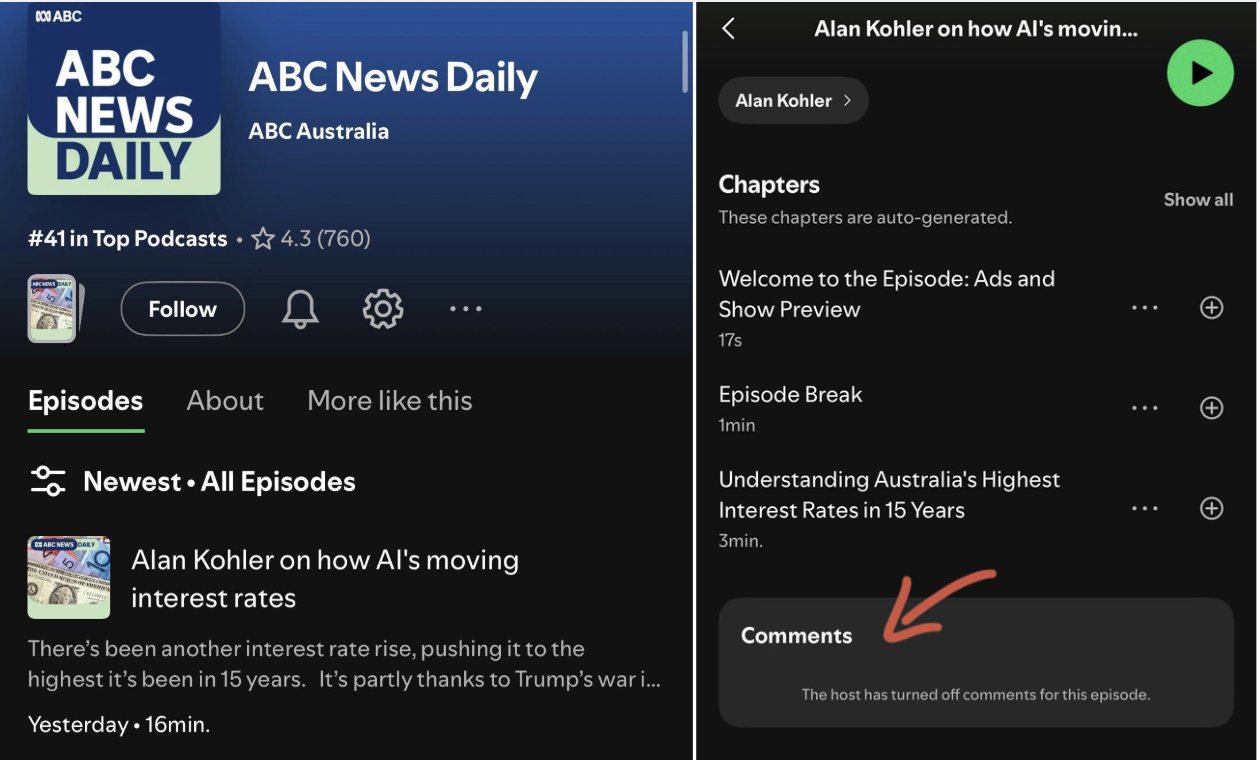
And what of NPR’s closest Australian counterpart, our ABC? A quick look through its podcasts on Spotify suggests Aunty has already shut that particular door, with comments switched off on the episodes checked. No impromptu playground beneath an interview there.
Still, the NPR episode raises a question for Australia’s social media experiment: when children lose access to their usual meeting placeÅs, where will they gather instead? These children found a quiet podcast and made themselves at home. Whether Australian kids are doing the same is another story waiting to be reported.
More from Mediaweek
The leading media trade publication in Australia.
Get our top stories straight to your inbox daily by signing up to our Newsletter
By providing your information, you agree to our Terms of Use and our Privacy Policy. We use vendors that may also process your information to help provide our services.


