



Programmatic outdoor faces its ‘prove it’ moment
Three in four agencies expect pDOOH spend to rise, but ROI and measurement remain the biggest barriers.

Programmatic digital out-of-home (pDOOH) has entered its “prove-it” phase in Australia, with agencies increasingly demanding evidence of ROI, transparency and measurement before committing more budget. Despite that scrutiny, three in four agencies expect their pDOOH investment to increase over the next year.
The findings come from the IAB Australia Programmatic Digital Out-of-Home State of the Nation 2026 Report. It found agencies broadly understand the channel and its role in media plans, but now want clearer evidence of what it delivers.
Gai Le Roy, CEO of IAB Australia, said the shift marked a new stage for the channel. “The conversation has moved from ‘explain it to me’ to ‘prove it to me’,” Le Roy said.
“Agencies have largely settled what programmatic out-of-home is and where it fits. What they want now is evidence of what it returns, how the tech is adding value, and how it works effectively alongside other digital inventory.”



The leading media trade publication in Australia.
Get our top stories straight to your inbox daily by signing up to our Newsletter
By providing your information, you agree to our Terms of Use and our Privacy Policy. We use vendors that may also process your information to help provide our services.
ROI remains the biggest barrier
Demonstrating ROI was cited by 42 per cent of respondents as the biggest barrier stopping pDOOH from taking a larger share of advertising volume. Audience measurement followed at 23 per cent.
Understanding cost versus benefit, the channel’s capabilities and its role in the media mix were each cited by 22 per cent. Ad effectiveness measurement was also nominated by 22 per cent of respondents.
Buyers are also calling for greater transparency around inventory quality, impression delivery and reporting. Their priorities include campaign pacing, spend delivery, supply paths, non-working media costs, screen availability, win rates and proof of delivery.
Agencies also want more consistent audience, reach and frequency metrics. The report identified demand for a standardised approach to counting impressions across different vendors.
Agencies want more from pDOOH technology
Agencies are already making strong use of pDOOH’s ability to control where and when advertising appears. Geo-location influences 88 per cent of campaigns, while 70 per cent use day-part targeting.
More advanced capabilities remain less common. Dynamic creative optimisation is used by 45 per cent of agencies, while brand first-party data and cross-channel frequency management are each used by 39 per cent.
However, agencies indicated they want greater use of automation, contextually optimised creative and technology that can help predict business outcomes.
pDOOH moves deeper into cross-channel planning
Eighty-two per cent of agencies now factor pDOOH into their broader cross-channel media planning. Another 65 per cent plan and buy it alongside other programmatic channels.
Digital video is the channel most commonly paired with pDOOH, at 86 per cent, followed by social media at 83 per cent and connected TV at 83 per cent. Retail media sits further behind at 59 per cent.
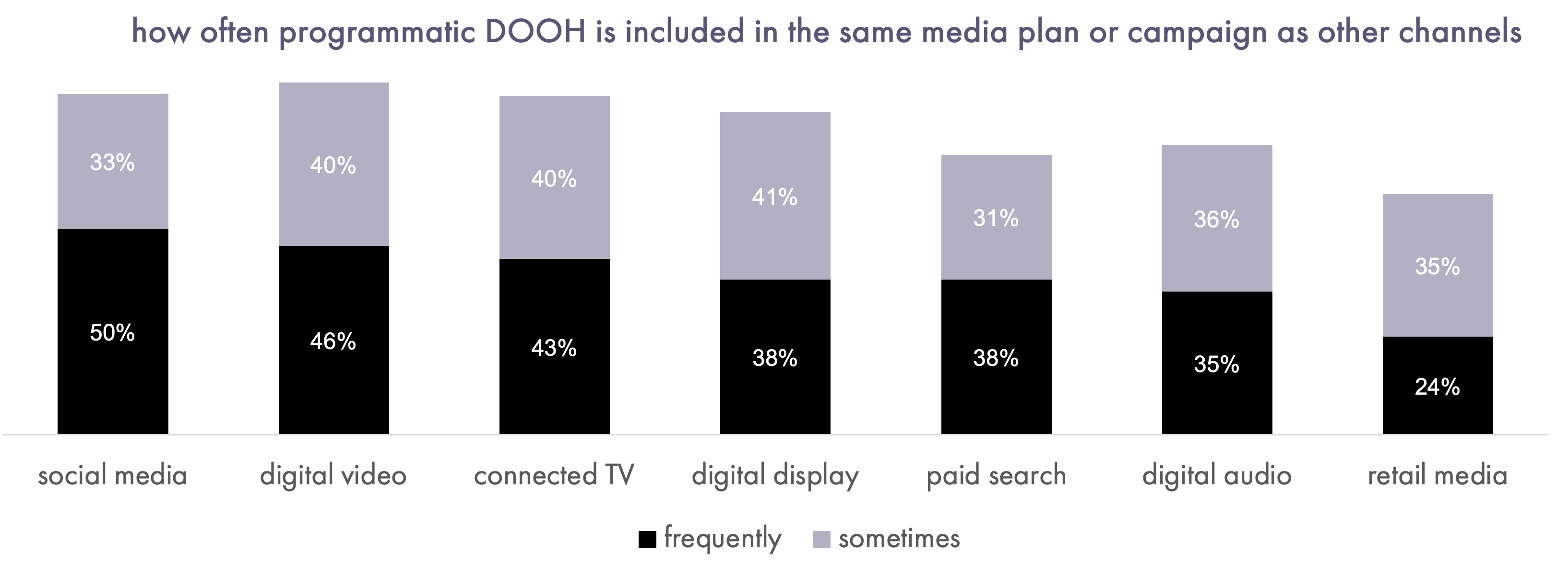
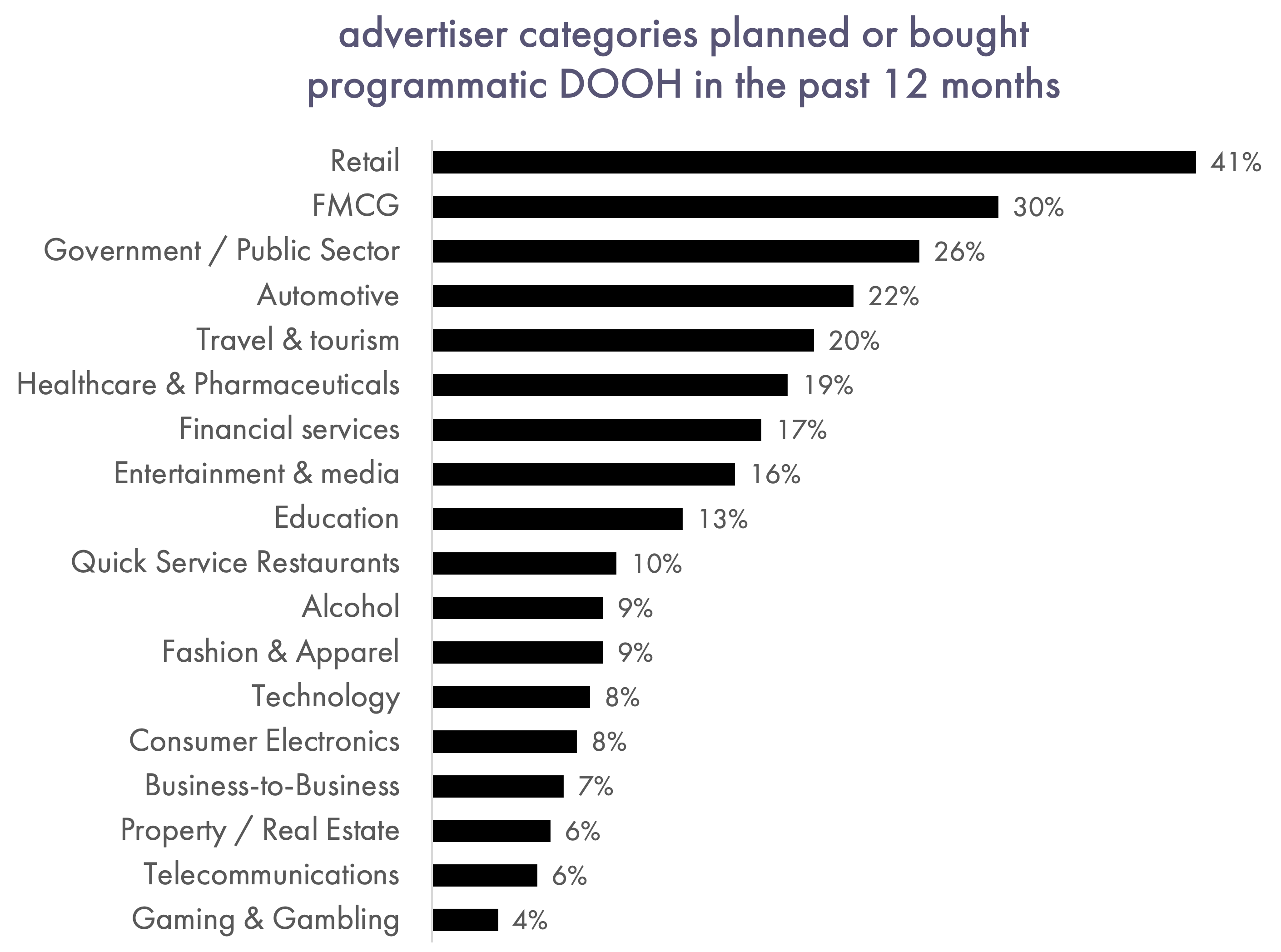
That gap is notable because retail was the advertiser category most agencies had used pDOOH for during the previous 12 months. FMCG and government or public sector advertisers followed.
“Programmatic out-of-home is well placed to take a larger share of digital budgets, and agencies are already planning it alongside video, social and connected TV,” Le Roy said.
“Retail media is something of an outlier here — in a market where so much retail media sits on screens, there’s an interesting opportunity for closer cross-media planning.”
Brand lift and context gain ground
The way agencies measure pDOOH effectiveness is also changing. Digital brand lift rose from 52 per cent to 60 per cent as a measurement tool year on year, although impressions delivered remains the most commonly used metric at 76 per cent.
Contextual relevance also recorded a sharp increase. The importance of a screen’s surrounding environment as a reason for buying pDOOH programmatically rose 20 percentage points to 79 per cent.
Privacy remains another area of uncertainty. Forty-three per cent of respondents said they were unsure about the impact of Australian privacy reforms on DOOH, up from 21 per cent last year.
The IAB Australia Programmatic Digital Out-of-Home State of the Nation 2026 Report was conducted in July 2026. It surveyed 163 advertising decision-makers from agencies involved in out-of-home advertising.
More from Mediaweek
The leading media trade publication in Australia.
Get our top stories straight to your inbox daily by signing up to our Newsletter
By providing your information, you agree to our Terms of Use and our Privacy Policy. We use vendors that may also process your information to help provide our services.


