



How one local story brought The Boston Globe thousands of subscribers in 72 hours
A local dispute became a viral read and a subscription windfall. The harder question is whether they'll stay.
.jpg%3Fv%3D1790638205482&w=3840&q=100)
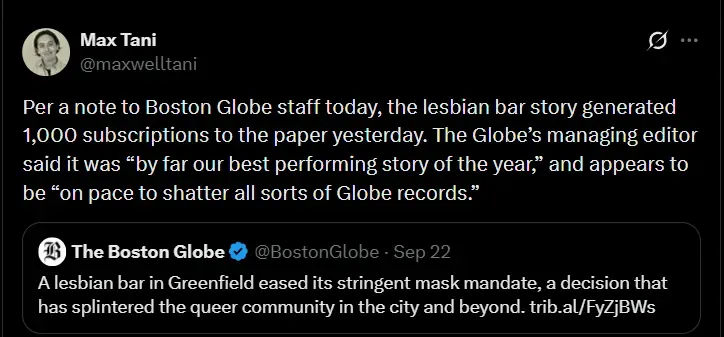
A Boston Globe magazine story about a small lesbian bar in western Massachusetts brought in “several thousand” new subscribers in about 72 hours, according to a Globe spokesperson, Nieman Lab reported.
The article, written by Annalisa Quinn and published on 22 September, followed the fallout at Last Ditch Bar in Greenfield after its owners made Saturday nights mask optional.
The decision prompted fierce criticism from those who had valued the venue’s strict masking policy.
Within 24 hours, the paper had sold 1,000 subscriptions.
What happened at Last Ditch?
Last Ditch Bar and Arts Venue opened in Greenfield in 2025, hoping to provide a dedicated space for the area’s queer community after two other local bars closed. Its founders made accessibility central to the venue, including a rule requiring patrons to wear a KN-95 mask or better.
But the business was struggling. Customers sometimes could not afford the cover charge, bills were mounting, and two of the three founders had stepped back from daily operations. On 31 August, Last Ditch announced that Saturday nights would become mask optional in an effort to bring more people through the door.
The announcement drew hundreds of Instagram comments, including accusations that the bar was abandoning disabled and immunocompromised patrons. An apology brought further criticism because the accompanying post lacked alternative text for visually impaired readers.


The leading media trade publication in Australia.
Get our top stories straight to your inbox daily by signing up to our Newsletter
By providing your information, you agree to our Terms of Use and our Privacy Policy. We use vendors that may also process your information to help provide our services.
By the time Quinn attended a community meeting, the argument had grown beyond a change to one night’s mask policy. Her account followed the people who wanted the rule kept, the financial pressure on the remaining owner and a discussion that ended with little resolved.
How the story went viral
There’s no secret sauce that guarantees a story will go viral. Editors know the familiar sweet spots, but stories tipped to take off can fall flat, while an unlikely piece finds an audience nobody saw coming.
Once the Globe shared it on X, the story travelled quickly: Know Your Meme recorded about 17.6 million views for the publisher’s post within a day, alongside widely shared reactions and parody. Those figures are snapshots of social posts, rather than readership figures for the article.
Writing for Nieman Lab, Laura Hazard Owen called Quinn’s article, in her opinion, a “perfect piece”.
She singled out its neutral register. Quinn reported the bar’s circumstances and the arguments around it without trying to make the already extraordinary details sound more extraordinary.
Quinn went on to single out three paragraphs which she felt showcased the clean and matter-of-fact copy:
Three housemates in their mid-20s opened it together, hoping to fill the void left by two local queer bars that had shuttered. One of the trio, Asa Rosario, a drag performer who uses it/its pronouns, envisioned a venue where it and its friends could perform.
and:
But by the time of Last Ditch’s monthly community meeting on September 11, only one of the original founders, Matellian, is still involved. The two others stepped back from the daily operation months before, Matellian says, citing various pressures and health issues. One had enrolled in clown school.
and:
Moreover, the Zoom attendees speculate that the mediator’s licensed status makes her a mandated reporter — an agent of the state, akin to police. One person going by “Moss” asks if the mediator could have them hospitalised against their will, adding that her presence is “wildly unsafe.
What next?
Well, if you want to read the story, you're going to have to subscribe.
The paper’s got an introductory offer that costs US$1 for six months (that's around AU$1.50), after which digital access costs around US$30 a month.
So, while successful, the real measure will be how many readers Quinn’s story draws in stay once that offer ends.
More from Mediaweek
The leading media trade publication in Australia.
Get our top stories straight to your inbox daily by signing up to our Newsletter
By providing your information, you agree to our Terms of Use and our Privacy Policy. We use vendors that may also process your information to help provide our services.


