



George Floyd the Musical: Broadway hits a new low
A dark comedy casting call, a cartoon poster and a "satire" defence. Playbill is sorry. Busted Broadway, less so.

If you've ever wondered whether the entertainment industry might be running out of ideas, wonder no more. Not only has it run out of ideas, but it seems it has also run out of class (though there's an argument that happened a helluva long time ago).
Case in point: George Floyd The Musical!
OK, we've taken some artistic licence with the exclamation mark. But let's face it: the absurdity of the situation begets ever more asinine grammatical choices.
For those readers hurriedly getting their credit card details ready: put the wallet away. The casting call has been pulled, and the apology has gone out, and the internet's collective jaw is still somewhere on the floor. The show itself, mind you, is reportedly still listed as "coming soon" on its creator's website. Make of that what you will.
How a casting call became a crisis
Playbill has served Broadway audiences since 1884 and runs one of the theatre world's busiest job boards. It found itself grovelling on 19 November 2026 after a listing for "comedic singers" for the George Floyd the Musical cast album went live on its site.
The listing came with a poster, seemingly AI-generated, showing a cartoon Floyd pinned beneath a police officer's knee. The tagline: "The $20 Bill That Changed The World!"
Who was George Floyd?
George Floyd was a 46-year-old Black man from Houston who had moved to Minneapolis, where he worked as a security guard and truck driver. A father of five, he was known to friends as "Big Floyd."


The leading media trade publication in Australia.
Get our top stories straight to your inbox daily by signing up to our Newsletter
By providing your information, you agree to our Terms of Use and our Privacy Policy. We use vendors that may also process your information to help provide our services.
On 25 May 2020, police were called to a corner store over an allegedly counterfeit $20 note. Then-Minneapolis police officer Derek Chauvin pinned Floyd to the ground and knelt on his neck for more than nine minutes while Floyd repeatedly said, "I can't breathe."
Footage of his death filmed by a bystander spread around the world, prompting some of the largest protests in US history and Black Lives Matter marches from London to Sydney.
Brands, broadcasters, and publishers spent years trying, with mixed results, to respond. Chauvin was convicted of murder in 2021 and sentenced to 22.5 years in prison.
Playbill says sorry
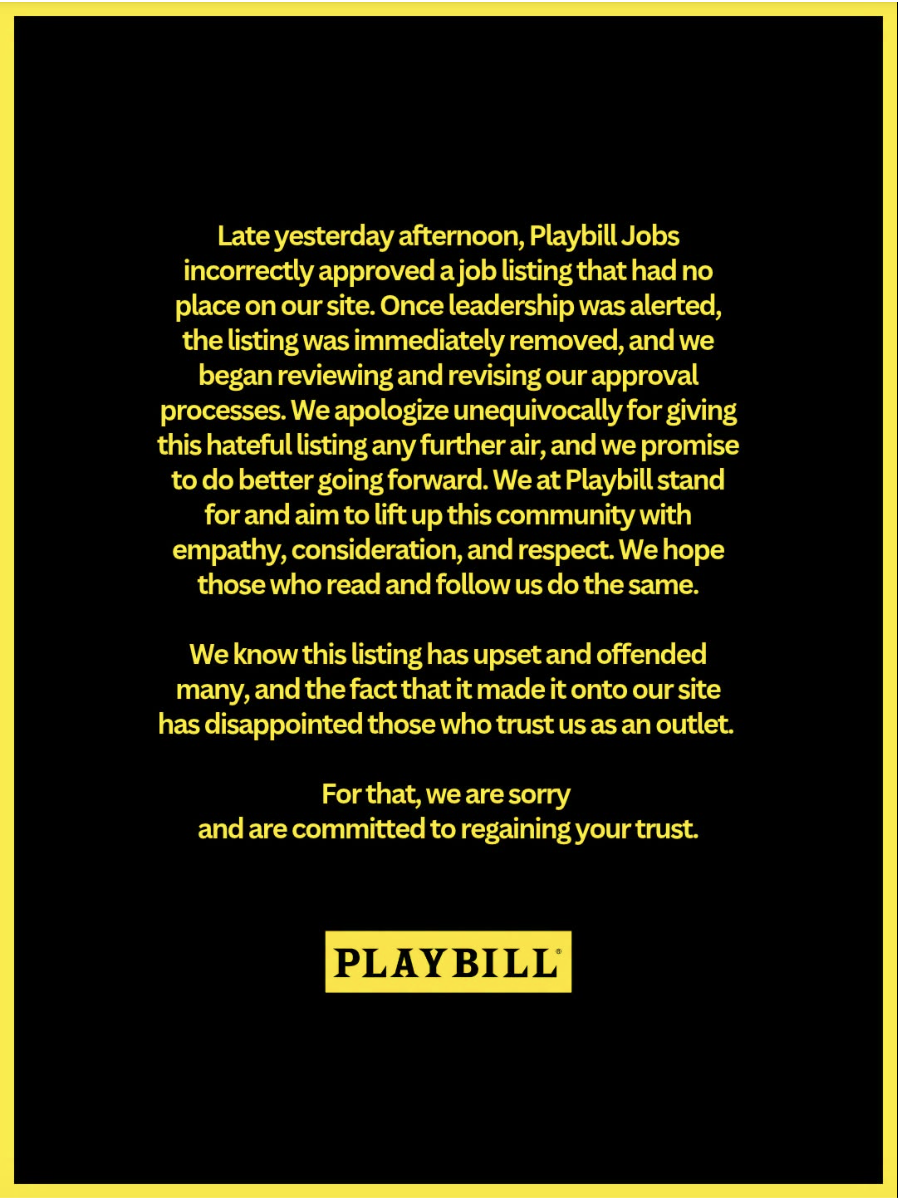
Playbill, to its credit, didn't try to spin it. In a statement posted to social media, the company said:
"Late yesterday afternoon, Playbill Jobs incorrectly approved a job listing that had no place on our site. Once leadership was alerted, we immediately removed the listing and began reviewing and revising our approval processes. We apologise unequivocally for giving this hateful listing any further air, and we promise to do better going forward."
It added: "We know this listing has upset and offended many, and the fact that it made it onto our site has disappointed those who trust us as an outlet. For that, we are sorry, and are committed to regaining your trust."
Satire, apparently
Busted Broadway, the company behind the production, is less inclined to say sorry.
The independent New Jersey record label makes cast albums for musicals that don't exist and, ideally, never will. It hit back on 19 November 2026 and insisted the show was never meant to mock Floyd or his murder.
"Busted Broadway seeks to push the limits of what is possible in musical theatre by producing provocative and satirical musical cast albums," the company said in a social media statement.
"Our George Floyd the Musical is NOT making light of, condoning, or mocking the horrific 2020 murder of George Floyd. It's a satire on the CULTURE, rather than the person."
Then came the closing argument: "Never judge a show by its title, as many who have never seen the script or score appear to be doing now."
That's a bold line from a company whose title, poster, and tagline are, to date, the only parts of the show anyone has seen.
The man behind the label is Kevin Lynch, who has said he started it to make an album of "subversive opening numbers from fictitious musicals."
Other titles he has floated include Abstinence the Musical, Human Centipede the Musical, and Genghis Khan the Musical. According to the New York Post, Lynch filed a suit in Manhattan federal court in June, alleging the Broadway production of Wicked didn't hire him for an apprenticeship because he is a white man. A conservative group that opposes DEI programs is backing the suit.

Broadway responds
Broadway took the "never judge a show by its title" advice and did the opposite.
West Side Story star Rachel Zegler called the project "so, so insanely awful" in an online comment.
Questlove, who has produced three Broadway shows, described the slow-motion horror of reading the headline.
"OMG!!!!!!!! it took 17 seconds to register," he wrote. "I saw the headline for 4 secs and was like 'wait they made a broadway play on how he developed those sandwich machin————OH GOD WAIT READ THAT AGAIN!!!!!!!!!!????????'"
Seventeen seconds is roughly 17 seconds longer than anyone at Playbill Jobs seems to have spent on the listing.
The approval problem
If the story feels familiar, that's because the advertising industry has been running the same play for months, just with a different cast.
In September, Converse apologised and deleted a social ad that critics said echoed KKK lynching imagery. Amber Groves, creative strategy director at Weave, told Mediaweek it was hard to believe something that loaded had made it through so many approval layers. Rhian Mason, co-founder of REALMS, pointed out that lots of reviewers is not the same as the right reviewers.
A month earlier, Callaway and creator group Good Good pulled a 15-second golf ad in which a man shoves a female staffer to the ground. A rambling apology video only made things worse. Before that, Campbell's became a crisis-communications case study, with RMIT University senior marketing lecturer Amanda Spry telling Mediaweek that "swift, honest and value-consistent responses are key to restoring brand legitimacy."
Playbill at least got the swift-and-honest part right. The harder question is how the listing got through in the first place, at a time when outrage is a business model. Oxford University Press named "rage bait" its 2025 Word of the Year after more than 30,000 people voted, and usage of the term reportedly tripled in 12 months.

Why trust is the real box office
None of this is an academic exercise for the theatre industry, which depends on audience goodwill in a way few sectors do.
Here, Live Performance Australia's latest Attendance and Revenue Report found ticket revenue rose 6.9% to $3.35 billion in 2024, while attendance climbed 4.6% to 31.4 million. Musical theatre drew more than 4.3 million people, up 2.1%, and remains the country's second-biggest live performance category.
That's a lot of people who trust that the musical they're buying tickets to was made in good faith, and a lot of trust for a trade platform to lose with one unchecked listing.
Busted Broadway asks us never to judge a show by its title. Fair enough. But every so often, the title is all the review anyone needs.
More from Mediaweek
The leading media trade publication in Australia.
Get our top stories straight to your inbox daily by signing up to our Newsletter
By providing your information, you agree to our Terms of Use and our Privacy Policy. We use vendors that may also process your information to help provide our services.


