



Did Sky News break ACMA rules airing chat with Hanson's daughter?
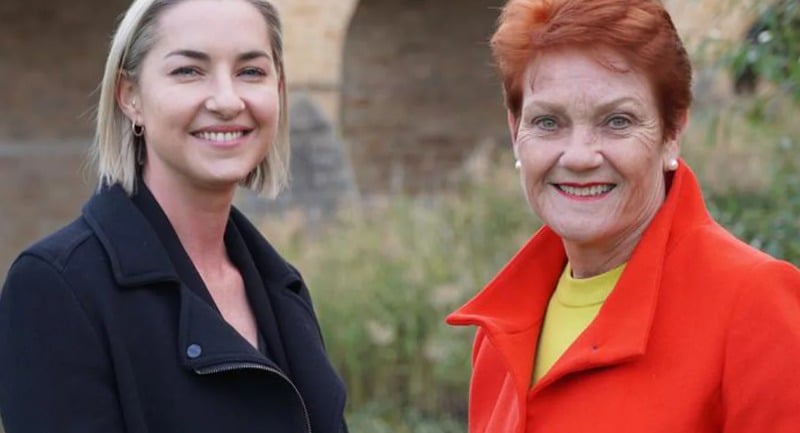
Lee Hanson appeared as a Richmond local in a Sky News segment, unidentified as a One Nation adviser, Pauline's daughter.

Sky News Australia is facing questions over its failure to identify a former Tasmanian One Nation Senate candidate and current political advisor as a political figure during a regional segment on the town of Richmond, Tasmania.
The package, filed by Sky News regional correspondent Jaynie Seal, saw the presenter travel to Richmond and interview several people who appeared to be locals discussing how the town has changed over the years and what support they would like to see from state and federal governments.
They also recount to Seal the benefits and some of the issues of living in a small regional town, such as the need for more pedestrian crossings and the necessity of tourism.
Seal is then shown seated opposite another woman in what appears to be a pub, who tells her that the issues impacting the town are "really not too dissimilar from what Australians are experiencing across the whole country, to be honest," the woman said. "You know, cost of living is a real issue."
That woman is Lee Hanson, senior advisor to One Nation NSW Senator Sean Bell and daughter of One Nation leader Pauline Hanson.
Hanson contested the 2025 federal election as One Nation's Tasmanian Senate candidate but failed to secure a seat, and has since vowed a political comeback.
She was not identified in any capacity -as a political staffer, party figure, or former candidate - at any point during the broadcast.


The leading media trade publication in Australia.
Get our top stories straight to your inbox daily by signing up to our Newsletter
By providing your information, you agree to our Terms of Use and our Privacy Policy. We use vendors that may also process your information to help provide our services.
What ACMA says
Australian broadcasting laws require political matter to be clearly identified, with the Australian Communications and Media Authority (ACMA) defining the term broadly under the Broadcasting Services Act 1992. The definition extends well beyond traditional election advertising to include any broadcast that seeks to influence public opinion on matters of political discussion.
Under the guidelines, material does not need to explicitly endorse or oppose a political party, candidate or policy to be considered a political matter. Instead, ACMA assesses the content, tone, presentation and broader context of a broadcast to determine whether it is capable of influencing public opinion.
The regulator says audiences should know "who is trying to persuade them to think or act in a certain way", warning that where the source of political messaging is disguised or omitted, "the political process can be compromised."
Which raises the obvious question: does any of this actually constitute political matter under the Act, or is Mediaweek reading too much into a chat about the cost of living over a counter lunch?
Hanson may well be a familiar face in Tasmanian political circles and the corridors of Parliament House. But knowing her name is one thing; spotting her at a pub table is another.
And on that front, the average punter's record is patchy at best.
Research from The Australia Institute has previously found that plenty of federal cabinet ministers, people who actually hold ministries, struggle to crack even one-third name recognition among voters, with some languishing in the single digits.
If a sitting Resources Minister can walk down the street unnoticed by 92% of Australians (according to the data), the idea that Joe Public would instantly clock a Senate adviser halfway through a schooner and a chicken parmy feels, at best, optimistic.
The requirements apply across commercial television and radio, community broadcasters, subscription television services and class licence holders, while the ABC and SBS operate under equivalent provisions in their own legislation.
ACMA's guidance also makes clear that the determining factor is not whether a candidate appears in an interview, comedy segment or entertainment program, but whether the broadcast constitutes political matter capable of influencing public opinion or voting behaviour.
Meanwhile, separate electoral laws also prohibit broadcasters from misleading voters about the voting process itself. In Tasmania, for example, the Electoral Act 2004 makes it an offence to broadcast electoral material that is intended, likely or capable of misleading an elector about recording their vote, with penalties of up to 200 penalty units, six months' imprisonment, or both.
Mediaweek has reached out to both Sky News Australia and ACMA for comment.
More from Mediaweek
The leading media trade publication in Australia.
Get our top stories straight to your inbox daily by signing up to our Newsletter
By providing your information, you agree to our Terms of Use and our Privacy Policy. We use vendors that may also process your information to help provide our services.


