



The analogue backlash: Social Soup exposes brand community fails
The research illustrates a gap between corporate community talk and the real connections Australians crave.

Every corporate marketer in Australia claims to run a community, but sadly many aren’t really sticking.
New data from influence agency Social Soup reveals a mismatch between corporate ambition and human reality. While Australians crave real-world connection more than ever, their interest in ad-driven brand ecosystems remains practically non-existent. No surprise really.
The agency presented the industry data at a morning breakfast event inside its Redfern office in Sydney. The briefing marked the second leg of its annual Influence Upfronts, following a presentation in Melbourne earlier in the week.
The headline data shows that 43% of Australians belong to more communities than they did two years ago.
However, the corporate sector entirely fails to capture this enthusiasm. Only 14% of women and a dismal 5% of men feel any genuine connection to a brand's self-proclaimed community.
The undeniable power of true influence
Social Soup founder and chief executive Sharyn Smith believes the industry suffers from a fundamental misunderstanding of what a community actually requires.
Brands frequently mistake transactions for relationships, plastering the word "community" across welcome emails and basic discount codes.


The leading media trade publication in Australia.
Get our top stories straight to your inbox daily by signing up to our Newsletter
By providing your information, you agree to our Terms of Use and our Privacy Policy. We use vendors that may also process your information to help provide our services.
"I sign up for 10% off and suddenly I'm part of something," Smith told the audience, describing the industry's lazy shift into community washing. "The moment a community exists to move product, the authenticity that made it work collapses."
Despite these corporate missteps, Smith highlighted that genuine influencer marketing now operates as the most compelling force in the advertising world.
She cited global research from the Institute of Practitioners in Advertising, which studied 220 influencer campaigns across 144 brands.
The research proved that influencers act as the absolute greatest long-term multipliers of impact, outperforming every other channel, including television.
When brands execute influencer marketing correctly, the commercial returns dominate the media mix.
 Digital fatigue is affecting consumer behaviour. Image: pexels
The great analogue backlash
Consumers actively shift their habits to escape digital fatigue.
According to Social Soup’s own research, which surveyed 900 Australians, 31% of people join real-world groups as a direct reaction to an online environment dominated by artificial intelligence and relentless algorithmic feeds.
Mental health and wellbeing drive 37% of community additions, closely followed by the pursuit of adult friendships at 35%.
Crucially for media buyers, the assumption that community lives strictly on smartphones is completely wrong. Only 3% of respondents participate in online-only groups.
The vast majority demand physical presence, with 46% sticking to in-person interactions and 51% mixing both worlds.
"As the world becomes more online, we always have an opposite reaction to that," Smith noted during a follow-up interview. "Brands need to think about that world, but then they also need to balance it with our goodwill."
Corporate bureaucracy kills connection
During a marketing leaders panel, industry experts targeted internal corporate structures for ruining authentic consumer engagement.
James Deysel, founder of consultancy Make Marketing Better and former snack brands chief marketing officer, argued that corporate anxiety prevents authentic consumer relationships.
Deysel noted that modern brand marketers spend roughly 80% of their time looking inward at project gate documents, endless alignment meetings, and internal board presentations. "We're just not focussing on the consumer enough," Deysel said. "My message to bigger businesses is just get back to focussing on the consumer, and this is the way you create focus in the business."
Lee Schofield, a futurist working with the UTS Human Technology Institute, highlighted a sharp rise in phone-free experiences, which have surged by 567%.
Schofield pointed out that as online content starts looking identical due to generative AI compression, consumers naturally crave the unscripted nature of real-life experiences.
"There is that craving for increased third spaces, for the analogue, for phone-free zones as well," Schofield explained to the panel. "How do you design the future so that technology's supporting, not overwhelming, an experience?"
The war between marketing and finance
The conversation shifted sharply toward measurement when Henry Innis, chief executive of marketing mix modelling platform Mutinex, challenged the validity of standard digital metrics.
Innis stated that performance marketing consumes about 46% of the average Australian marketing budget, with search eating up 30% of that pool.
Innis directly called out the massive disconnect between chief marketing officers and chief financial officers. He noted that marketers communicate the true value of their work poorly to their own finance departments.
"If you want to influence someone, understand how they get paid," Innis advised the room, pointing out that finance executives ultimately care about growth and share price.
He encouraged marketers to aggressively challenge finance teams. Innis suggested that when a finance executive confidently presents a target number, marketers should force them to walk through their assumptions in exact detail.
He promised that the initial confidence quickly fades once the raw assumptions face scrutiny.
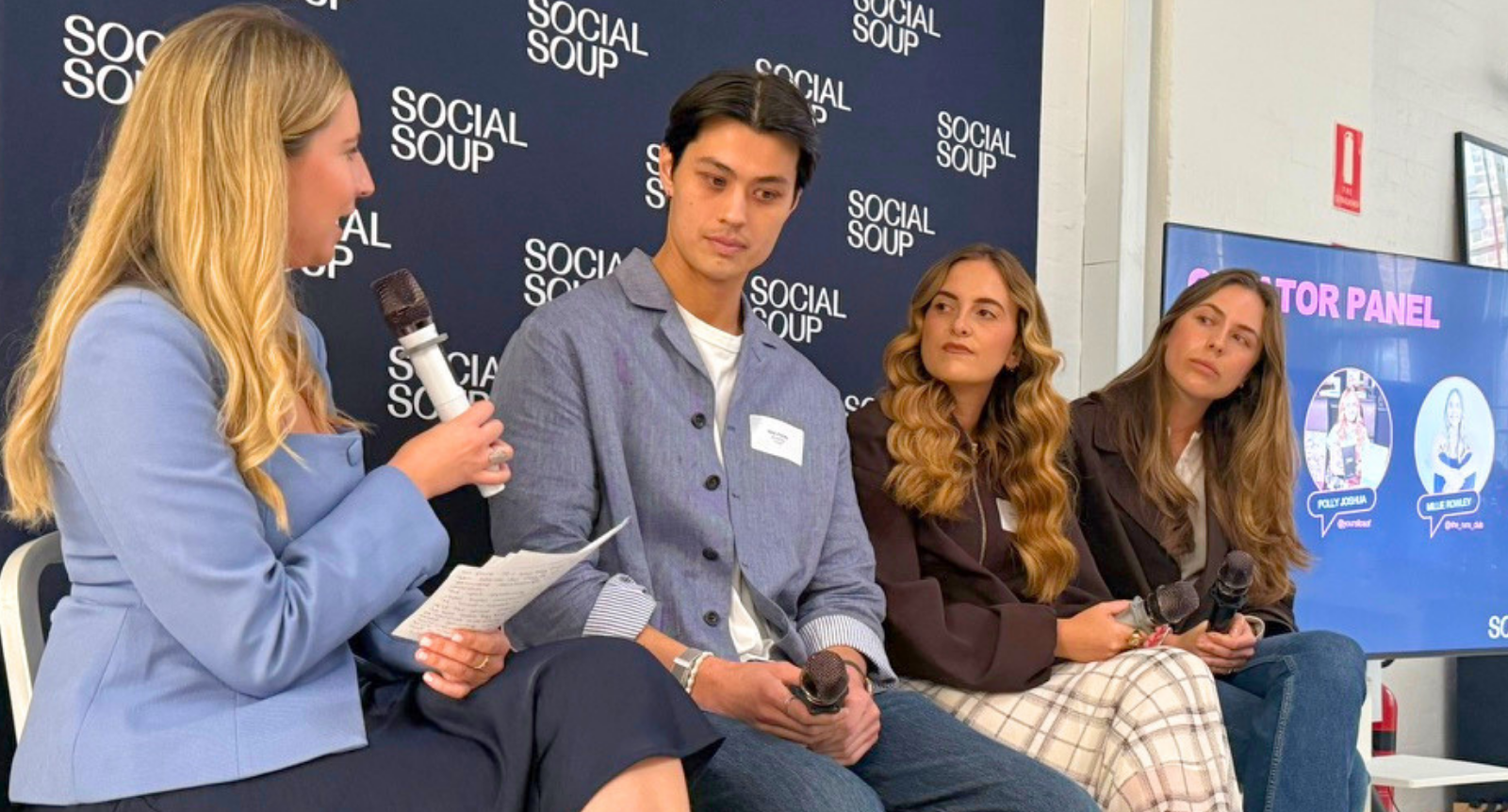 Influencer panel led by Social Soup’s Emily Green, featuring Nick Ficky, Polly Joshua, and Millie Rowley. Image: file
What creators actually want from brands
The event also featured a panel of creators, moderated by Social Soup account director Emily Green, focusing on how brands can successfully navigate these niche networks.
The agency's research confirms that creators understand their audiences far better than corporate brand managers do, with 71% stating they hold a superior grasp of community dynamics.
This deep audience connection means creators fiercely protect their personal brands. In fact, one in two creators regularly reject corporate partnerships if the values fail to align with their community.
Millie Rowley, founder of the running and wellness community She Runs, explained that the traditional deliverables checklist rarely works. Rowley, whose community has grown to over 27,000 followers, urged brands to focus on consumer value rather than rigid corporate scripts.
"The run is the least interesting thing about us, honestly," Rowley said. "It's about belonging. It's about connection. It's about community."
Fellow creator Nick Fricky agreed, noting that the best brand partnerships start by respecting creative freedom. "Any time that you get a creative brief, it kind of starts with maybe who you're speaking to, the consumer first, rather than the product and the three benefits that it does," Fricky said.
The final takeaway on business reality
Following the presentation, Smith reflected on the key lessons from the two days of Upfronts. She pointed directly to the measurement gap that Innis highlighted as the ultimate hurdle for the influencer industry.
"We have so much evidence now that it is such a powerful channel, yet it's not scaling like it should do," Smith noted.
She identified the biggest challenge as successfully translating community value into a language that the corporate finance function actually understands.
Ultimately, Smith noted that the research paints a clear picture of modern consumer desires as they seek to escape the digital grind.
"Community is something that defines us as a species," Smith concluded.
"They say it takes a village to raise children, but I think life, in general, takes a village. And that's how we're all living now. We're looking for our village".
Feature image- Sharyn Smith, founder and chief executive, Social Soup: supplied.
More from Mediaweek
The leading media trade publication in Australia.
Get our top stories straight to your inbox daily by signing up to our Newsletter
By providing your information, you agree to our Terms of Use and our Privacy Policy. We use vendors that may also process your information to help provide our services.


