



How AI helped flood the ABC with thousands of complaints
AI-assisted campaigns drove a surge in ABC complaints, but fewer than 1% of findings resulted in any editorial breaches.

Artificial intelligence-assisted campaigns helped more than double the number of content complaints the ABC received, even though fewer than 1% of the Ombudsman’s findings resulted in an editorial breach.
The ABC Ombudsman’s annual report revealed content complaints surged 107% to 8,686 during the 2025–26 financial year. Of those, 5,259 were linked to 48 organised campaigns, accounting for 61% of the total.
The figures show the challenge facing the national broadcaster as it attempts to distinguish broad community concern from organised pressure, particularly when AI can make thousands of campaign emails appear individually written.
Overall written complaints increased just 3% to 18,738, while general complaints covering matters such as scheduling and personal preference fell 28% to 10,052.
AI changes the complaints game
The Ombudsman said the rise in content complaints was largely driven by campaigns involving similar or identically worded submissions, including emails produced with AI.


The leading media trade publication in Australia.
Get our top stories straight to your inbox daily by signing up to our Newsletter
By providing your information, you agree to our Terms of Use and our Privacy Policy. We use vendors that may also process your information to help provide our services.
“Complaints were categorised as campaigns where a concentration of complaints raised similar concerns about the same content within a specific period,” the report said.
“They may be substantively similar or identically worded or appear co-ordinated.”
The Sydney Morning Herald reported that one group using the technology is Pen Power Australia, a letter-writing movement established to challenge antisemitism and what it considers anti-Israel narratives.
Coordinator John Grimwade said the group began around May 2025 when he decided supporters needed a fast, repeatable way to respond to institutional decisions.
In a first-person account published by Christian news outlet The Daily Declaration, Grimwade said the model involved drafting a letter, distributing a link and allowing supporters to send it directly to the intended recipients. The aim was to turn “scattered outrage into coordinated civic action”.
Pen Power initially expected to run about two campaigns a week, attracting 20 or 30 participants. It later expanded to five to 10 campaigns each week, generating dozens or hundreds of letters per action.
How Pen Power operates
Pen Power uses Activist Mailer, a US campaigning platform that Grimwade said was provided free of charge because of the group’s stated purpose of defending Jewish communities and opposing antisemitism.
The technology alters the wording, tone, formatting and length of campaign emails while retaining the same message. Each email is sent through an individual supporter’s inbox, making the correspondence appear less uniform.
According to the Herald, internal WhatsApp messages showed Grimwade telling members in August that Pen Power had sent more than 40,000 emails.
“Our campaigns go out as required,” Grimwade said. “We try to keep up with the ABC in particular, but so many of their reports are biased, or statements made that lack proper context.”
The Ombudsman’s report did not identify Pen Power or attribute any specific campaign to the group.
Middle East coverage dominates complaints
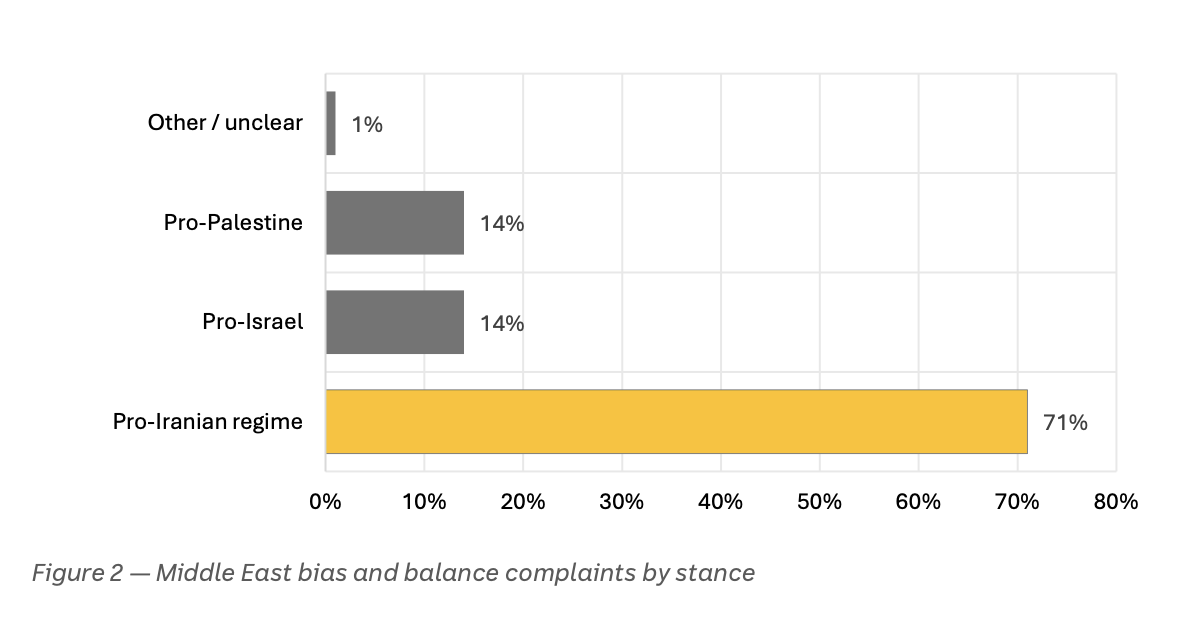
Coverage of Middle East wars and conflicts generated approximately 4,600 complaints, representing 53% of all content complaints.
More than 3,000 alleged the ABC’s coverage favoured the Iranian regime, while 1,148 concerned perceived bias in its Israel-Palestine reporting.
Among complaints dealing specifically with bias and balance, 3,002 alleged pro-Iranian coverage, compared with 579 alleging pro-Israel bias and 569 alleging pro-Palestinian bias.
The largest campaign generated 2,746 complaints about ABC Instagram and YouTube reporting from inside Iran. Most complainants identified themselves as Iranian Australians or members of the Iranian diaspora.
They argued the coverage lacked impartiality because it was produced inside an authoritarian country where interviewees may not have been able to speak freely.
The Ombudsman did not uphold the complaints, finding the ABC had adequately signposted that the perspectives were not necessarily representative of Iran’s wider population. It also noted the broadcaster had published substantial reporting carrying alternative views.
Thousands of complaints, few breaches
Despite the surge, 88% of the 6,772 findings the Ombudsman considered complied with the ABC’s editorial standards.
Another 775 findings, or 11%, were recorded as “Action taken”, meaning the ABC addressed the concern promptly enough that further investigation was unnecessary.
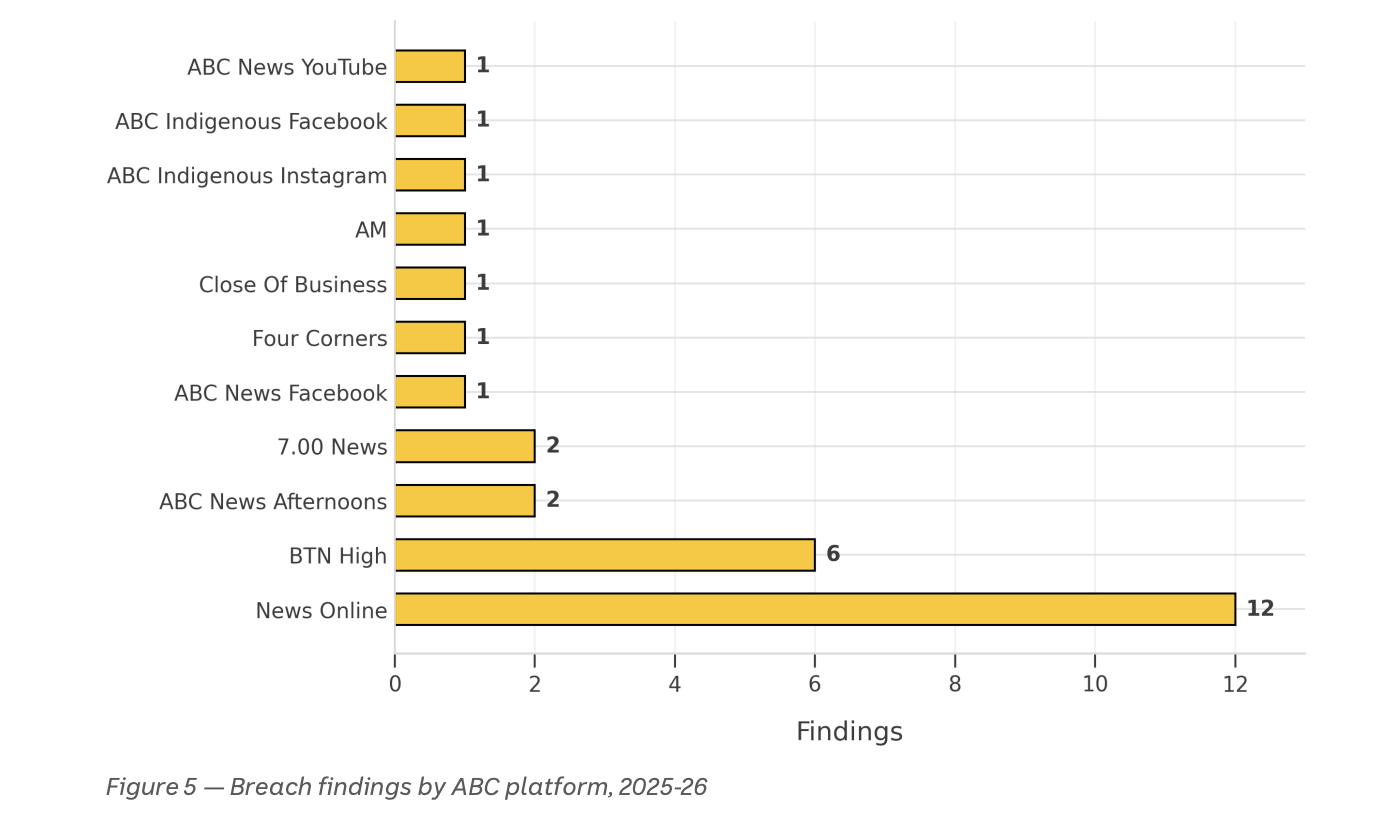
Just 29 findings involving 14 stories resulted in a breach, fewer than 1% of all findings and a 48% fall from the previous year.
Only one concerned Middle East reporting. It involved an ABC News Online story that incorrectly quoted the Lebanese President using material taken from an AI-generated video.
AI therefore helped generate thousands of complaints about the ABC while also contributing to one of the few errors the Ombudsman identified.
ABC changes how campaigns are counted
Since 31 March 2026, substantively similar complaints that appear campaign-coordinated and are sent outside the ABC’s official complaints form have been counted as one complaint.
The Ombudsman investigated 64% of content complaints during the year and reduced its average response time from 16 days to 14.
While changes to the complaints system mean some figures cannot be directly compared with previous years, content complaints finished 67% above the five-year average.
More from Mediaweek
The leading media trade publication in Australia.
Get our top stories straight to your inbox daily by signing up to our Newsletter
By providing your information, you agree to our Terms of Use and our Privacy Policy. We use vendors that may also process your information to help provide our services.


