


AI sameness crisis has a new challenger
Every creative director has a version of the same story. You’re deep in a pitch, you ask your AI tool for 10 directions, and you get back 10 versions of the same idea wearing different hats. One’s got a pun. One’s “purpose-led.” One has a rhetorical question in the headline. But they’re all, fundamentally, the same ad.
This is not a bug report. This is Tuesday.
The quiet panic under half the industry’s AI experimentation isn’t that the robots are taking jobs. It’s that the robots are making everything sound the same. And when every brand’s AI-assisted work starts rhyming with every other brand’s AI-assisted work, you don’t have an efficiency problem.
You have a creative crisis.
Springboards, an AI platform serving advertising and marketing teams, thinks it found the source code of the problem, and this week it launched a tool to fix it.
Time is a river, except when it isn’t
Springboards co-founder and chief executive officer Pip Bingemann explains what Flint does, and why it exists. As a point of references he touches on a research paper named Artificial Hive Mind. The study prompted 70 different AI models with the same open-ended question: give me a metaphor for time.
A full 69 of them answered: time is a river.
“Not wrong,” Bingemann says. “But that’s exactly the reason your last pitch died.”
The paper neatly illustrates what researchers call convergence, the tendency of large language models to collapse toward the statistically most likely answer. Feed them an open-ended creative prompt and they do not explore the space. They head straight for the middle of it.
For an accountant or a lawyer, convergence functions as a feature. It delivers the most correct answer, fast, every time. For a strategist, a copywriter, or a creative director staring down a blank brief, it represents a fundamental problem.
“Frontier models are getting smarter, faster, and more polished,” Bingemann says. “But their outputs grow eerily similar and more repetitive. For a strategist, writer, marketer, comedian or creative team, convergence isn’t a feature, it’s a bug. So we built the model we needed for ourselves.”

L-R: Springboards co-founders Pip Bingemann and Amy Tucker, with CTO Kieran Browne. Image: supplied
Tiny but mighty
That model is Flint. Flint launched this week as the centrepiece of a full platform overhaul at Springboards. In a market crowded with AI tools promising to do everything, Flint exists to do one thing: generate high-variance ideas that avoid collapsing into the obvious.
It runs on 30 billion parameters, small by frontier model standards, where the arms race for scale has pushed the biggest models into the hundreds of billions. But Springboards chief technology officer Kieran Browne argues scale remains precisely the wrong thing to optimise for creative work.
“The naive approach to divergence involves just turning up the temperature on a standard model,” Browne says. “But that doesn’t get you interesting. It gets you incoherent. It starts hallucinating nonsense.”
Instead, Springboards trained Flint to identify specific decision points in a generation, moments where the model can branch meaningfully without breaking the underlying knowledge. It takes the scenic route, Browne says, without crashing the car.
Outperforming the giants
The results on the independent Novelty Bench benchmark look striking. Flint scores seven out of 10 for creative diversity. This means when prompted 10 times, it generates seven functionally distinct responses rather than 10 surface-level paraphrases of the same idea.
The average score across leading large language models sits at 2.88.
“Flint significantly outperforms the world’s largest LLMs on the one metric that actually matters for the future of the creative industries,” Browne says. “And what feels particularly exciting is that we achieved this without degrading the base model’s general capabilities. You can train a model to range more widely without gutting what it already knows.”
Springboards has operated for three years, originally as a high-ticket enterprise tool for advertising and marketing teams. Hundreds of agency and in-house teams across the US, UK and Australia use the platform, including TRG and BMF, largely to survive the brutal economics of new business pitching.
But ask those agencies to go on record about it, and many politely decline.
Flint is launched out of Springboards – a ‘divergence’ AI model. Image: supplied
The pitch-room taboo
“Nobody wants to admit the robot helped them brainstorm,” Bingemann says, with a degree of diplomatic understatement. Clients regularly share successful campaigns with the Springboards team, campaigns where the platform played a meaningful role, and ask them to keep the usage quiet.
The secrecy revolves less around shame than optics. Procurement teams, client-side brand guardians, and a creative industry still nervously negotiating its relationship with AI have collectively created a culture where the tools that prove most useful remain the least discussed.
But Bingemann thinks that stigma is shifting. “Two years ago, people felt terrified of admitting AI use. Now it becomes standard practice. People slowly realise AI is just a tool, and human taste remains the ultimate judge.”
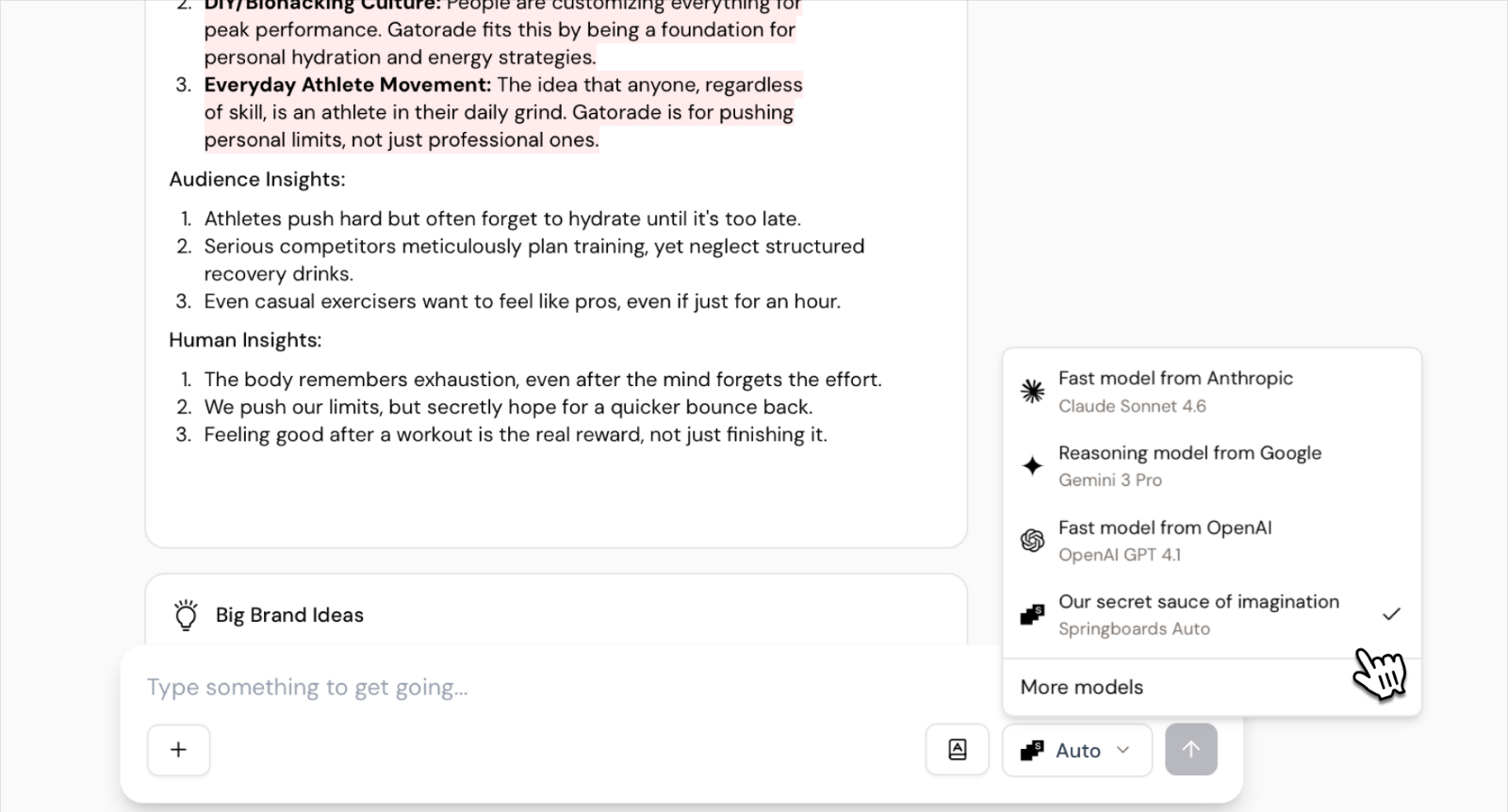
Within Flint, you can access the suite of mainstream LLMs. Image: supplied
BMF executive planning director Anna Bollinger stands as one of the few willing to speak openly. “Springboards acts as an incredible ideation platform and creative strategy partner,” she says. “It surfaces ideas and insights that other models ignore and, in doing so, takes you down the most unexpected and refreshing creative paths.”
TRG head of brand strategy Christopher Owens speaks more directly: “What if your imaginary strategy friend didn’t have to be imaginary? Springboards gets you to more curious places faster. Surrender to it.”
Crazy, but not too crazy
On the Flint launch briefing, one distinguished tech journalist highlighted the obvious tension: can the platform act crazy, but not too crazy? What happens when a client needs ideas that push boundaries but stay firmly within ‘Coca-Cola red’?
Browne acknowledged the tension but reframed it. “State of the art models focus entirely on single ground truth answers. But judges, whether they sit on award juries or client boards, evaluate creative work by its novelty and its ability to avoid cliché.
Those represent different optimisation targets.”
Co-founder Amy Tucker clarified where Flint sits in the process. The platform does not produce final outputs. It produces stimuli: directions, provocations, and unexpected angles that give the human in the room something to react to.
“The human who knows what good looks like has to take the work in the right direction,” Tucker says. “AI brings the spark. The human builds the fire.”
That framing matters in a market still jittery about automation displacing craft. Springboards makes a deliberate bet: the value of AI in creative work lies not in replacing human judgment, but in expanding the raw material that human judgment evaluates.
From enterprise tool to open platform
Blackbird Investments partner Thomas Humphrey, whose firm backs Springboards, sees it as the right bet at the right moment. “We see a clear shift from generalised AI and ‘one model to rule them all’ to models purpose-built for specific capabilities, and creativity represents one of the hardest specialties to crack. Flint isn’t AI as decoration. It serves as the engine the whole software product relies upon.”
The platform overhaul accompanying the Flint launch sends its own signal. Previously, Springboards operated on a sales-led enterprise model costing $1,000 a month, prioritising relationships, mostly with large agency networks.
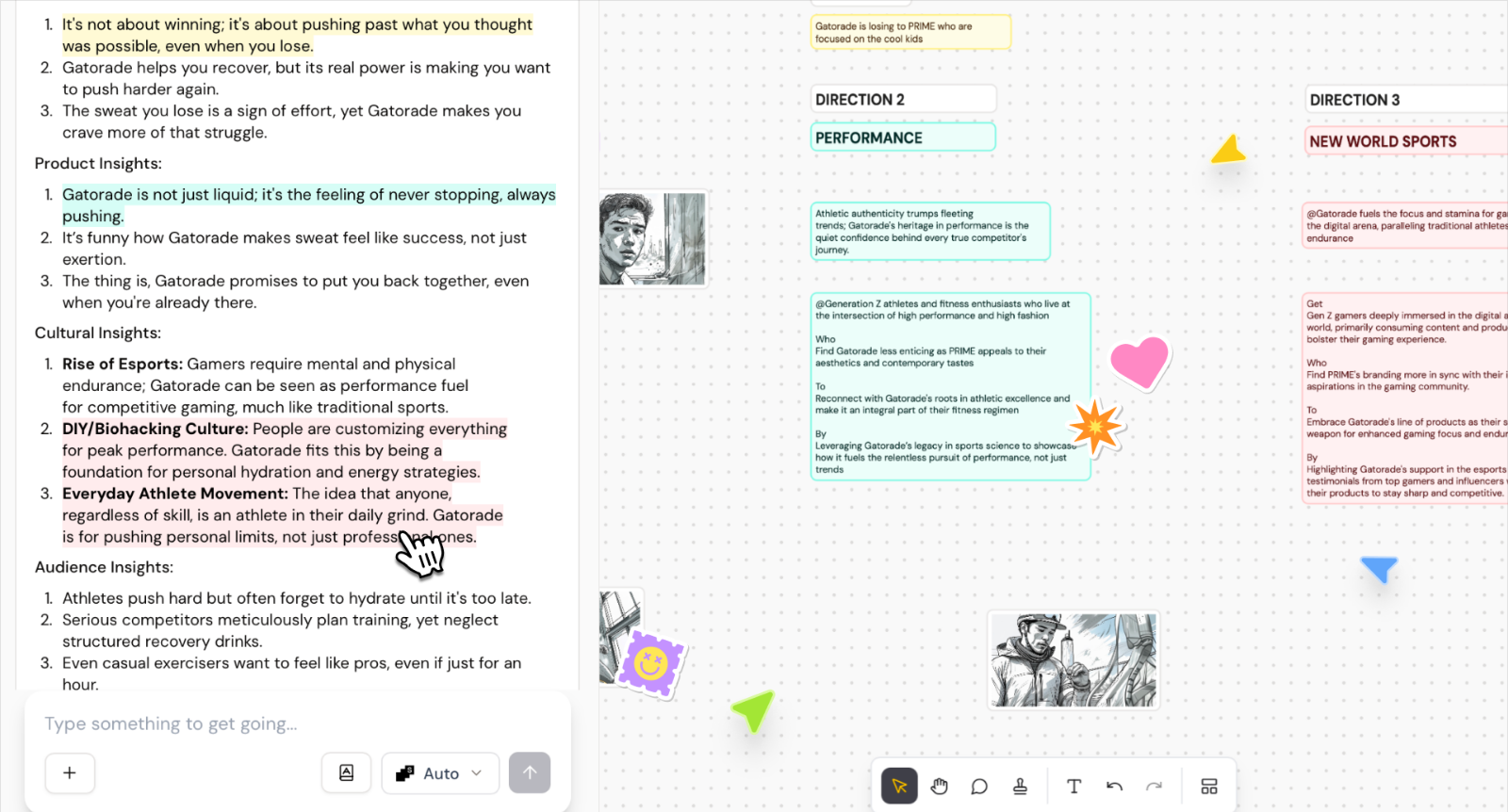
Flint let’s the user create from multiple sources of ‘messy’ information on a canvas. Image: supplied
The new platform opens access significantly. Springboards now offers a free tier. A paid tier sits at $30 a month and gives users access to Flint alongside leading models from Anthropic, Google and OpenAI.
Freelancers, small agencies and boutique consultancies can now enter the ecosystem.
“Our goal always focused on building tools that enable advertisers and marketers to do their best work,” Tucker says. “We feel so excited to finally open this up to everyone, from solo freelancers to global agency teams.”
Springboards also launched Spark Sessions, a monthly masterclass series for annual subscribers featuring practitioners including Mark Pollard, James Hurman, Faris Yakob, Rosie Yakob, and Zoe Scaman.
The pricing shift reflects something broader happening in the market. As AI tooling becomes table stakes, the competitive advantage moves from access to application. The agencies that figure out how to use these tools creatively, not just efficiently, stand to pull ahead.
Flint forms Springboards’ argument that divergence, not convergence, holds that advantage.
If sixty-nine out of seventy models think time is a river. Flint is looking for the seventy-first metaphor.
Flint Alpha operates globally now via springboards.ai.
Feature image: AI generated