

By Maddie Basso, Head of Yahoo DSP Australia
Cannes is always a whirlwind – it’s the kind of week that feels like a month while you’re in it, and then is somehow over in a flash. Now that the dust has settled and the jetlag has (mostly) worn off, a few things have become a lot clearer.
This wasn’t my first time at Cannes but a new experience attending as part of the Yahoo team – and the gap between visits turned out to be the perfect vantage point. The Cannes I remembered was a very different beast to the one I walked into this year, and the shift was obvious within about a day.
If you weren’t there, here’s what stood out to me.
If AI is in your future tense, you’re way behind
I have to start with AI. This was clearly the number-one trend in conversations at Cannes, and for good reason. However, this year I noticed a clear discrepancy.
I still came across many people talking about AI in a future sense – as in, soon we’ll be able to have technology which can do x, y and z. But, for the most part, that technological capability is already here. Well, at least for Yahoo, it makes me think the question isn’t whether AI is ready for businesses, but whether most businesses are ready for AI.
Beyond that, I think we need some honesty about what “AI-powered” actually means. Is it a capability you’ve built yourselves? Or a platform you’ve onboarded that three people in the business know how to use?
Everywhere you look, there are claims of innovation and boundary-pushing – but the level of genuine implementation tells a different story.
If I can coin a term, I’d call it AI-washing: businesses saying they have AI capability without asking whether that capability is genuinely theirs, or genuinely new.
What I took from Cannes is that the industry is sitting at wildly different stages of this journey and there’s still a long way to go. I think 2026 is the year we need to get honest about the gap between the claim and the capability.

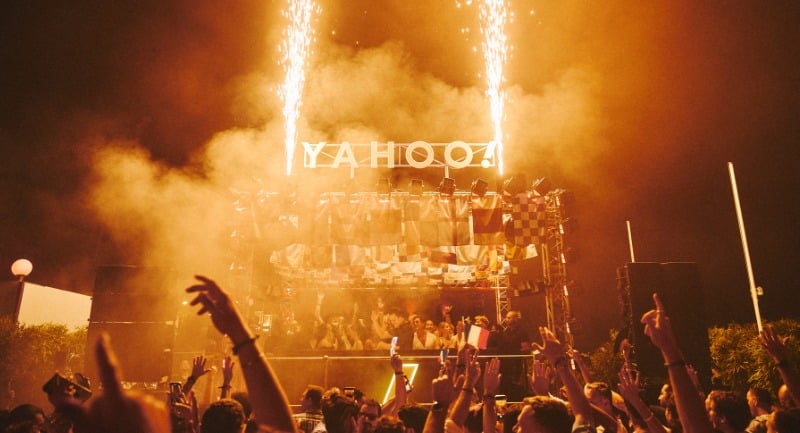
Maddie Basso on the ground at Cannes
Australia’s smallness is our superpower, if we let it be
This year’s Cannes had a noticeably smaller Australian contingent, with a much stronger showing from the US and across EMEA.
Sitting in on meetings with my global counterparts, it is staggering how much money and scale they talk about when it comes to campaigns.
Australia will never be able to match that because we will never have the same monetary mass. But, our smallness is an asset because it gives us speed – the ability to test, fail, adjust and ship again before a bigger market has finished its first round of internal sign-off.
We should embrace this as a strategic advantage because it gives us room to experiment, play, and, importantly, get things to market with less red tape. It means we can actually lead the world, if we move fast enough.
That means being willing to experiment in public, learn quickly and not wait for perfect conditions. It’s a very Australian instinct, when we let ourselves lean into it instead of measuring ourselves against markets ten times our size. Our nimbleness isn’t something to apologise for. It’s something to build a strategy around.
Less networking, more “now what”
The biggest shift wasn’t about a single technology or a market; it was the tone of the conversations themselves.
Cannes used to be, at least partly, a place you went to be seen – to collect business cards, float ideas, plant seeds for a partnership that might bloom eighteen months later.
This year, the seed-planting felt almost beside the point, because people wanted solid outcomes now.
While networking is still a solid component of the festival, I found it was less of a focus. Instead, it was a place to strengthen relationships or collaborations, most often those cross-border ones. I found most conversations moved quickly past the pleasantries and into, “Okay, so how do we make this happen?”
There was a transparency to that shift I found genuinely refreshing. More accountability in how we talk to each other is only ever a good thing, and it’s the reminder I’ve brought home with me – to make sure every conversation is hooked around a clear end goal, and that we’re ready to move fast enough to get there.
The conversations happening on that small stretch of the French coast have moved on from theory into something far more accountable: where do we go from here, and how do we make it happen now, together?