
Friday May 22, 2026
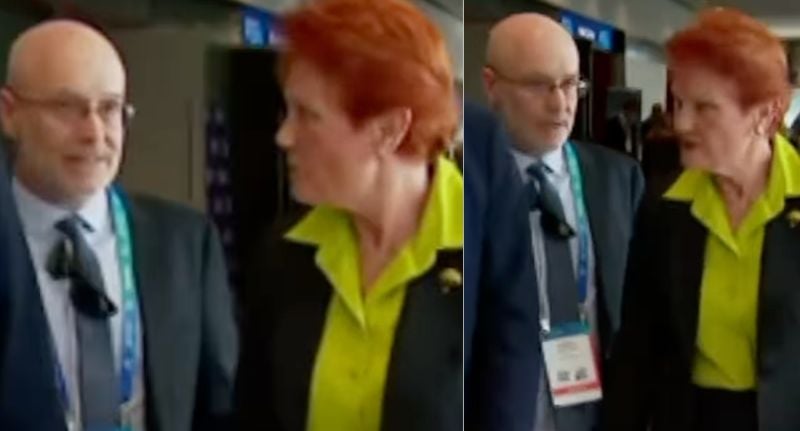
Pauline Hanson staffer reprimanded after telling journalist to ‘shut up’
One Nation staffer Richard Henderson has confirmed to Mediaweek he was “reprimanded” by Senator Pauline Hanson after telling a journalist to “shut up” following a press conference in Adelaide.
The exchange, captured on video by both Nine and Seven, involved Guardian Australia senior correspondent Sarah Martin.
The vision of the incident shows Hanson beginning to walk away from the lectern while Martin continues to ask questions.
Henderson can then be heard telling Martin, “We’re done”, before she responds: “Did you just tell me to shut up?”
“Yes, I did tell you to shut up,” Henderson replies.
View this post on Instagram
Exchange captured on camera
Following the interaction, Hanson was filmed speaking with One Nation MP Barnaby Joyce in footage captured by 7News cameras.
Joyce can be heard saying: “That was good, you did very well”.
Hanson then replied: “I said you’re the nasty b*tch.”
It remains unclear who the Senator was referring to in the exchange.
View this post on Instagram
Guardian Australia declined to comment when approached by Mediaweek.
Main image: Richard Henderson and Pauline Hanson. Source 7NEWS
The surprising cost of ABC’s ‘Media Watch’ each week
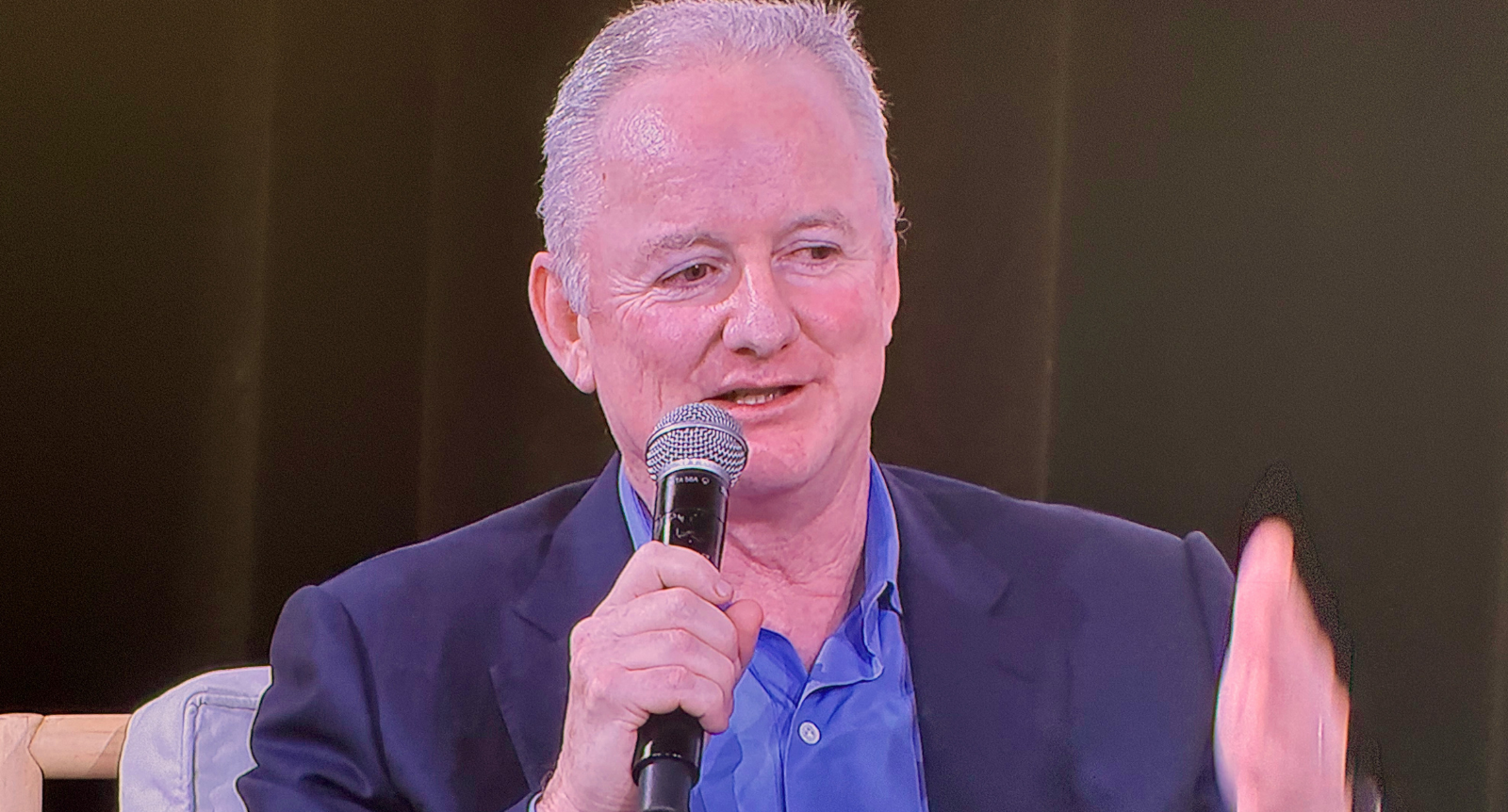
Freedom of Information documents have revealed the total cost of producing one of the ABC’s iconic shows, Media Watch, the Sydney Morning Herald reports.
The website of the weekly, 15 minute show, says it’s “Australia’s leading forum for media analysis and comment. Walkley award-winning investigative reporter and former foreign correspondent Linton Besser brings you a fearless critique of the week’s journalism.”
Apparently, it’s value for money.
Each episode costs $4,440.52, which doesn’t include salaries. The SMH reports that this week’s episode averaged 544,000 viewers.
View this post on Instagram
Managing Director of the ABC, Hugh Marks reportedly said on ABC Melbourne on Thursday morning that Deloitte was once paid $200,000 to produce a report showing the economic impact their productions have on the local economy.
That figure was $772 million in the three years from July 2022 to June 2025.
As the ABC reviews their budget, Marks said the report didn’t help him decide the show’s future.
Omnicom faces shareholder revolt over John Wren’s A$108.5m package
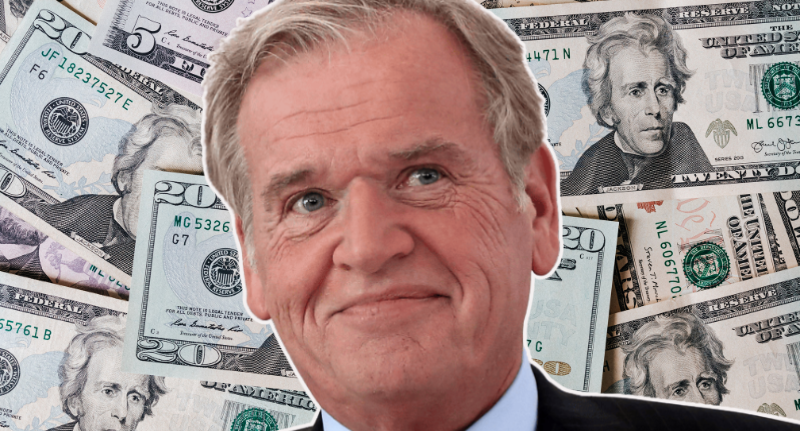
Omnicom big boss John Wren has faced investor backlash over his A$108.5 million annual pay package, with nearly half of shareholders voting against the agency group’s new compensation policy.
As reported by Campaign UK, more than 43% of shareholders opposed the board’s decision to give Wren, Omnicom’s chairman and chief executive, four million share options as part of an incentive scheme running from 2025 to 2028.
The policy was still approved, with almost 57% of shareholders voting in favour at Omnicom’s annual stockholders’ meeting. The vote was advisory.
Investor pushback
Institutional Shareholder Services, a leading proxy advisory group, criticised Wren’s share options package ahead of the vote, calling it “front-loaded” and “lacking pre-set performance criteria.”
ISS recommended that investors oppose the policy.
Wren is due to receive options worth around A$480.5 million over three and a half years.
He became eligible for the first portion, notionally worth A$107.4 million, last year, with the remainder due to vest in equal amounts over the period. His total package for 2025, including benefits, was A$108.3 million.
How the pay plan works
Wren has the right to exercise the option to buy stock at a pre-agreed price of A$120.28 per share, but will only profit on the amount that Omnicom’s share price rises above that level.
Omnicom’s stock has recently been trading below that price, at about A$111.60 earlier this week. Wren, who has been CEO since 1997, previously earned an A$1.55 million salary plus bonuses, with annual packages of more than A$31 million in recent years.
He reduced his salary to A$1 and received the share options as part of a new employment agreement designed to align his remuneration with shareholder interests following Omnicom’s A$14 billion takeover of Interpublic.
The package is also intended to keep him in the role until the end of 2028, when he is due to step down as CEO and become executive chairman.
ISS flags governance concerns
ISS said Omnicom’s financial performance last year had been “mixed” and that the company had provided only a “limited” rationale for creating the share options package.
“Such a practice limits the board’s ability to meaningfully adjust future pay opportunities in the event of unforeseen events,” ISS said. The proxy adviser added that while the stock options include an incentive to increase the share price, time-vesting vehicles are not considered strongly performance-based.
ISS also raised concerns about some bonus targets for other senior Omnicom executives, describing them as “non-rigorous.”
WPP also faces pay pressure
The Omnicom close call arrives after WPP also faced pushback over executive pay earlier this month.
About 25% of WPP shareholders voted against its remuneration report and new compensation policy at the company’s annual meeting.
WPP CEO Cindy Rose can earn a potential annual package of A$20.3 million, compared with A$15.7 million for her predecessor Mark Read.
WPP said it would engage with major shareholders who did not support the remuneration resolutions and report back within six months.
Arthur Sadoun remains the lowest-paid holdco CEO amongst rivals WPP and Omnicom.
Publicis Group plans to increase its base compensation by 20% to A$2.3 million after finding out that it’s the lowest-paid CEO among foes WPP and Omnicom.
If approved by the board, the proposed increase would take Sadoun’s total potential package, including bonuses, to about A$17.1 million.
Top image: John Wren
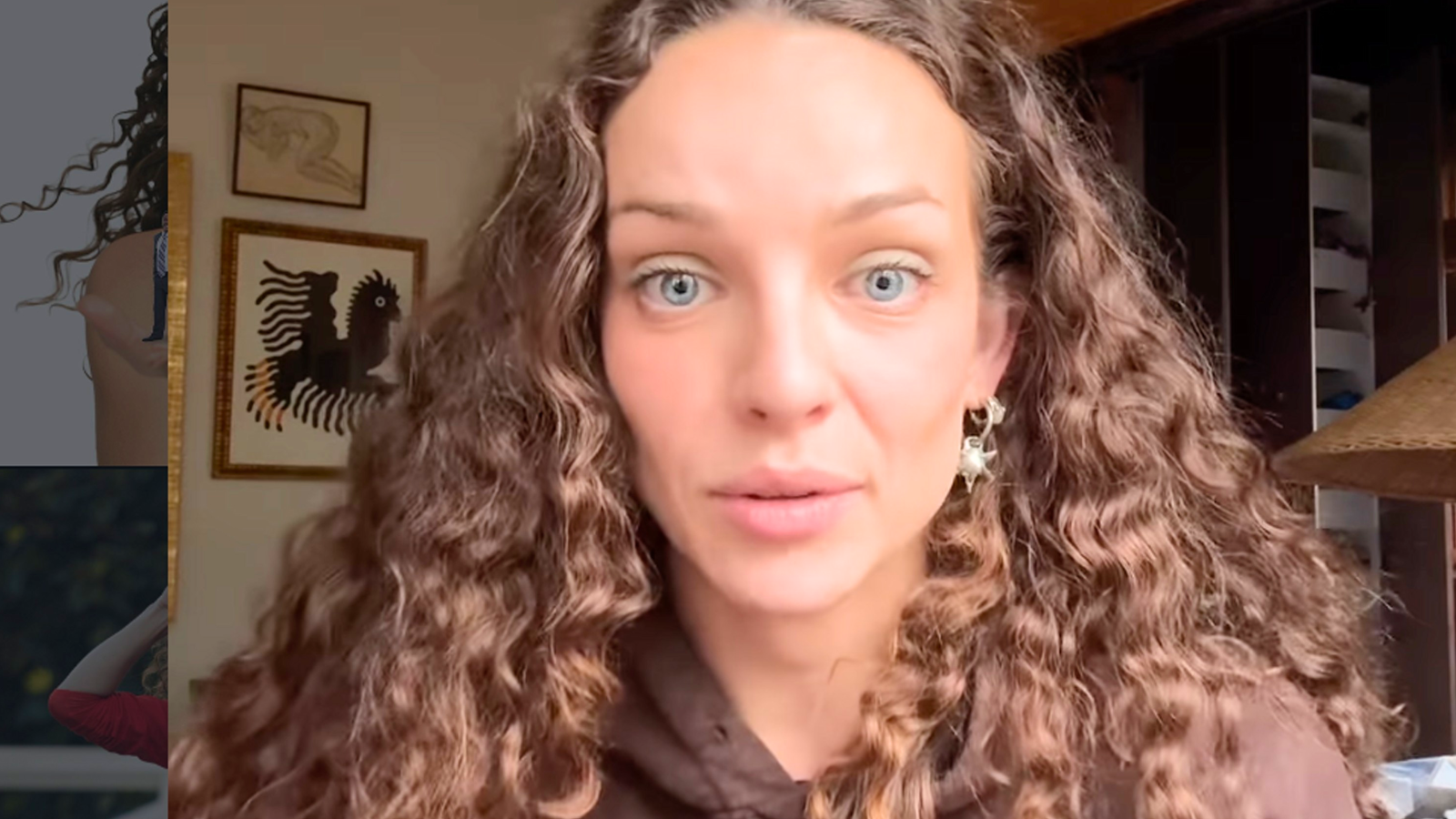
'I envy you': An open letter to Abbie Chatfield
This Mediaweek contributor has requested anonymity
Hi Abbie,
I’m writing this anonymously as I’m a journo and I don’t want it to seem I’m seeking personal attention.
This is genuinely for you and the public; for once, it’s not about me.
I’ve been watching the media’s treatment of you this year, and it’s bloody appalling. You’ve called it a “smear campaign”, and I absolutely agree.
Your Instagram post last night (see below), in which you were “begging these people to leave me alone for just one month,” was heartbreaking.
So I wanted to let you know you are supported by some of us, and send a strong message to the public that even insiders can see what they’re doing to you.
You first got my attention on The Bachelor in 2019, where some other contestants were clutching their pearls and disliked you for being ‘forward’. But I watched in fascination, because it was glorious.
I thought, here’s a woman who is unapologetically being herself, doing it for herself. In a way that I as a people-pleasing Gen X would never have been brave enough to do.
It’s been your m.o. in everything you’ve done since.
I know you have some ‘privileges’ in life that I don’t have – such as being white, and “really, really ridiculously good-looking” (a reference from a 90s movie that shows my age). Those things matter in media, and may have contributed to your confidence without you realising – but unlike so many others on socials, you’ve tried to use your platform for good.
So as part of a minority group in society (I won’t identify myself here, though), I envy you. You’ve been living the media life I wanted to for years. Speaking your truth, shaking things up, saying what others (like myself) can’t or won’t.
View this post on Instagram
Yes, you’ve sometimes said the ‘wrong’ thing – but so have I in a personal setting. I take the joke too far, or say weird things out of context, or am too familiar with people I’ve just met (with what I say, not physically, obvs).
It’s a human trait that many don’t acknowledge in themselves – and so when someone with your level of exposure takes a controversial stance, or f**ks up, they won’t let it go.
No matter how much you educate yourself, self-reflect and apologise.
This year in particular, I’ve seen that backlash against you pile up. But in true Abbie style, you’ve called them out. You refuse to be silenced – as evidenced especially by the announcement of your national speaking tour.
It’s inspired me. I’m now confident enough to entertain the idea of my own platform where I can express myself and finally be authentically me in a way I haven’t felt I could until now.
As they say, “opinions are like a**holes, and everyone’s got one” – which applies especially to the ones who won’t look in the mirror as they tear people down.
Thank you, Abbie, for being you and sending a clear message to all women that authenticity is bloody satisfying and worth it.
Love, A secret admirer (awkward, but true)
Score! Paramount+ locks in A-Leagues rights for another three years
Paramount+ and the Australian Professional Leagues have extended their media rights partnership for another three years, keeping Paramount+ as the exclusive streaming home of Australian football.
The renewed deal will see every Isuzu UTE A-League Men’s match and every Ninja A-League Women’s match continue to stream live on Paramount+, while Network 10 will maintain its free-to-air coverage across the competition.
The extension comes as Paramount Australia and New Zealand said A-League viewing on Paramount+ had reached record levels during the 2025/26 season, up 55% since the 2021/22 season.
According to the broadcaster, the season has already reached four million Australians across Paramount+ and Network 10 ahead of the Final Series.
Network 10 retains free-to-air coverage
Under the agreement, Network 10 will continue broadcasting one men’s match per week and 10 women’s matches per season, including the Grand Final.
Every Ninja A-League Women’s match will also stream live and free on 10 Streaming, while marquee men’s fixtures will air on 10’s primary channel.
Fans using Paramount+ will continue to have access to highlights, minis and replays, while shoulder programming, including Football Tonight, Total A-League and DubZone, will remain part of the offering across 10 Streaming.
Paramount backs football growth ambitions
Adam Cush, Director of Sport, Paramount Australia and New Zealand, said: “We are incredibly proud to continue our partnership with the Australian Professional Leagues and to build on the strong foundation we have established together.
“The A-Leagues’ future in this country is bright, and we are determined to play our part in expanding its reach, growing its audience and giving football the platform it deserves.”
Steve Rosich, Chief Executive Officer of the Australian Professional Leagues, said the renewal followed an extensive market process.
“After an extensive open market process that showcased the demand and value of the A-Leagues, we are really pleased to renew our partnership with Paramount+ and Network 10, the home of Australian football.
“The process confirmed that Paramount+ and Network 10 provide us with not just a strong commercial outcome, but the greatest free-to-air exposure of any alternative offering, with Paramount+ delivering the reach and affordability that football fans deserve.”
Football remains central to Paramount+ sport strategy
The deal further strengthens Paramount+’s football slate, which also includes CommBank Matildas and selected CommBank Socceroos matches, the AFC Asian Cup Saudi Arabia 2027 and the FIFA Women’s World Cup Brazil 2027.
The 2026/27 Isuzu UTE A-League and Ninja A-League seasons will begin on 16 October 2026.
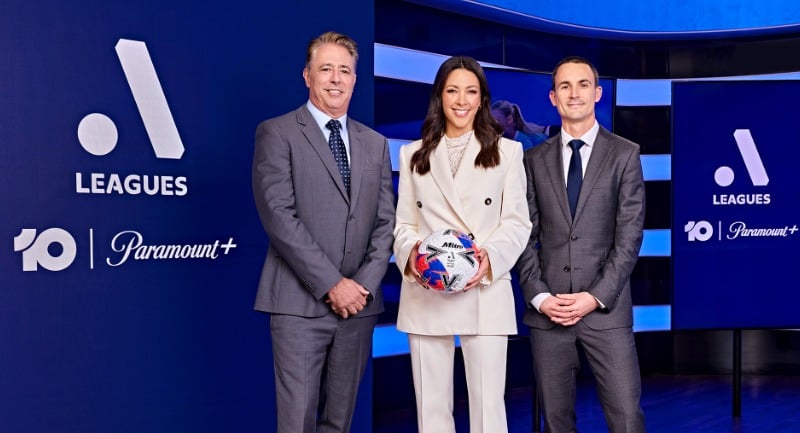
Main image: Steve Rosich (CEO APL) Tara Rushton, Adam Cush (Director of Sport, Paramount ANZ)
Elon Musk’s X fined $650k in Australian child safety battle
X Corp has been fined $650,000 after failing to fully comply with an eSafety transparency notice seeking information about how it was addressing child sexual exploitation and abuse material on its platform.
The Federal Court penalty follows a three-year legal process involving the social media platform, formerly known as Twitter, and Australia’s online safety regulator.
Justice Michael Wheelahan said reporting requirements under Australia’s Online Safety Act were an essential part of enforcement.
“Where the operator of a large social media platform has failed to comply with those reporting requirements, the public has an interest in the commissioner seeking and obtaining a public declaration of contravention, which will contribute to a deterrent effect,” he said.
Justice Wheelahan said a penalty near the maximum was appropriate for X Corp, describing it as a “substantial corporation”.
“A penalty near the maximum is appropriate in the case of the respondent, which is a substantial corporation so that it operates as a real deterrent and is not simply a cost of doing business,” he said.
eSafety says transparency is critical
The case centred on a transparency notice issued by eSafety in early 2023. The notice sought information about steps the platform was taking to comply with the Australian Basic Online Safety Expectations.
Julie Inman Grant, eSafety Commissioner, said transparency was central to holding technology companies accountable.
“Meaningful transparency is critical to holding technology companies to account,” Inman Grant said.
“In early 2023, we asked some of the world’s biggest technology companies, including Twitter, to report on steps they were taking to comply with the Australian Basic Online Safety Expectations in relation to the proliferation of child sexual exploitation and abuse materials on their platforms.
“This is not only a key part of our work as Australia’s online safety regulator, but it also provides the Australian public with important information about how these companies are tackling the worst-of-the-worst content on their platforms.”
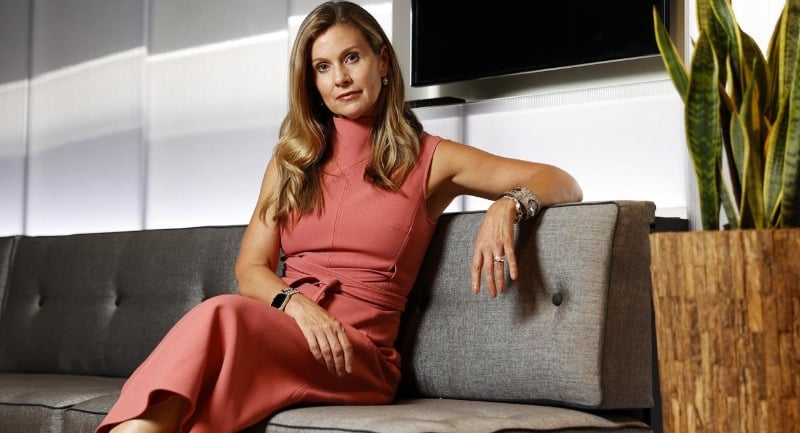
Julie Inman Grant
Legal process followed Twitter’s transition to X
In July last year, the Full Federal Court held that X Corp was required to respond to eSafety’s transparency notice.
That ruling followed X Corp’s earlier appeal of the Federal Court’s October 2024 decision, which found the company was required to comply with the notice issued to Twitter in February 2023.
Twitter merged into X Corp in March 2023, after Elon Musk’s acquisition of the platform.
The penalty reinforces that technology companies offering services in Australia must comply with local online safety regulations.
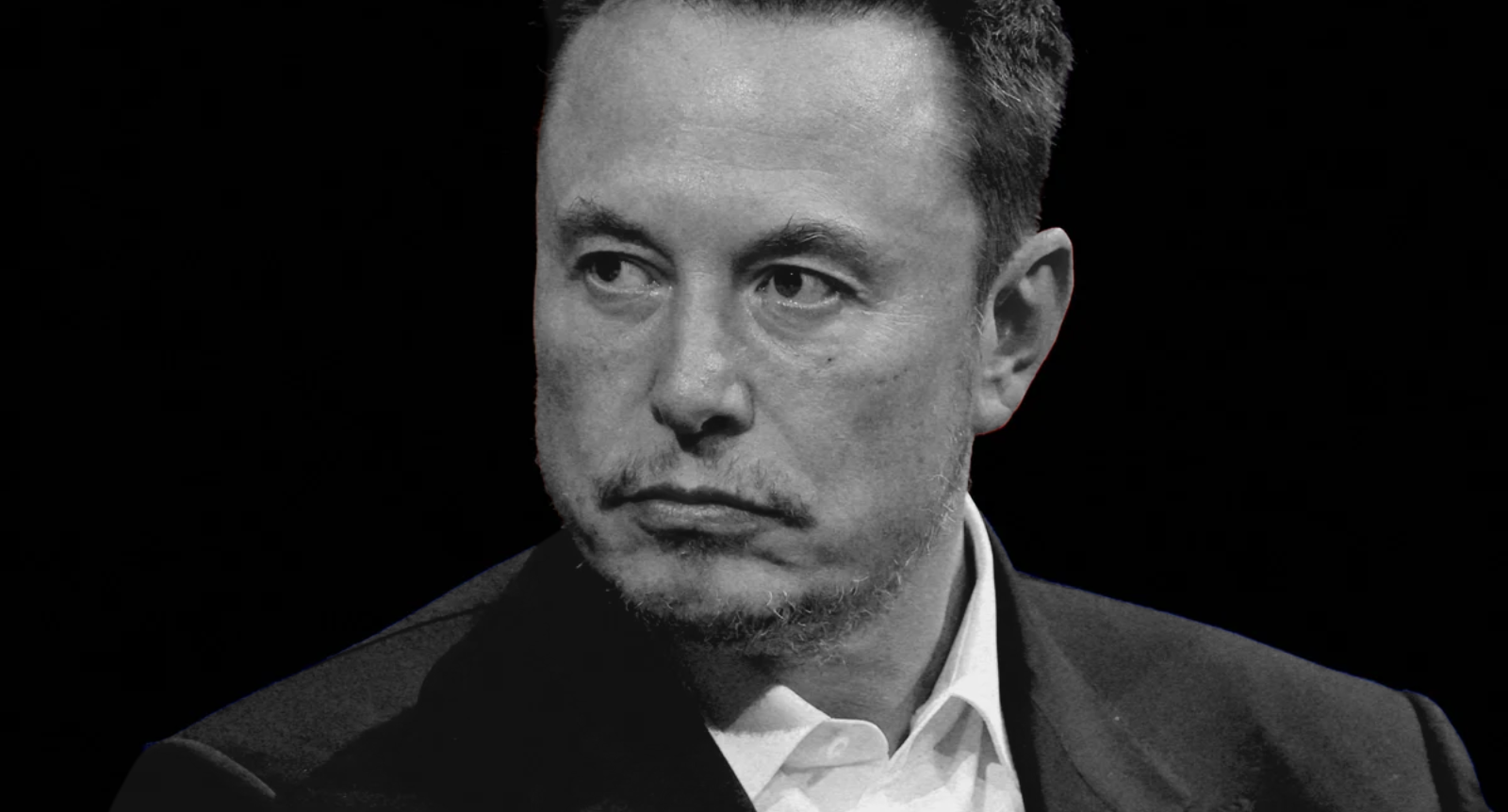
Main image: Elon Musk

Cost-of-living crunch sends Australians bargain-hunting online
Cost-of-living pressures drove Australians online in April, with new Ipsos iris data showing audience growth for insurance, grocery, rewards and cashback brands.
The data found Australians were searching for cheaper services and better value across several everyday spending categories, including insurance, groceries, utilities and rewards programs.
What did Australians search for in April?
Budget Direct recorded one of the strongest month-on-month gains. Its audience rose by 33.3 per cent, from 1.1 million to 1.49 million, as consumers sought cheaper car and home insurance options.
Coles Group also grew its online audience, rising from 11.2 million to 12 million in April. Ipsos said users were spending longer online as they planned their weekly grocery shop.
Comparison site Canstar recorded year-on-year audience growth of 40.6 per cent, increasing from 1.29 million to 1.85 million.
Rewards and cashback sites grow
Everyday Rewards reached its highest audience on record, up 15.8 per cent year-on-year from 10.1 million to 11.7 million.
Rewards programs, coupon websites and cashback apps were especially popular with younger audiences. People aged 18 to 39 made up 40 per cent of the Everyday Rewards audience, compared to 11 per cent for Australians aged over 65.
ShopBack also saw strong growth, with its audience increasing 41.9 per cent year-on-year from 4.4 million to 6.3 million.
OzBargain’s audience grew 21.6 per cent year-on-year, from 1.7 million to 2.1 million. Audiences aged 18 to 39 made up 40 per cent of ShopBack’s audience and nearly 51 per cent of OzBargain’s audience.
The findings align with Ipsos’ latest Issues Monitor, which found cost of living remained the top concern for Australians. The monitor found 63 per cent of respondents named it as their number one worry.
News websites reach 21.5 million Australians
Ipsos iris data also showed 21.5 million people used a news website or app in April. That represented 95.4 per cent of online Australians aged 14 and over.
Major stories driving online news engagement included ANZAC Day services, the arrest of decorated veteran Ben Roberts-Smith on suspicion of war crimes, and the ongoing fuel crisis in the Middle East.
Other high-interest topics included NRL and AFL updates, the alleged murder of a five-year-old Indigenous girl in Alice Springs, and the Geelong oil refinery fire.
The top news brands by online audience in April were ABC News, news.com.au, nine.com.au, The Guardian Australia and 7news.com.au, according to the ranking report included in the release.
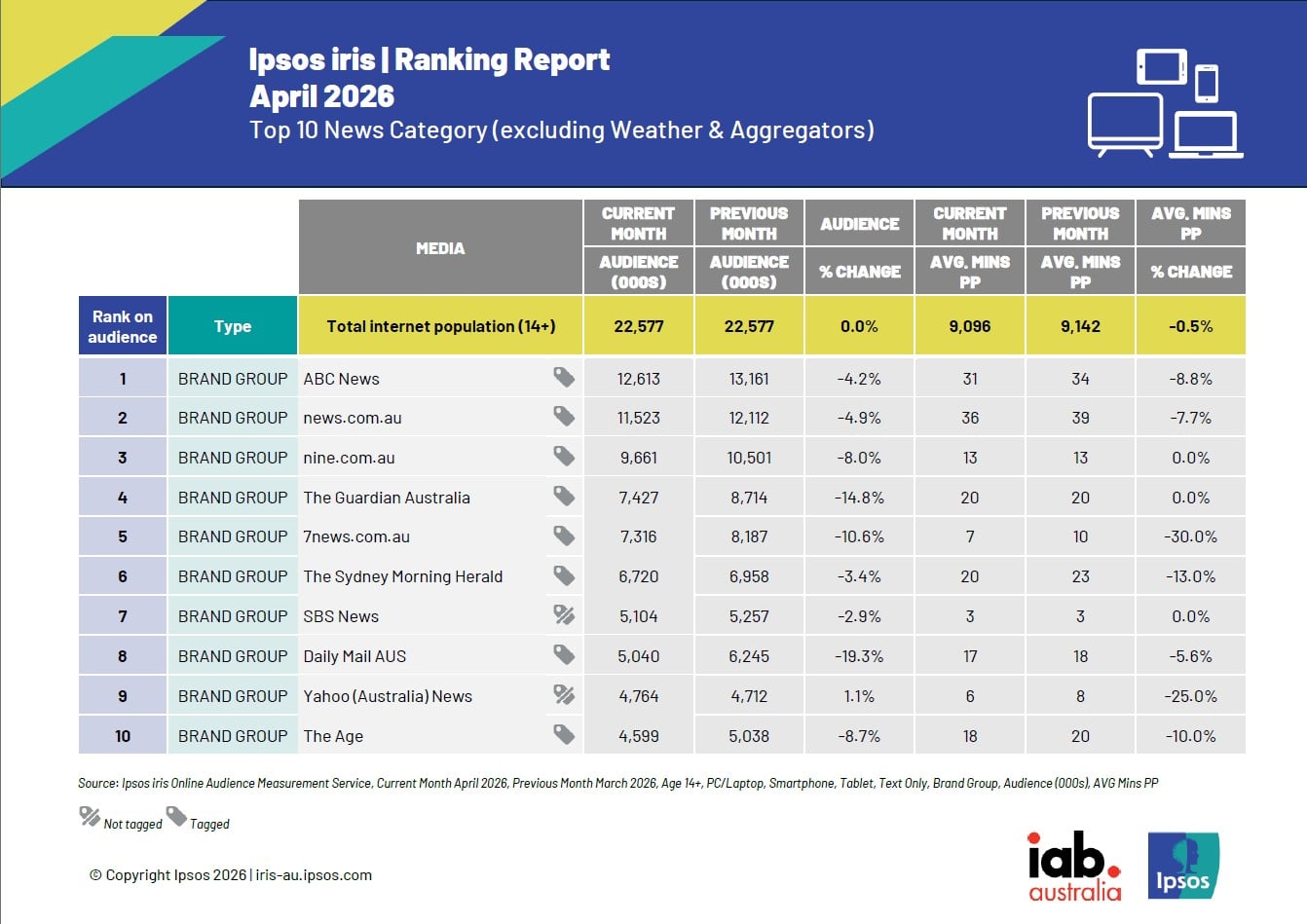
ipsos iris news ranking, April 2026
Career category records strongest growth
The career category recorded the strongest year-on-year audience growth for the second consecutive month, up 9.8 per cent.
It was followed by automotive, up 7.2 per cent, homes and property, up 4.4 per cent, energy suppliers and utilities, up 3.4 per cent, and entertainment, up 2.9 per cent.
Ipsos iris, endorsed by IAB Australia as Australia’s digital audience measurement currency, found 22.57 million Australians aged 14 and over used the internet in April.
That figure was up 2 per cent year-on-year. Australians spent an average of five hours a day online, up 2.6 per cent compared to the same period last year.
The most consumed online categories in April were social networking, online media, search engines, technology and entertainment.
Ipsos iris measures digital audiences across smartphones, PCs, laptops and tablets. Its methodology combines a single-source passive panel with site-centric census measurement through media-owner tagging.
Main image: Image by wayhomestudio on Magnific
EXCLUSIVE: How CMOs can maximise SEO even as AI rewires search
Surprise: SEO is not dead. It is just getting a much bigger and different role.
As brands invest in AI-led search, whether through GEO, LLMs or other emerging discovery channels, C-suite executives and CMOs are turning their attention back to SEO.
But Edge Marketing’s Luke Gosha believes the fundamentals have not changed.
In this exclusive interview, Mediaweek sat down with Gosha, Head of Search and AI Strategy at Edge Marketing, ahead of his appearance at Athens SEO 2026 – The International Tech SEO & AI Conference, to unpack the biggest shifts in how brands are thinking about AI-led search.
He said brands need to “understand how they can appear in AI.” The answer, he argued, comes down to where SEO now sits inside a business.
“What has happened over time is that the role of SEO has been very technically focused,” Gosha said.
While SEO remains a highly technical channel and is closely aligned with development teams, Gosha said AI search is forcing brands to view it as part of a broader marketing and brand strategy.
“It is really important that the role of SEO sits across multiple different channels,” he said.
“What happens on social media is also part of how sentiment is understood around a brand, and how brand sentiment is understood by machines.”
Is SEO dead?
The phrase “SEO is dead” has followed the industry through several rounds of headlines and technological changes. Gosha believes people who think that are “foolish” and “short-sighted.”
He said the role of SEO has evolved and is now “multifaceted.”
“The role of SEO has always been search first,” he said. “People have associated that with just Google, and that has made sense, but search is very multifaceted.”
While Google remains central, consumers are now discovering brands across social platforms, LLMs, traditional search engines, forums and review sites. For Gosha, that means SEO can no longer be treated as a Google-only function.
He said LLMs also rely on live search signals when retrieving real-time information, meaning brands still need to think carefully about how they perform in search.
“Rank is used to retrieve information from a live search index, so it absolutely still matters how you are performing in search.”
The agency and in-house balance
The UK vs. the Aussie market
Gosha joined the Gold Coast-based indie following a tenure at London-based brand and performance agency StrategiQ, where he served as Head of Search and AI.
Asked what differences stood out in the Australian market, Gosha said some clients still view SEO as either something they build in-house or outsource to an agency.
He argued the strongest model is when both “coexist together.” Gosha said the European market has been built on that model, in which in-house teams excel at relationships.
“You have a stakeholder who is ingrained in the business, and then you have an agency with strategic insight and expertise.”
That, Gosha said, is “very powerful” when those two come together.
But trust remains a sticking point. Gosha said some brands have previously worked with providers that focused on short-term uplift rather than long-term strategy, including offshored work or black-hat SEO tactics.
For him, the better approach starts with business goals built around critical questions: what the brand’s strategic ambitions are and where it sees itself in 12 or 24 months.
“When clients are thinking about SEO, it is really important they think about who they are partnering with and think more around strategy.”
AI exposed siloed teams
Gosha said AI has exposed how siloed SEO has become. While technical SEO remains important, brands now need to think about search as part of a broader marketing ecosystem.
“The key thing for brands to think about is ensuring that SEO is still grounded in technical fundamentals,” he said.
“But CMOs should absolutely be thinking about SEO as an integrated channel and leaning more into how the brand is showing up on social media.”
That shift matters because AI-led search is shaped by more than website performance.
Gosha said platforms such as Reddit, Quora and review sites are increasingly important because they help LLMs understand brand sentiment.
The role of SEO, then, is not just to optimise pages but to help brands understand how they are being discussed across the customer journey.
From “the first touchpoint of a brand all the way through to loyalty,” he explained.
That, he said, gives brands a clearer view of where customer experience issues may be surfacing, especially when negative sentiment begins appearing in online communities.
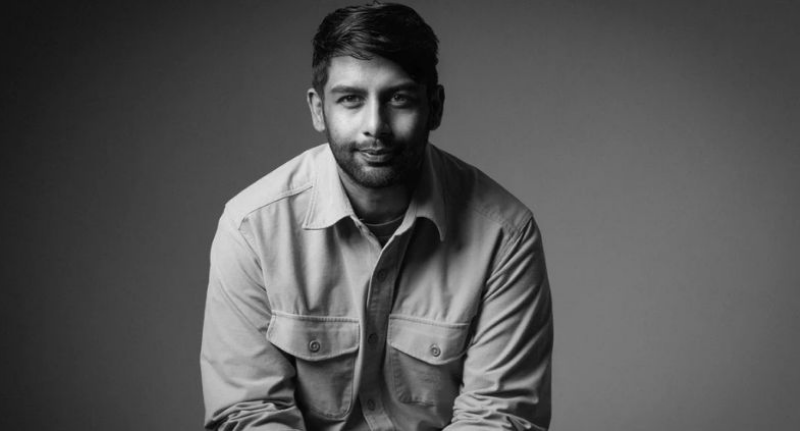
Main Image: Luke Gosha
Think HQ taps former Dentsu leader as Chief Operating Officer
Independent positive change agency Think HQ has appointed Victoria Gehrig as Chief Operating Officer.
Gehrig joins the agency’s national leadership team, bringing experience across agency operations, scaling businesses and M&A integration. She returns to the Australian market after six years in the United States, where she served as Global M&A Integration Director at dentsu.
During her time at dentsu, Gehrig led acquisition activity from due diligence through to integration across large-scale, multi-market acquisitions.
Before dentsu, Gehrig spent more than a decade at Isobar Australia, eventually becoming Group General Manager.
During that period, she helped scale the business from a 20-person digital agency into a 350-plus-person operation across four national offices, winning multiple ANZ Digital Agency of the Year awards.
In her new role, Gehrig will work with Think HQ Founder and Managing Director Jen Sharpe to strengthen the agency’s operational foundation across Melbourne and Sydney.
Think HQ on the appointment
Sharpe said Gehrig’s experience made her a strong fit for the agency’s next phase.
“Vic has scaled agencies, integrated businesses and delivered at a global scale- and that’s exactly what we need for Think HQ’s continuing growth.
“This kind of experience is rare, which made asking Vic to join the team a no-brainer.”
Gehrig on joining Think HQ
Gehrig said she is focused on helping the agency grow without losing what makes it distinctive.
“Jen has built Think HQ into something truly unique in the agency landscape, and I’m excited to help her scale at pace.”
The appointment follows a period of growth for Think HQ, which has expanded to 120 people nationally, opened a new Sydney office and grown its client base across government, corporate and for-purpose sectors. Gehrig is based in Melbourne and has commenced in the role.
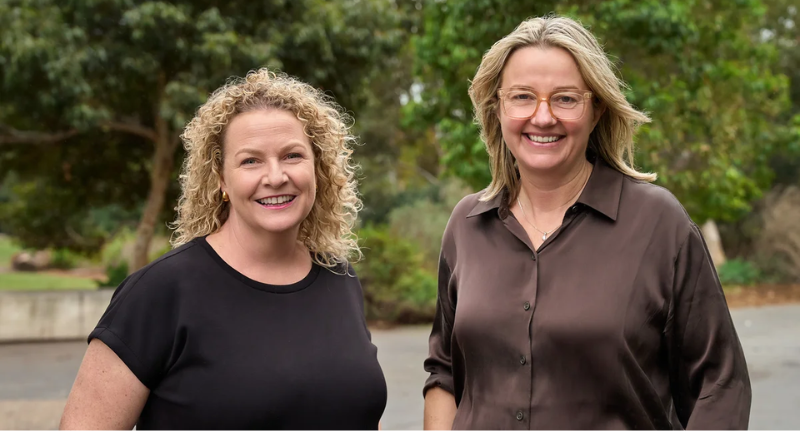
Top image: L to R – Victoria Gehrig and Jen Sharpe
Spotify to monetise AI-generated covers in Universal partnership
Spotify and Universal Music Group have locked in a licensing deal that will allow subscribers to generate song covers and remixes using artificial intelligence (AI).
The contract marks the first time Spotify will allow listeners to generate AI-generated content through its platform. As per The Guardian, the tool is expected to launch as a paid add-on in the Spotify app, allowing Premium users to remix songs by participating artists and create licensed AI-driven covers.
Spotify said the feature could create an additional revenue stream for artists and songwriters, in addition to the royalties they already receive.
This partnership coincides with Spotify’s latest internet scrutiny; they recently replaced their iconic logo with a shimmering dark green 3D disco ball as part of the platform’s 20th-anniversary celebration. The move invited heavy backlash, with some even questioning whether it violated the brand identity.
Consent, credit and compensation
Spotify co-chief executive Alex Norström said the tool is being built with artist protections in mind.
“Solving hard problems for music is what Spotify does, and fan-made covers and remixes are next,” Norström said. “What we’re building is grounded in consent, credit and compensation for the artists and songwriters that take part.”
The financial terms of the deal have not been disclosed, and the companies have not revealed which artists will participate.
Universal Music is home to artists including Taylor Swift, Ariana Grande and Billie Eilish.
Universal Music backs the move
Universal Music Group CEO Lucian Grainge said the deal is designed to support human artists while opening new revenue possibilities.
“Building on our long track record of leading the industry through technology changes, and collaborating with Alex, Gustav, Daniel and the team at Spotify, this initiative is firmly artist-centric, rooted in responsible AI, and will drive growth for the entire ecosystem,” Grainge said.
AI becomes Spotify’s next frontier
The deal arrives as Spotify seeks new ways to expand beyond traditional music subscriptions and incorporate AI into its ecosystem.
Earlier this month, Spotify announced a beta feature allowing AI agents to save and play “personal podcasts”, offering users a private daily briefing. The company has also rolled out a Verified by Spotify badge to help users distinguish between human artists and AI-generated content.
Spotify said the badge, marked with a green checkmark, will appear on artist profiles and in search results.
“In the AI era, it’s more important than ever to be able to trust the authenticity of the music you listen to,” the company said.
Top image: Spotify
Children’s publishing dominates as ABIAs crown 2026 winners
Children’s literature dominated the 2026 Australian Book Industry Awards, with Zeno Sworder’s Once I was a Giant taking out the night’s top honour, Book of the Year, at the annual ceremony in Sydney.
Books+Publishing and the Australian Publishers Association announced the winners at The Grounds of Alexandria on Thursday night, with writer and media personality Benjamin Law hosting the event.
Now in its 26th year, the Australian Book Industry Awards recognises excellence across Australian publishing, with more than 50 judges from publishing, bookselling, media and library sectors selecting winners across fiction, non-fiction, children’s and industry categories.
Children’s titles lead the night
Sworder’s illustrated picture book also won Children’s Picture Book of the Year, with the awards spotlighting a strong year for children’s publishing.
The Hall of Fame honours also focused on figures in children’s literature, with author and former bookseller Paul Macdonald receiving the Pixie O’Harris Award and acclaimed Australian author Mem Fox receiving the Lloyd O’Neil Award for outstanding service to the Australian book industry.
Macdonald said he was “thrilled, honoured and humbled to be awarded the 2026 Pixie O’Harris Award. I am absolutely in awe of the list of prestigious past winners.”

Zeno Sworder, whose book ‘Once I was a Giant’ won Book of the Year
Sally Hepworth and Charlotte McConaghy among major winners
In the adult categories, Sally Hepworth won both General Fiction Book of the Year and Audiobook of the Year for Mad Mabel.
Geraldine Brooks took out Biography Book of the Year for Memorial Days, while The Mushroom Tapes by Helen Garner, Chloe Hooper and Sarah Krasnostein won General Non-fiction Book of the Year.
Charlotte McConaghy won Literary Fiction Book of the Year for Wild Dark Shore, while Angie Faye Martin received The Matt Richell Award for New Writer of the Year for Melaleuca.
The Social Impact Book of the Year award went to A Piece of Red Cloth by Leonie Norrington, Merrkiyawuy Ganambarr-Stubbs, Djawa Burarrwanga and Djawundil Maymuru.
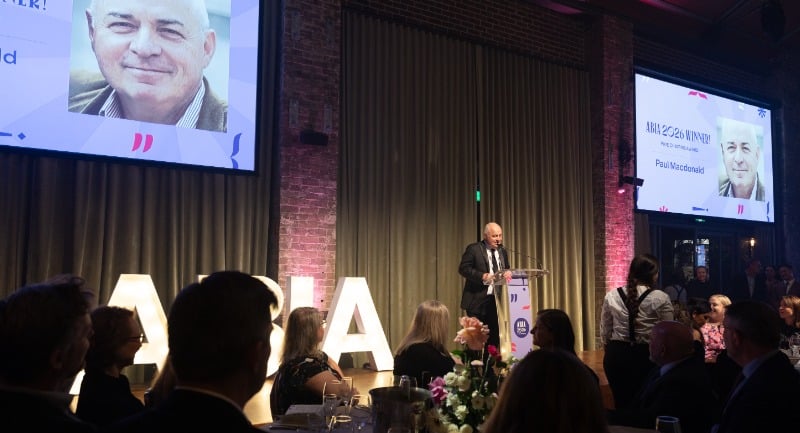
Former bookseller Paul Macdonald receiving the Pixie O’Harris Award
Publishing industry recognised
Among the industry awards, Penguin Random House Australia was named Publisher of the Year, while Magabala Books won both Small Publisher of the Year and Children’s Publisher of the Year.
Gleebooks Dulwich Hill won Bookshop of the Year, Readings was named Book Retailer of the Year, and BIG W took out Multicategory Retailer of the Year.
Judging chair Michaela Kalowski said, “It was inspiring and exciting to see the range of themes in the books that were ABIA finalists this year. They speak to the richness of the Australian publishing industry and the talent & dedication of authors, publishers and the teams who brought these books to readers.”
She added: “The Judges brought nuance, depth of industry experience and great thought to deciding on the winning books in each category.”
Full list of winners
Book of the Year
Once I was a Giant – Zeno Sworder (Thames & Hudson Australia)
Audiobook of the Year
Mad Mabel – Sally Hepworth; narrated by Hannah Fredericksen and Jenny Seedsman (Macmillan Australia Audio, Pan Macmillan Australia)
Biography Book of the Year
Memorial Days – Geraldine Brooks (Hachette Australia)
Book of the Year for Older Children (ages 13+)
Wandering Wild – Lynette Noni (Penguin, Penguin Random House)
Book of the Year for Younger Children (ages 7–12)
Caution! This Book Contains Deadly Reptiles – Corey Tutt, illustrated by Ben Williams (Allen & Unwin)
Children’s Picture Book of the Year (ages 0–6)
Once I was a Giant – Zeno Sworder (Thames & Hudson Australia)
General Fiction Book of the Year
Mad Mabel – Sally Hepworth (Macmillan, Pan Macmillan Australia)
General Non-fiction Book of the Year
The Mushroom Tapes – Helen Garner, Chloe Hooper and Sarah Krasnostein (Text Publishing)
Illustrated Book of the Year
The Art of Kaylene Whiskey: Do you believe in love? – Kaylene Whiskey and Natalie King (Thames & Hudson)
International Book of the Year
Heart the Lover – Lily King (Canongate)
Literary Fiction Book of the Year
Wild Dark Shore – Charlotte McConaghy (Penguin, Penguin Random House Australia)
Small Publishers’ Adult Book of the Year
The Rot – Evelyn Araluen (University of Queensland Press)
Small Publishers’ Children’s Book of the Year
Sundays Under the Lemon Tree – Julia Busuttil Nishimura, illustrated by Myo Yim (Scribble, Scribe)
Social Impact Book of the Year
A Piece of Red Cloth – Leonie Norrington, Merrkiyawuy Ganambarr-Stubbs, Djawa Burarrwanga and Djawundil Maymuru (Allen & Unwin)
The Matt Richell Award for New Writer of the Year
Melaleuca – Angie Faye Martin (HQ, HarperCollins Publishers)
Industry award winners
Lloyd O’Neil Award – Mem Fox
Pixie O’Harris Award – Paul Macdonald
Bookshop of the Year – Gleebooks Dulwich Hill
Book Retailer of the Year – Readings
Multicategory Retailer of the Year – BIG W
Commissioning Editor/Publisher of the Year – Vanessa Radnidge (Hachette Australia)
Marketing/Publicity Campaign of the Year – Cherry Lam Colouring Book Series (Penguin Random House Australia)
Publisher of the Year – Penguin Random House Australia
Small Publisher of the Year – Magabala Books
Children’s Publisher of the Year – Magabala Books
What the runway really tells us: AFW 2026 and the new consumer
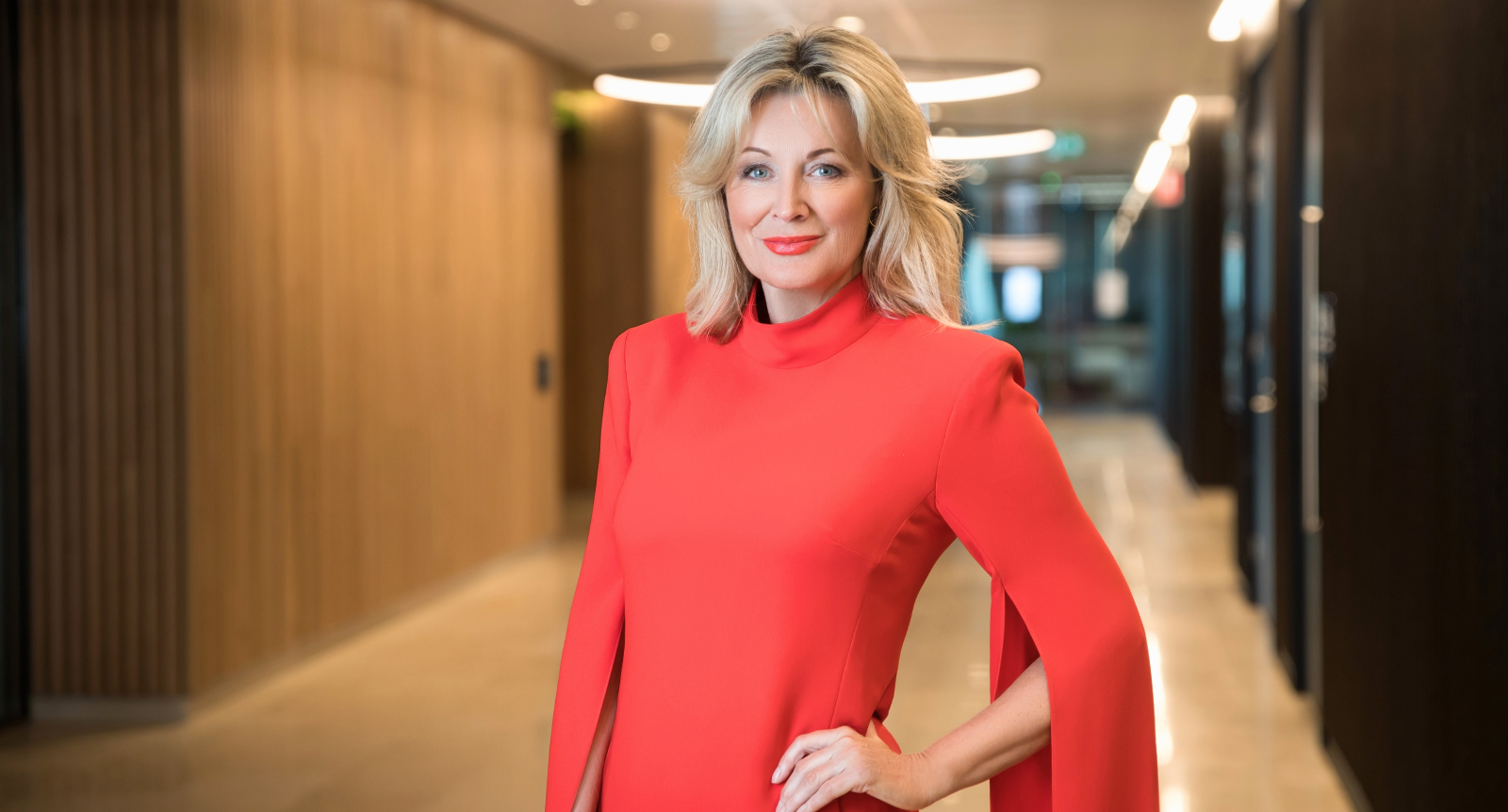
By Sharon Williams OAM, founder and CEO of Taurus Marketing.
Australian Fashion Week wrapped at the Museum of Contemporary Arts last Friday, and the fashion world is busy dissecting hemlines, silhouettes and standout shows.
However, if you’re a marketer, brand strategist or a business leader watching from the outside, what just happened on those runways tells you something far more useful than what Australians will be wearing this winter.
It tells you exactly who your customer has become.
I’ve spent over 30 years working with brands and different audiences and I still see Fashion Week as one of the clearest indicators of what people care about in a given moment. Not because fashion sets trends but because it reflects them.
The themes that emerge each season often reveal changing consumer tastes, values and spending habits. It gives brands a real-time snapshot of where consumer sentiment is heading.
What did AFW 2026 tell us?
Consumers are craving authenticity over performance
One of the clearest themes across this year’s AFW, from Toni Maticevski‘s sculptural return to the bold cultural commentary of Jordan Gogos, was a move back toward personal style and self-expression. As Paper Mache Mag wrote ahead of the event: “This season is not about what is trending. It is about what feels right.”
That shift matters well beyond fashion. Over the past five years, social media has heavily shaped consumer behaviour. Consumers buy products because they see them constantly online or influencers promote them, they follow trends driven by algorithms and make purchasing decisions with visibility in mind.
That behaviour still exists, but consumers now more easily distinguish the genuine from the manufactured. In other words, the consumer is increasingly allergic to inauthenticity and can smell it from a mile away.
Experience has overtaken product
The decision to move AFW to the Museum of Contemporary Art was not just a venue change. It made a statement about the growing importance of the customer experience and how consumers engage with brands in 2026. After 15 years at Carriageworks, the MCA brought a new atmosphere and cultural weight to the event.
The venue was part of the story. The feeling was the product.
This is what consumers pay for now. The product still matters but the experience matters more than many brands tend to realise. Consumers buy into an identity, feeling and lifestyle as much as functionality and aesthetics. Brands and marketers who continue to focus on features, pricing or specifications risk the opportunity to build connection, consumer loyalty and longevity.
Sustainability is no longer a value-add. It’s an expectation
This year’s AFR strategy focused on building a long-term global presence and supporting the sustainable growth of the Australian fashion industry. The collections themselves already showed this philosophy.
A noticeable shift to conscious consumerism emerged, as designers favoured craftsmanship and longevity over quantity and “fast fashion” trend cycles.
For brands, the message is clear: sustainability is no longer a surface-level “greenwashing” tactic you use to make yourself look responsible. Consumers increasingly look for proof and expect brands to reflect sustainability in their decisions, operations and values.
In fact, today’s consumer can separate genuine commitment from performative responsibility and often asks themselves the question: “Does this brand share my values before I even look at what they’re selling?”
Digital has changed, but not in the way most brands think
Australian retail data points to AR and VR adoption growth and AI-driven recommendations as growing influencers of purchase decisions. With nearly half of apparel sales now occurring across digital channels, such as social media, the online experience is no longer secondary to the in-store one.
However, the mistake some brands make is treating digital as a distribution channel rather than a brand and relationship-building channel. The consumer expects online experiences to reflect the in-person experience, engaging and emotive, rather than transactional.
The most powerful thing AFW 2026 demonstrated beyond any individual collection is that Australian consumers are more emotionally sophisticated, values-driven and deliberate in the brands they support than ever before. They are not waiting for brands to catch up. They are simply choosing the ones that already have.
The runway is talking, are you listening?
For marketers, the key takeaway from this year’s AFW is how quickly consumer expectations are evolving. Consumers no longer respond to brands that simply market well or feed into “hypes” and “trends”. Today’s consumer expects authenticity, substance and a reflection of their values over surface-level branding alone.
This is what the runway is telling you. The question is whether you’re paying attention.
About Sharon Williams OAM
Sharon Williams OAM, founder and CEO of Taurus Marketing, is a strategic communications leader with a proven track record helping entrepreneurs, high-growth businesses and corporations build powerful brands and reputations.
Williams has led award-winning integrated PR and marketing campaigns across her 30 years in business, underpinned by her proprietary Taurus Bullseye™ methodology and practical “No Bull” approach.
As a recognised thought leader, speaker and media commentator, her expertise spans PR, branding, digital, crisis communications, investor relations, business strategy and entrepreneurship.
Feature image- Sharon Williams OAM: supplied.
Aussie-born The Yard Gym becomes Nike Training’s first global gym partner
Nike Training has announced The Yard Gym as its first official global gym partner.
The partnership will see Nike Training and The Yard Gym team up to create training experiences, activations and community moments designed to inspire more people to train with purpose and consistency.
TYG was founded in Australia in 2020 by husband-and-wife duo Daniel and Tiarne Bova.
What formed as a vision to create a space where people of all ages and fitness levels could train as athletes has unfolded into a global movement built around premium, community-led training.
A global training partnership
TYG is known for its structured approach to strength and endurance workouts, designed to support people at every stage of their fitness journey.
Chloe Speed, VP/GM, Nike Training, said the partnership brings together Nike’s performance expertise and TYG’s approach to community and programming.
“By combining Nike’s expertise in performance innovation with TYG’s industry leading approach to community and programming, we’ll help more athletes push the limits of what’s possible and raise the bar of training globally.”
Nike Training will become the exclusive provider of footwear, apparel and accessories for all TYG trainers and team members. The products have been selected to meet the functional and performance needs of TYG’s coaches and instructors.
Training with purpose
Nike products and branding will be incorporated into existing and future TYG gyms as part of the partnership.
Daniel Bova, Co-Founder and CEO of The Yard Gym, said the two brands share a focus on consistency and progress.
“It’s about showing up and putting in the work, every single day. We share the same obsession: building stronger, better humans in and out of the gym.”
The partnership will see Nike Training and TYG work together on new training experiences and community activations, with a shared focus on innovation, progress and helping athletes train on their own terms.
Main Image: Nike Training X TYG