


Australia’s digital advertising and ad tech sector is facing pressure on its future talent pipeline, as AI changes day-to-day work and employers prioritise more experienced, commercially minded staff.
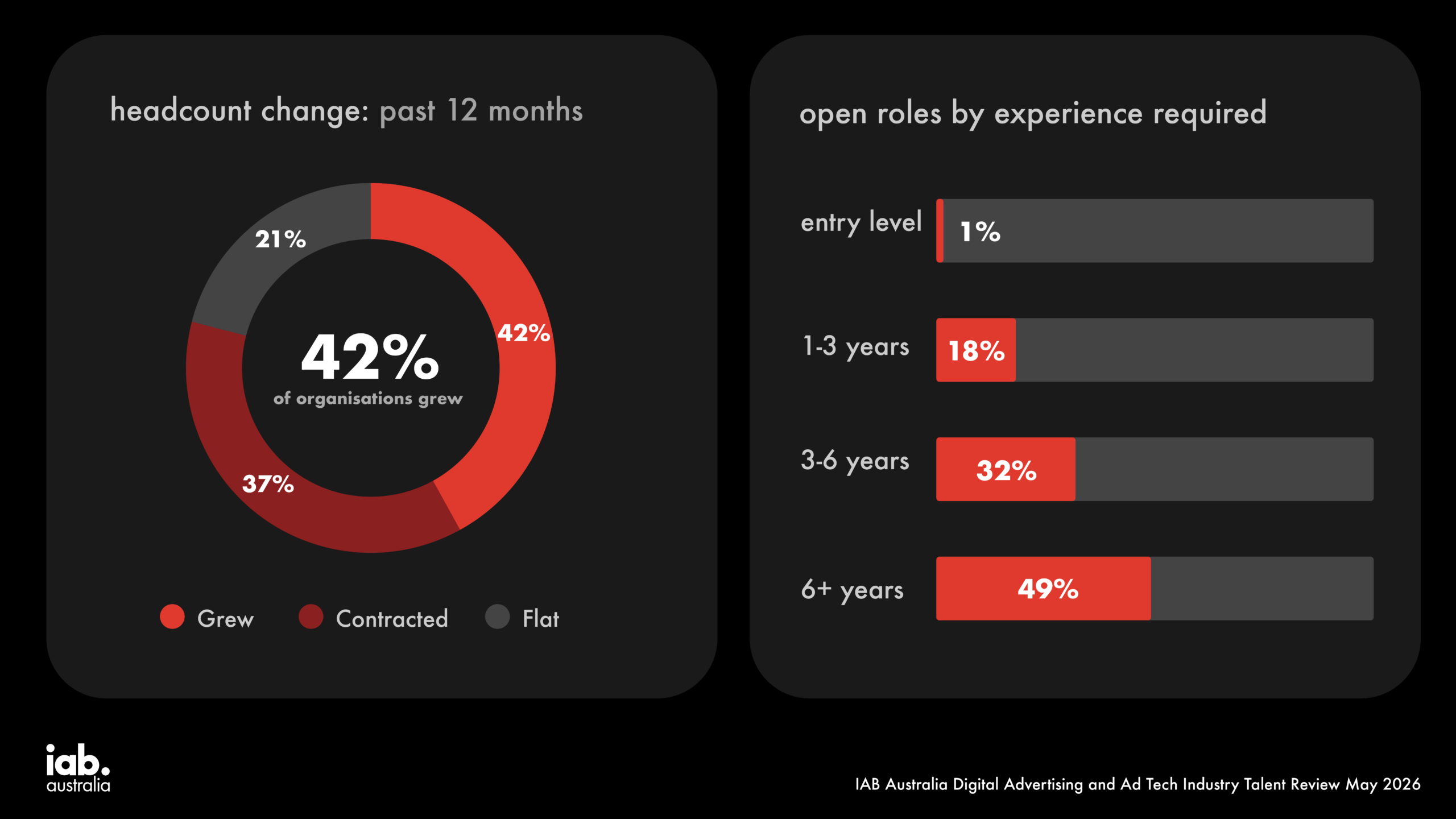
The findings come from IAB Australia’s 2026 Digital Advertising and Ad Tech Industry Talent Review, which shows entry-level roles have almost disappeared from the available vacancy pool, falling to just 1 per cent of vacancies.
At the same time, 49 per cent of open roles now require more than six years’ experience. The Review points to a market still investing in talent, but doing so more selectively.
What is happening to digital advertising jobs?
The Review found the industry is not moving in one direction. Over the past year, 42 per cent of organisations reported headcount growth, 37 per cent contracted and 21 per cent remained flat.
Growth is being led by locally headquartered technology companies, emerging ad tech firms and global businesses still building their Australian presence. Contraction is more concentrated among larger, established global platforms responding to AI-driven efficiency programs and global restructuring.
The industry vacancy rate has fallen to 2.4 per cent, the lowest level since tracking began. Only 40 per cent of companies reported having any open roles.
AI shifts expectations for talent
AI is delivering productivity gains across the sector, but the impact is being felt most sharply in junior and process-driven roles. Those roles have traditionally helped develop the next generation of media and advertising talent.
Employers are now placing a higher premium on candidates who can combine AI fluency with commercial judgement, strategic thinking and client leadership.
Gai Le Roy, CEO of IAB Australia, said the Review highlights a structural workforce issue that needs an industry-wide response.
“If the industry wants to maintain a strong Australian media and advertising market, it cannot focus only on short-term efficiency. Continued investment in people, leadership capability and future talent pipelines will be critical.
“AI capability is rapidly becoming a baseline expectation across most parts of the market. But the findings also make it clear that technical skills alone are not enough. The capability gaps employers are struggling with most are strategic thinking, commercial acumen, leadership and the ability to work with clients and businesses in more sophisticated ways as the market becomes more complex.
“This is an area where the industry needs to work together. Employers, industry bodies and education providers all have a role to play in ensuring Australia continues to develop the depth of talent and expertise the market depends on.”

Gai Le Roy
Hiring remains cautious
The Review found 23 per cent of organisations expect to increase hiring over the next six months. Almost half (49 per cent) expect staffing levels to stay the same, while 28 per cent expect a decrease.
Commercial roles continue to dominate the sector, with 50 per cent of the workforce employed in sales and client service roles. The Review said this reflects the commercial structure of Australia’s digital advertising and ad tech market.
The workforce also remains heavily concentrated in NSW, which accounts for 76 per cent of roles. Victoria accounts for 19 per cent, Queensland for three per cent, and South Australia and Western Australia for one per cent each.
Salary, offshoring and regional remits
Salary increases have moderated, with the average increase over the past year sitting at 3.5 per cent. The most common increase was three per cent.
Offshoring also continues to rise. A quarter of companies reported an increase in offshoring over the past 12 months, while 15 per cent reported increased use of contractors.
Australian-based teams are also carrying broader regional workloads. Around 47 per cent of Australian-based roles also cover New Zealand, while about 31 per cent cover APAC.
Gender and age representation
The Review found gender representation is close to parity overall, with the workforce 46 per cent female and 54 per cent male. However, representation varies significantly by role.
Female representation is strongest in marketing and research or analytics roles, but remains low in technology and engineering.
The workforce is also concentrated in mid-career age groups. Around 88 per cent of workers are aged between 25 and 49, while under-25s account for 7.5 per cent and workers aged 50 and over account for 5.3 per cent.
Industry calls to action
The report outlines four calls to action for the sector:
- Individuals should invest in AI fluency, while also building strategic thinking, storytelling and commercial acumen.
- Hiring managers should widen the talent lens and consider candidates from adjacent industries.
- Organisations should build graduate and internship pipelines before the entry-level shortage deepens.
- The industry should advocate for more Australian-based training pathways in measurement, AI and digital advertising capability.
IAB Australia said it will use the findings to inform its industry training, mentoring, research and capability-building programs across AI, measurement, privacy, leadership and digital advertising fundamentals.
First conducted in 2021, the annual Digital Advertising and Ad Tech Industry Talent Review was created to address a gap in available workforce data for Australia’s digital advertising industry. The 2026 Review is based on data gathered from 54 ad tech and media owner organisations in May 2026.