



Women 45+ hold the purse strings - but brands are still missing the signal
Brands chasing reach, virality and creator hype may be overlooking credibility.

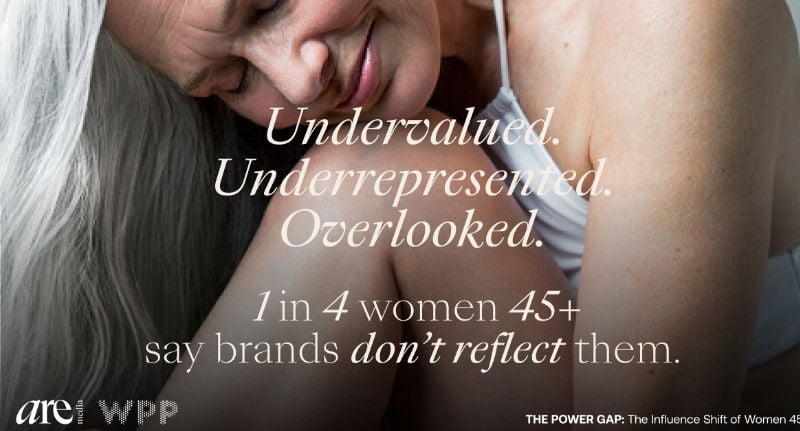
More than one in four Australian women aged 45+ say brands don’t represent them, despite controlling billions in spending, according to new research from WPP Media and Are Media that challenges how influence is typically measured in today’s social-first marketing landscape.
It’s a curious disconnect at a moment when women over 45, think Gwyneth Paltrow, Jennifer Lopez, Jennifer Aniston and Angelina Jolie, remain some of the most recognisable and influential cultural figures on the planet.
Unveiled at the AIMCO Creator Summit, The Power Gap study suggests brands chasing reach, virality and creator hype may be overlooking credibility, the factor most likely to drive conversion among one of Australia’s most commercially powerful consumer cohorts.
The numbers alone are difficult to ignore.
Australia is home to 4.8 million women aged 45+, many at the peak of their earning power and household influence.
In beauty alone, this audience spent an average of $2.8 billion on health and beauty products in the past four weeks - accounting for 34% of total national category spend, more than Gen Z and Gen Y combined, according to Roy Morgan Single Source September 2025.
Yet despite that economic clout, many feel invisible.


The leading media trade publication in Australia.
Get our top stories straight to your inbox daily by signing up to our Newsletter
By providing your information, you agree to our Terms of Use and our Privacy Policy. We use vendors that may also process your information to help provide our services.
More than a quarter of women aged 45+ surveyed said they do not feel represented by major brands across advertising, packaging and communications, rising to nearly one in three among the largest segment of the audience.
For Natalie Bettini, Head of Consumer Data & Insights at Are Media, that disconnect between influence and recognition is precisely where the opportunity lies.
“Women over 45 have always been central to household and discretionary spending, but what’s changed is their visibility and their voice,” Bettini told Mediaweek.
“Clearly, as the research highlighted, we still have work to do as an industry to reflect her authentically. The research is pretty detailed on this, with more than one in four women 45+ saying they don’t feel represented by major brands, despite being Australia’s most economically powerful female cohort. That gap between influence and recognition is what’s really driving the shift we’re seeing now.”
A $2.8 billion beauty signal
The spending signal is particularly stark in beauty.
According to the study, women 45+ now account for more than a third of all national beauty and personal care expenditure.
But the research suggests marketers may be misunderstanding how influence actually works for this audience.
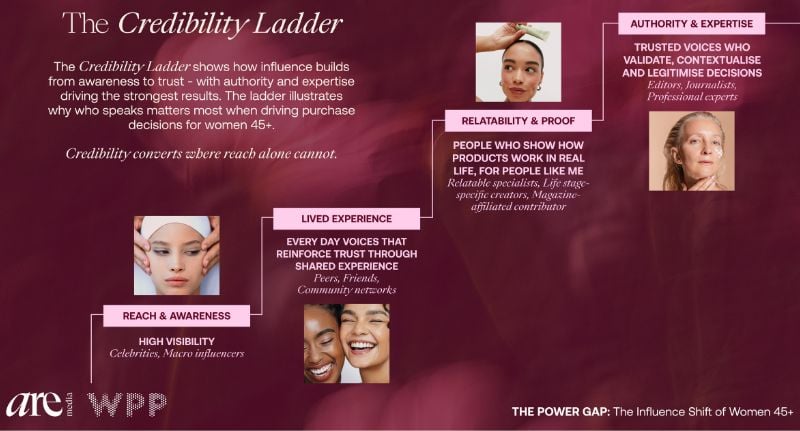
The national quantitative study of 1,067 women aged 18+ found that women 45+ operate within a layered ecosystem of influence, built on expertise, trust, and validation across multiple touchpoints rather than on a single viral social interaction.
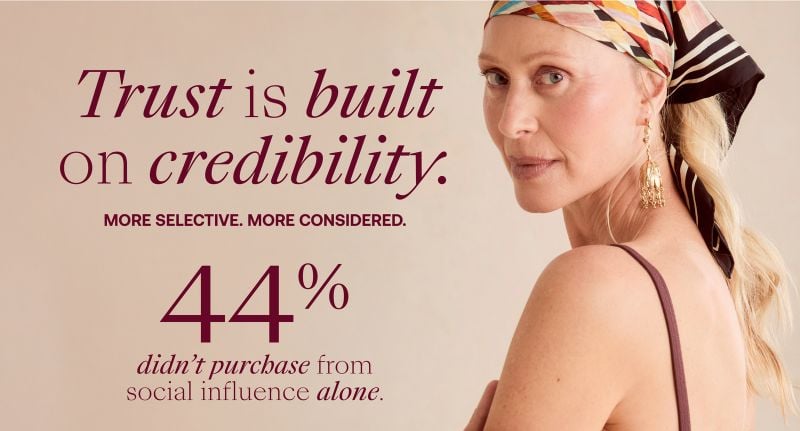
Nearly twice as many women aged 45+ reported not purchasing any beauty or personal care products based on a single social media recommendation in the past six months compared with women aged 18–44 (44% versus 23%).
However, when influence does resonate, credibility becomes the defining factor.
Among women who purchased following recommendations, those aged 45+ were four times more likely than younger women to have also noticed advertising for the product in editorial-driven media (36% versus 9%).
The research found that for beauty enthusiasts aged 45+, the most influential sources include editorial websites, contributions from experts and editors, consumer reviews, and paid advertising.
They were also more likely than younger audiences to follow specialist creators or editors (52% versus 44%), reflecting a preference for depth, expertise and consistency over celebrity-style personalities.
Expertise beats celebrity
For Shivani Maharaj, Chief Creator Officer at WPP, the findings highlight a widening gap between how brands approach creators and how this audience actually engages with influence.
“I disagree,” Maharaj told Mediaweek when asked whether women 45+ had previously been overlooked in advertising.
“A lot of ad dollars go to this audience, especially on TV. What has changed is that audiences have migrated to platforms, and representation (largely) on these channels is driven by younger generations. We need more creators 45+, creating to represent this part of Australia.”
According to Maharaj, the shift is less about spending power suddenly appearing and more about where influence now lives.
Maharaj said the research points to a fundamental shift in how influence works across life stages - and why brands relying on a one-size-fits-all creator strategy risk missing older audiences altogether.
“The people who influence younger generations are very different to those who influence older generations, and a lot of that has to do with life stage,” she said.
While younger audiences often gravitate toward personality-led creators - what the study describes as “generalists” driven largely by social media culture - influence among women 45+ tends to centre on expertise and credibility.
As audiences get older, Maharaj said they are far more likely to trust specialists: people with recognised authority, knowledge and track records in their fields.
That dynamic is reflected in WPP’s own creator data.
“Our WPP Brand AI data, which has 56,000+ creators in Australia, showed us that the people with influence for W45+ are people they grew up with, knowing their expertise and background,” she said.
Those trusted voices often come from established media and publishing environments - figures such as magazine editors, fashion directors, beauty columnists, restaurant critics, broadcasters and television personalities.
The social media blind spot
Maharaj argues the issue is not that brands are ignoring women 45+, but that many misunderstand how to show up on platforms where discovery now happens.
“I don’t think they are ignored by brands,” she said.
“I think there are some mistakes being made on social media, specifically, which is where brands are now discovered. Firstly, they don’t show up at all and think it’s for Gen Z only. Secondly, they show up with the wrong talent, or lastly, they brief it as if it’s an ad.”
The research also found that one in three women aged 45+ follow social accounts to support health goals or issues and to learn new skills, while more than one in four seek travel inspiration.
Bettini says that behaviour reflects a shift in how this audience consumes media and information.
“It’s not that the spending power is new; that’s been clear in the data for a long time,” she said.
“What’s changed is mindset. Women 45+ are far more intentional in how they consume.”
A call for more 45+ creators
One of the clearest implications from the study is the need for better representation within the creator economy itself.
“We need a call to arms for more women 45+ to become creators in our country,” Maharaj said.
“We need more of them in Australia, period. There’s only a finite group of them, and then we need agents to help them build their brands.”
For marketers under pressure to deliver performance, the advice from both organisations is straightforward: credibility and trust must sit at the centre of the influence strategy.
“Push your agency to find them. Use tools and technology. Do the research,” Maharaj said.
“Ask people who are 45+ who they follow and who influences them. You need to show up with them, and you need to show up with the people who influence them (younger people can influence them, too). A woman 45+ reads inauthenticity instantly, so you need to get this right. They are a strong, confident and very vocal group of women.”
Bettini added that brands should reconsider how they define influence in the first place.
“Brands need to rethink what influence looks like for this demographic, and that doesn’t always mean dipping into your usual creator marketing talent pool to brief in your social-first campaign,” she said.
“You need to pinpoint those people with real expertise and credibility, and that layer of trust, more often than not, for women 45+, comes from traditional channels that extend into social media, like publishing.”
In other words, if brands are still chasing hype, they may be missing the most powerful buyers in the room.
More from Mediaweek
The leading media trade publication in Australia.
Get our top stories straight to your inbox daily by signing up to our Newsletter
By providing your information, you agree to our Terms of Use and our Privacy Policy. We use vendors that may also process your information to help provide our services.


