



JCDecaux: Why the $20m MOVE switch is OOH’s best weapon
Following the March 16 hard switch to the new MOVE currency, JCDecaux shares how the fresh data validates OOH.

The Australian Out of Home (OOH) industry has officially crossed the Rubicon.
The mandatory hard switch took place on 16 March. Now, the Outdoor Media Association’s $20 million MOVE platform serves as the sole trading currency for the sector.
The industry has officially left behind the static averages of MOVE 1.5. Instead, the new system models a synthetic audience of 2.2 million Australians. It uses this data to predict the reach of over 180,000 outdoor advertising sites nationwide.
For JCDecaux Co-CEOs Max Eburne and David Watkins, the transition to the new currency provides the ultimate tool to prove the channel’s worth against digital and broadcast rivals.
“The single biggest advantage this gives Out of Home is competitive credibility,” Eburne told Mediaweek. “MOVE allows Out of Home to stand alongside digital and broadcast with a level of measurement depth and granularity that removes ambiguity in planning discussions.”
Watkins noted that this new granularity drives the growth of programmatic trading and demonstrates effectiveness through Marketing Mix Modelling (MMM).
“When competing directly for budget, credibility and comparability matter. MOVE strengthens both,” Watkins said. “It gives planners clearer evidence of how audiences move, when they move, and how that movement intersects with specific assets.”


The leading media trade publication in Australia.
Get our top stories straight to your inbox daily by signing up to our Newsletter
By providing your information, you agree to our Terms of Use and our Privacy Policy. We use vendors that may also process your information to help provide our services.
Precision at scale
The updated MOVE data confirms that Out of Home advertising reaches 97% of Australians weekly. However, the JCDecaux leaders noted that their conversations with agencies moved beyond pure brand awareness long ago.
“What the 97% figure does is remove any lingering hesitation around scale,” Eburne explained. “It shifts the conversation from ‘does Out of Home reach enough people?’ to ‘how do we deploy that reach most effectively?’”
This shift toward sophisticated, data-led deployment aligns with JCDecaux’s recent internal restructuring.
In February 2026, the company appointed former Australian Radio Network executive Angus Leech to the newly created role of national director of revenue. The appointment coordinates how the business monetises a market that is becoming increasingly data-driven.
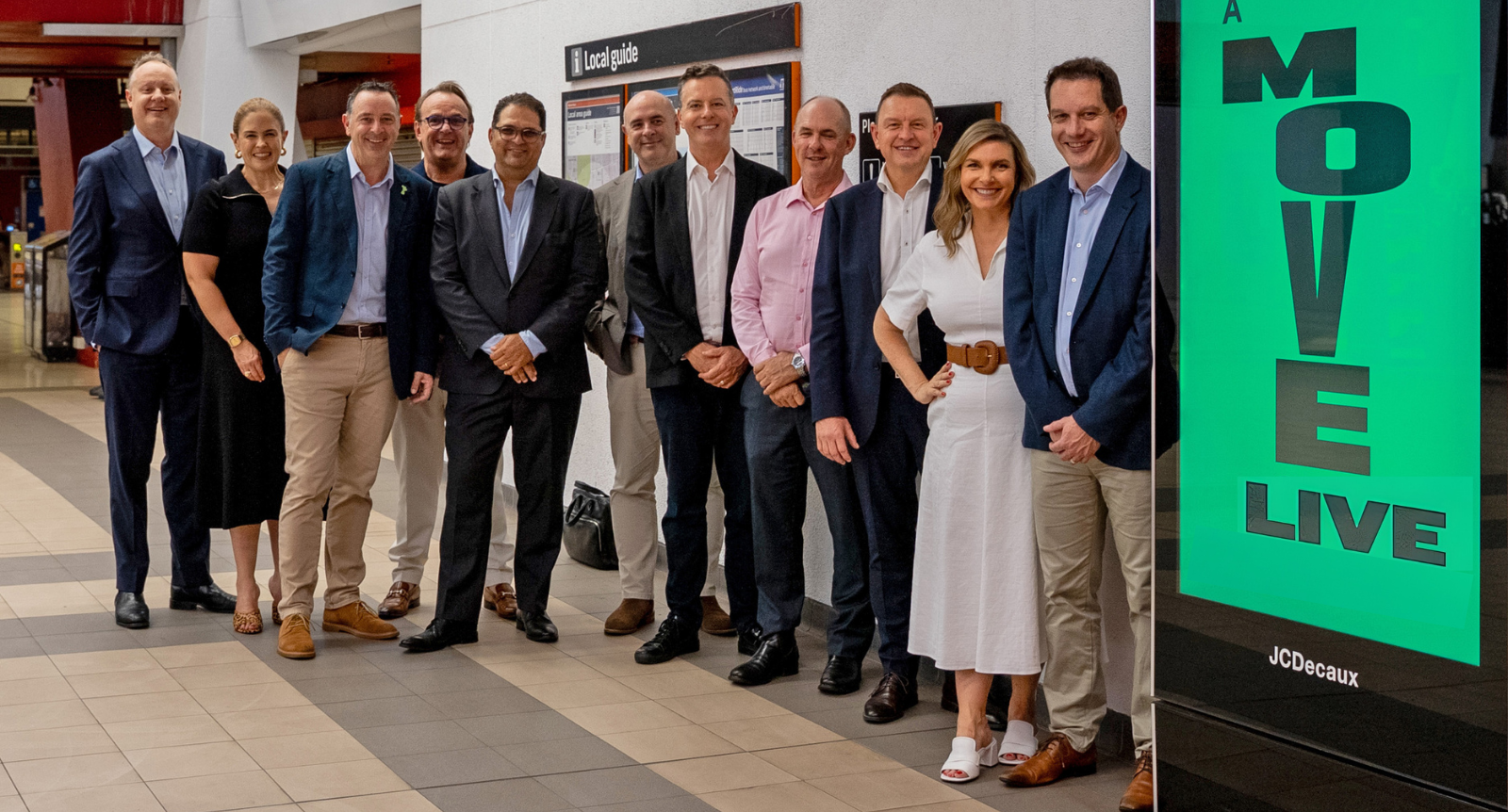 The MOVE board alongside a JCDecaux installation. Image: supplied
Measuring genuine attention
As its cornerstone feature, the new MOVE platform introduces Visibility Adjusted Contacts (VAC), replacing older legacy metrics.
Rather than counting the potential audience that could see an ad, VAC measures the estimated number of people who actually looked at it.
“In a fragmented media landscape, attention is scarce,” Watkins said. “A currency that moves closer to measuring it strengthens the commercial case for Out of Home. Visibility Adjusted Contacts shifts the conversation from how many people could see an ad to how many are likely to have actually looked at it.”
By incorporating attention signals, VAC provides planners with a stronger basis to differentiate between formats, environments, and placements based on exposure quality.
Validating the strategy
The progression from gross audiences to VAC directly reinforces the “Be Seen. Be Remembered.” brand positioning that JCDecaux launched last year.
The positioning argues that mere exposure is not enough, and that ads need to drive actual memory encoding.
Watkins said the evolution of MOVE brings the industry currency closer to reflecting that reality. He highlighted that JCDecaux already operates this way through UNIVERSE, its proprietary planning ecosystem. It combines audience movement data, behavioural insights, and network intelligence.
The new hour-by-hour, 365-day granularity will also change how creative agencies approach outdoor campaigns.
“Greater granularity across the year gives creative agencies more confidence to design for context, not just coverage,” Eburne said. “When planners can see how audiences shift by time of day, season, holiday period, or travel patterns, creative can be aligned more deliberately to those moments.”
Whether messaging reflects commuter peaks, retail cycles, or airport dwell times, both leaders believe that better data does not replace creativity. It sharpens it.
Feature image- JCDecaux Co-CEOs, Max Eburne and David Watkins
More from Mediaweek
The leading media trade publication in Australia.
Get our top stories straight to your inbox daily by signing up to our Newsletter
By providing your information, you agree to our Terms of Use and our Privacy Policy. We use vendors that may also process your information to help provide our services.
.jpg%3Fv%3D1787017979605&w=3840&q=75)


