


By Steph Babin, Managing Partner, Curious Nation
Marketers love the word ‘immersive’. It signals ambition, scale and innovation and suggests a move beyond the flatness of traditional media into something richer, more memorable.
But somewhere along the way, immersive brand storytelling got confused with the tools used to create it.
Those working in the brand experience world have become fluent in the language of technology when it comes to activation creation. But there’s an increasing disconnect from what actually makes an experience land: how it feels.
Immersion is not a format, it’s a feeling, something that is not only enjoyed in the moment, but lives on with these storytellers going on to share their excitement with friends, family and broader audiences. And that distinction matters more than ever in an environment where return on investment and constrained budgets are now non-negotiable. This is why immersive experiences must become more than events; they must also serve as distribution engines.
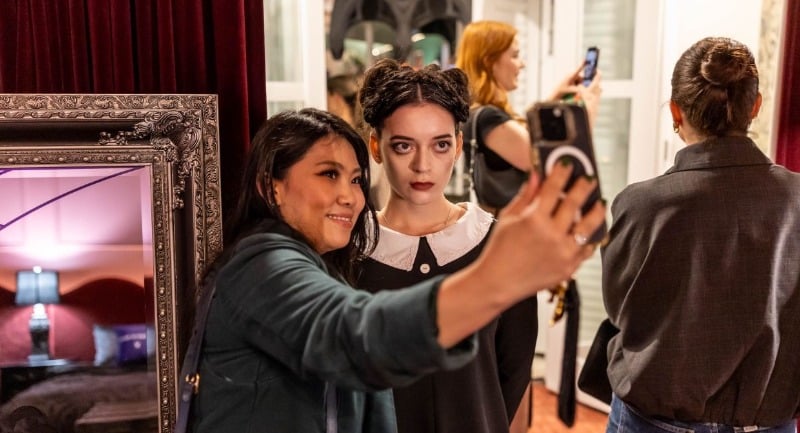
Netflix’s immersive ‘Wednesday’ experience
The true audience of an activation is not the 100 people who walk through the door, but the thousands, sometimes hundreds of thousands, who experience it secondhand across social platforms, group chats and dinner conversations. These are the secondary audiences, where scale is built.
But secondary reach is not automatic; it has to be designed, and the new measure of immersion is retellability. A great experience is not just attended, it is narrated. It can be distilled into a single sentence that travels. That is what ignites social spread, not just something that looks impressive, but something that is easy, compelling and irresistible to explain.
When people retell an experience, they are not just sharing content, but translating a feeling into a story, and stories move further, faster and with more credibility than any paid placement.
This is why immersive, strategically designed experiences can outperform traditional media. Instead of paying to reach every audience directly, you create something that audiences choose to carry for you.
A recent example was this year’s ‘Big Night In’ promotion for Woolworths and Netflix.
This year, it expanded into culture by creating something people could step inside, transforming a boutique hotel into three distinct Netflix worlds, from the opulence of Bridgerton to the eerie tension of Squid Game and the gothic calm of Wednesday.
Every detail was considered: Netflix show characters in costume, themed environments, and a walk-in pantry stocked with Big Night In partner brands that felt like part set, part story device.
But the real strategy was not just the experience itself. As one attendee said, ‘Staying in is now the coolest thing to do, and Woolworths and Netflix just proved it to me’. It was how that experience would travel.
From the outset, it was designed for secondary audiences. Influencers and media seeded the first wave of content, but the environment itself did the heavy lifting.
Every room, every interaction, every detail gave people something to film, photograph and, more importantly, describe. And a radio partnership with Nova’s Fitzy, Wippa, and Kate, across social media, extended the story into earned channels and allowed consumers to win a stay at the hotel.
Content should never be an afterthought in immersive design; it should be built in from the beginning. What are the moments people will capture? What are the angles? What are the interactions that prompt participation? What is the one-line story they will tell afterwards?
When those questions are answered early, the experience becomes inherently shareable. Not because it asks to be shared, but because it gives people something worth sharing.
And this is where budget constraints become less of a limitation and more of a strategic lens. If you only have the budget for one activation, then it cannot just be good in the room; it has to be exceptional in the retelling. It has to carry beyond geography and scale through people.
Technology still plays a role in enabling this, but it is most effective when it serves the sensory, human layer of the experience, the things that create memory. The things that make someone say, ‘you had to be there,’ even as they try to explain them. Because in reality, most people won’t be there.
And that is exactly the point. The goal of immersive storytelling is not to maximise attendance; it is to maximise impact. Build it once, design it to be felt and make sure it travels.