

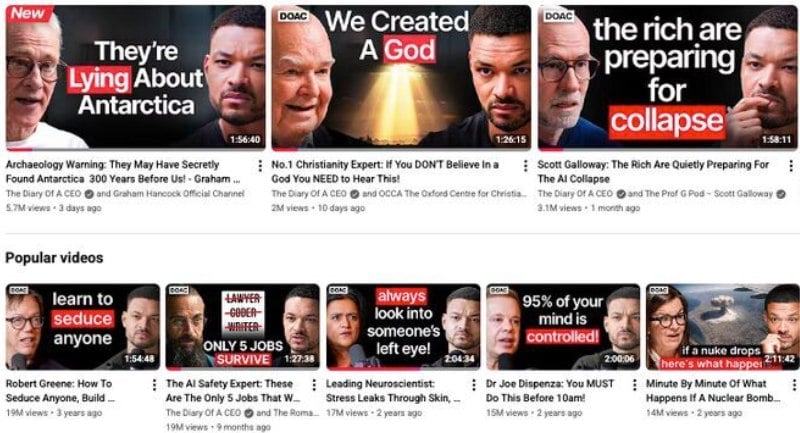
Matt Lakajev knows exactly what Diary of a CEO is doing to your brain – and he wants you to know it too.
The founder of Seven Figure Creators says the mechanics behind the podcast’s increasingly alarming YouTube thumbnails and titles are not accidental. They are the product of a well-understood system, engineered to hijack attention before a single conscious thought is formed.
“There are three things that fire off in a human’s brain, pre-verbally,” Lakajev said.
“So, before we can think about a thought, a thought comes to us. The first thing we look for is danger. The second thing we look for is recognition. And then the third thing is novelty.”

Matt Lakajev
The split-testing spiral
Founded by Steven Bartlett back in 2017, Diary of a CEO (DOAC) has built one of the world’s most-listened-to podcasts on sharp interviews and high-profile guests.
But Lakajev argues that the show’s evolution reflects something systemic – what happens when performance data, not editorial judgment, drives content decisions.
“A few years ago, it was really wholesome conversations,” he said. “But what happens is when you bring in a team and when people start split testing thumbnails and headlines – whenever you split test something, if you keep split testing it forever, it’ll either be World War III or porn. Because that’s the thing that hijacks human beings’ attention.”
The endpoint of that spiral, Lakajev says, is a show optimised entirely for views – at the expense of the value it delivers.
“Views and metrics and retention are not an indicator of the positive thing that you can give back to society.”
READ MORE: ‘Driven or dragged’: Steven Bartlett shares methods of success with media industry
READ MORE: Nova signs exclusive deal with FlightStory, bringing The Diary Of A CEO to Australian advertisers
The broadcast television parallel
The strategy is not new.
Commercial broadcast television perfected fear-as-engagement decades ago – make the viewer feel something terrible is about to happen to them personally, and they will stay tuned.
On YouTube, the same principle drives click-through rates.
Lakajev cites a recent DOAC episode featuring geopolitical analyst Professor Jiang Xueqin as a case in point.
“Professor Jiang comes on, and he’s just like, ‘World War III, we’re here.’ Everyone’s going to click on that. But then you actually listen to it – he’s not actually saying that. But the way that they weave the hooks into it, it’s like a retention thing.”

What’s at stake
Diary of a CEO is not a tabloid.
Its currency has been credibility – the sense that host Steven Bartlett is asking questions worth asking, of guests worth hearing. But Lakajev’s critique cuts to a deeper tension: the metrics used to measure success do not measure the right things.
When a show optimises for performance on views, it is not asking whether it is making its audience more informed, more capable, or better off. It only asks whether they clicked.
For a show of DOAC’s stature, that is not a trivial trade-off.