

All news is local. One of the Iron Laws of journalism. Then again, maybe all those clicky adages are just a crock?
How else to explain the coverage – or lack thereof – of one of the biggest legal cases of its kind since OJ Simpson walked free.
A verdict that shook America
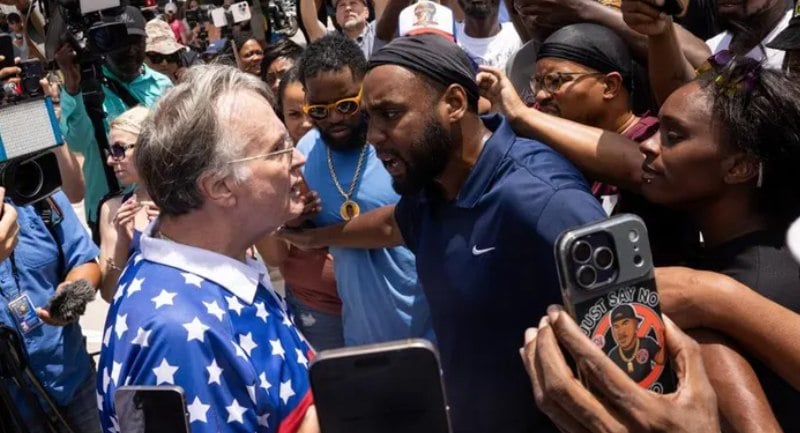
Last week, in a Texas courtroom, a 19-year-old student named Karmelo Anthony was found guilty of the stabbing murder of another student, 17-year-old Austin Metcalf. Anthony is black, Metcalf is white.
The majority of the jury was white. Three potential black jurors were excused. Thus, the case had its full measure of toxicity.
The case transfixed America, and the verdict torched a firestorm of race-based anger.
Supporters of Anthony outside the court erupted. On social media, caucasians were warned to stay off the streets.
The Metcalf family, the judge, the jury, the hapless defence lawyer – white – all came under attack.
It is ongoing, and there is still an appeal against the 35-year sentence, with significant mitigating factors such as provocation and self-defence to be considered.
Where was free-to-air?
My point is not about the merits of the verdict, only this: How many Australians would have known about these events if they had relied on free-to-air network news?
On the day of the verdict, I trawled the afternoon news across all the networks and found nothing.
Nonetheless, I tried again on the evening news, and the case didn’t seem to rate a mention.
Switch to YouTube, and there it was: wall-to-wall coverage, updates, anger, outrage – the whole nine yards.
I called my dad, a retired journalist who’s worked everywhere from New York to Fleet Street, and he was well ahead of me – choosing to head to YouTube without even bothering with free-to-air.
Of course, YouTube is hardly an unimpeachable source, and you have to tread carefully through the crackpots, but it has become an invaluable source of news for someone like my father (a proud boomer) who, despite its shortcomings, still watches the free-to-air product and has given up on print media (except, he tells me, the Sunday paper… for the TV guide).
But he’s not alone.
A study tracking viewers across 20 countries found people are now spending close to an hour and 40 minutes a day on YouTube – up nearly 12 minutes from the year before.
Here’s the part that should really alarm the free-to-air networks: YouTube isn’t just eating mobile minutes anymore. It’s coming for the couch.
Connected TVs’ share of YouTube viewing time climbed from 28 per cent to 35 per cent between January 2024 and December 2025.
Mobile viewing fell from 35 per cent to 31 per cent across the same period.
YouTube is no longer a phone habit. It’s a television habit – and it’s sitting in the same room as your 65-inch screen, competing for the same eyeballs the networks have taken for granted for decades.
The bigger question
At the crux of this entire sad state of affairs sits the question: Are Australians so insular that we are uninterested in anything beyond our own tiny bubble? And what news values determine whether a story gets a run?
Because if free-to-air keeps ignoring the stories people are clearly hungry for, the audience won’t wait around. They already know where the remote points next.