

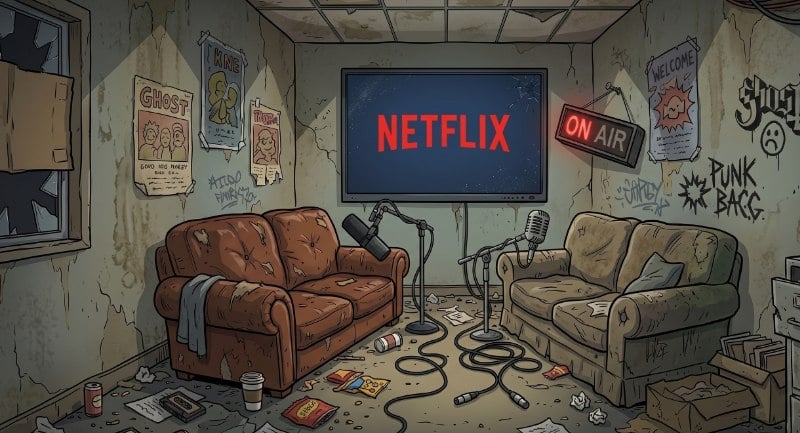
The streamer that cracked the password-sharing problem, conquered live sport, and convinced half the world to stay home on a Friday night has a new ambition: podcasts.
It’s spending eight figures a year on them. But, according to multiple sources, barely anyone is tuning in.
“I don’t see how Netflix really wins out of this,” James Cridland, editor of podcast industry trade Podnews, told Mediaweek.
“They have an old Hollywood model of commissioning expensive stuff, paying for it, and hoping they get enough people to pay for the content. Whereas YouTube has a very different model of just allowing people to upload stuff. So it’s a very different world.”
That’s the uncomfortable reality sitting beneath Netflix’s bold pivot into exclusive video podcasting – a strategy that has seen the company snap up deals with Barstool Sports, Spotify Studios, The Ringer, and iHeartMedia, luring shows like Pardon My Take, The Bill Simmons Podcast, and The Zach Lowe Show behind its subscription wall.
The content is there. The promotion is there. The engagement, so far, is not.
Writing for Puck, entertainment journalist Matthew Belloni reported that Netflix’s podcast category has yet to crack Nielsen’s weekly top 10, with multiple internal sources telling him the overall numbers are “low.”

James Cridland
Netflix’s podcast play
The deals arrived in quick succession.
In October 2025, Netflix struck an agreement with Spotify Studios and The Ringer, bringing a suite of sports titles onto the platform.
Barstool Sports and iHeartMedia followed in December, with the iHeartMedia arrangement subsequently expanded.
At the time, co-chief executive Greg Peters told investors the push was “based on demand signals that we get from our members.”
The timing of those demand signals, it turns out, may have been optimistic.
Netflix’s most recent Engagement Report showed total hours viewed in the second half of 2025 grew by just 2%, while analyst firm MoffettNathanson estimated global subscriber growth of 10% over the same period, which, as Belloni noted, translates to an 8% decline in daily engagement per subscriber.
Signing podcasters to lock in more viewing time looks different when per-user viewing time is already contracting.
Cridland points to a deeper strategic misalignment.
“What Netflix now seems to be chasing is the time-spent-viewing metric, or the time-on-Netflix metric. That’s something Netflix appears not to be doing as well as YouTube, which has overtaken Netflix in daily viewing and is certainly growing. And so if you’re chasing that metric rather than profitability, I don’t see how Netflix can win, because YouTube essentially has 20, 30, or even 200 times as much content.
“How can you possibly win that battle if you’re just chasing time spent on a platform?”
There are carrots, of course. Unlike YouTube’s ad-share model, Netflix pays upfront, a meaningful draw for podcasters tired of riding the CPM rollercoaster.
“More financial security, absolutely,” Cridland explained. “So there are obvious benefits in podcasters getting on there.”
The perception gap
What makes this particularly uncomfortable for Netflix is that the quality gap used to be its greatest asset.
“If you look at the consumer perception difference between Netflix and YouTube, it used to be so obvious that Netflix was where the high-quality stuff was,” Cridland said.
“YouTube is where the amateur stuff is, but there are some quite fun things on there. Now that has totally changed. And I think that’s going to be so hard for Netflix to keep up.”
READ MORE: Netflix subscribers paying more despite less original content
READ MORE: Netflix sends $1bn of its Australian-made revenue overseas
Not all bad news
OK, so not every data point lands in the negative column.
A report by Edison Podcast Metrics, published on 3 June 2026, found that 14% of weekly podcast consumers used Netflix to listen to podcasts in the first quarter of 2026, a meaningful slice for a category that only launched on the platform months earlier.
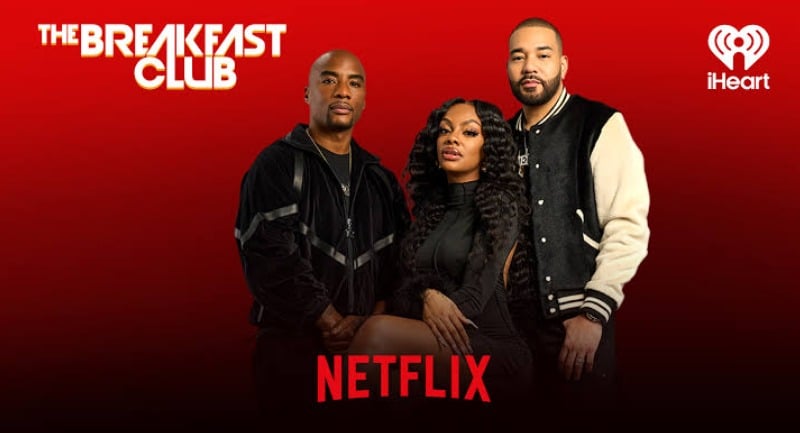
Cridland offers a measured read on the uneven performance: “What I suspect is going on is that there are one or two really successful shows, The Breakfast Club (pictured above) being one of them, and then there are lots of shows that frankly aren’t doing particularly well.
“But you could say that about all shows on that platform. There’ll be some shows that do incredibly well, and most won’t do particularly well. That’s kind of the nature of these things, I suppose.”
What comes next
Netflix has not publicly acknowledged any underperformance in its podcast category, and the platform continues to promote the content prominently.
But the streamer arrived at the advertiser market earlier this year with bullish claims about becoming a “formidable” advertising player – ambitions that depend, in part, on demonstrating meaningful audience scale in newer content categories.
Podcasting’s commercial case for Netflix still rests on an unresolved question: can it change where people habitually go for long-form audio-visual content, or has YouTube already won that muscle memory?
“The stuff that I watch on YouTube is very different to the stuff Netflix would end up paying for,” Cridland admitted.
“Netflix is not going to end up paying for a guy with a beard who eats a lot, which is one of the shows that I watch. Or a guy in Scotland opening deliveries from AliExpress and taking them apart to find out how they work.”
The algorithm that made Netflix indispensable was built on the certainty that it knew what you wanted before you did.
On podcasts, for now, it seems the audience hasn’t quite got the memo.