


Adam De Roma, senior advertising sales manager, at Gameloft for brands
The advertising industry has spent the last decade chasing attention as if it were the only metric that matters. More reach. More impressions. More “views” that may or may not have involved a human being.
And yet, if attention alone did the job, we’d all be out of excuses by now.
Because here’s the truth most of us have felt in our bones: a lot of “attention” is just someone waiting for the skip button. Technically present. Mentally elsewhere. Thumb hovering.
That’s the gap we set out to explore in our latest white paper, Attention & Emotion in Play: developed by Gameloft for brands in collaboration with Mediamento Institute and neuroscientist ActFuture.

Adam De Roma, senior advertising sales manager, at Gameloft for brands. Image: supplied
The study explored a fundamental question: Is attention without emotion simply exposure?
Using attention tracking and biometric emotional analysis, the research measured not only visual attention levels, but also real-time emotional reactions across gaming and traditional digital advertising environments.
The findings were striking: gaming environments generate two times more positive attentive exposure compared to traditional digital formats.
They also capture 22.3% higher emotional uplift and 2.2 times higher levels of happiness than pre-roll video advertising.
Attention isn’t the outcome. It’s the entry ticket.
Decades of neuroscience and behavioural research point in one direction: emotion plays a central role in what people remember and how they decide. In advertising terms, emotion isn’t a soft metric. It’s the thing that turns a message into memory. And memory is what turns into action.
So the question becomes: ‘Where do you find real attention and real emotion, at the same time, in a media world designed to distract?’
You find it in one place people are voluntarily concentrating.
Gaming.
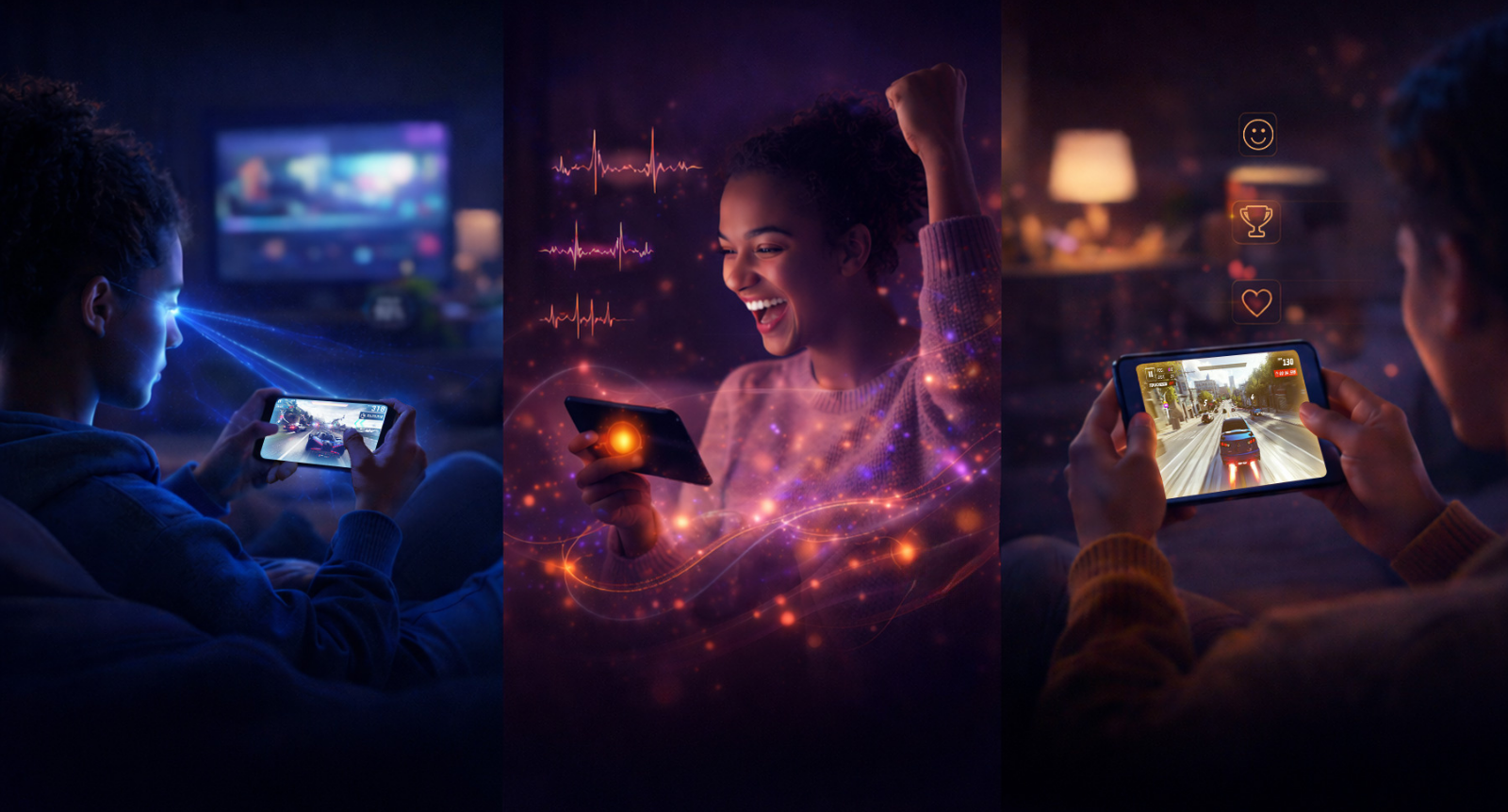
In Australia, gaming isn’t a side hobby. It’s mainstream. Image: supplied
Gaming isn’t a niche in Australia. It’s the default.
In Australia, gaming isn’t a side hobby. It’s mainstream. 82% of Australians play video games and 94% of households have a gaming device. That’s not “emerging”. That’s a mass reach.
It’s intergenerational, gender-balanced, and already baked into everyday life. And it’s a fundamentally different kind of media moment.
On the open web and in video feeds, the environment trains people to avoid ads. Countdown timers. Clutter. Tabs. Notifications.
In gaming, players choose to be there. They’re actively involved, problem-solving, progressing, winning, losing, and retrying. They’re not watching a story unfold.
They’re inside it.
Which means audiences don’t just see advertising. They experience it.
Not all attention is equal
Passive exposure is a different psychological state from active engagement, and most digital environments cater to passive, fleeting glances. Gaming, by design, creates sustained, intentional focus.
Our research indicates that gaming can deliver up to 92% sustained attention in-game, along with stronger emotional response compared to traditional digital video formats. We’ve seen lifts in core brand outcomes too. +25% ad recall, +29% brand consideration, and +24% purchase intent in the right conditions.
This is the part where the industry must stop treating gaming as “something to test”.
Stop ‘testing’ gaming. Start planning for it.
Fortunately, some brands are already there.
Through global ecosystems like COMBO!, Gameloft for brands’ gaming network that reaches 1.3 billion players worldwide, advertisers are increasingly using gaming to create deeper, more emotionally resonant brand experiences.

Gameloft for brands’ gaming network that reaches 1.3 billion players worldwide. Image: supplied
Utilising in-game advertising, custom integrations, branded experiences, and creative that behaves like part of the culture rather than an interruption to it.
Others are still acting like it’s 2014 and the audience is only teenage boys in a basement.
It isn’t.
Gaming in Australia is a family connection, a time-filler on commutes, a daily ritual, and a competitive release. It’s people choosing to focus on a world that constantly steals it.
So yes, attention still matters. But the industry needs to mature a bit. Attention is the beginning, not the end.
As the industry moves into 2026 planning cycles, the question is no longer whether gaming deserves a place in the media mix.
The real question is whether brands still want to optimise for passive exposure or for the kind of positive attention and emotional engagement that actually drive outcomes.
Because in today’s fragmented media landscape, attention may get you noticed.
But emotion is what makes people remember.
And gaming is one of the few environments capable of delivering both at scale.
Download the Attention & Emotion in Play white paper here
Feature image- Gameloft: supplied. Sponsored content.