

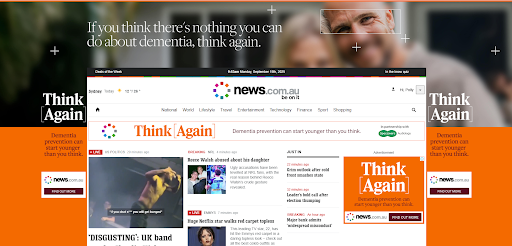
Dementia is the leading cause of death in Australia, with more than one million Australians projected to be living with the condition by 2065.
Despite the dire statistics, most people still can’t separate fact from common misconception.
That gap, between the scale of the problem and the public’s grasp of it, is where Specsavers Audiology and News Australia chose to plant a flag.
The result: a 252% surge in web traffic for dementia-related content across the News Australia network, and a branded content campaign now being held up as the centrepiece of News Australia’s Frontiers 2026 roadshow, themed around “The Power of Passion.”
The campaign, built around News Australia’s Think Again dementia awareness initiative, did not lead with audiograms. Instead, it led with fear, love, and the quietly alarming fact that untreated hearing loss raises dementia risk by up to 24% for every 10-decibel decrease in hearing.
Safe to say most Australians had no idea.
The brief: making the invisible visible
Nat Grabbe, General Manager of Client Partnerships VIC at News Australia, told Mediaweek the insight driving the campaign was both urgent and underappreciated.
“I don’t think many Australians knew how hearing loss is actually a risk factor for dementia, and that you can actually do something about it,” Grabbe said.
Research underpinning the campaign found 74% of Australians would want to know if they were at higher risk of developing dementia.
The intent was present. The problem, however, was mastery: fewer than one in three Australians feel confident in their dementia knowledge, and more than half cannot distinguish common misconceptions from facts.
For Specsavers, one of Australia’s largest providers of audiology services, the gap represented a genuine duty of care. The challenge was sharper still: how do you make a routine medical appointment feel emotionally essential?
The strategy: mastery meets purpose
The campaign was structured around two pillars.
The first was education – arming Australians with clear information on early signs, risk factors, and what they could actually do about them.
The second was emotional reframing.
“It’s something that people can be passionate about because it’s a tangible thing – it’s something people can act on. It empowers people to take control. And I think that’s the difference here: that link between learning more about hearing loss and the risk factors it has for dementia, and actually knowing you can do something about it,” Grabbe said.
Specsavers was positioned not as a commercial player chasing audiogram bookings, but as what the campaign team called an “Adjacent Enabler” – a brand facilitating better health outcomes through early detection.
The reframe was deliberate: a hearing check is not a clinical appointment; it is an act of care for the people you love.
“The purpose here, in this campaign, is that it isn’t just about hearing loss. It’s actually about protecting people that you love. And I think those two things working together are really strong connections and really resonate for audiences thinking about this particular topic,” Grabbe said.

The execution: journalism, not advertising
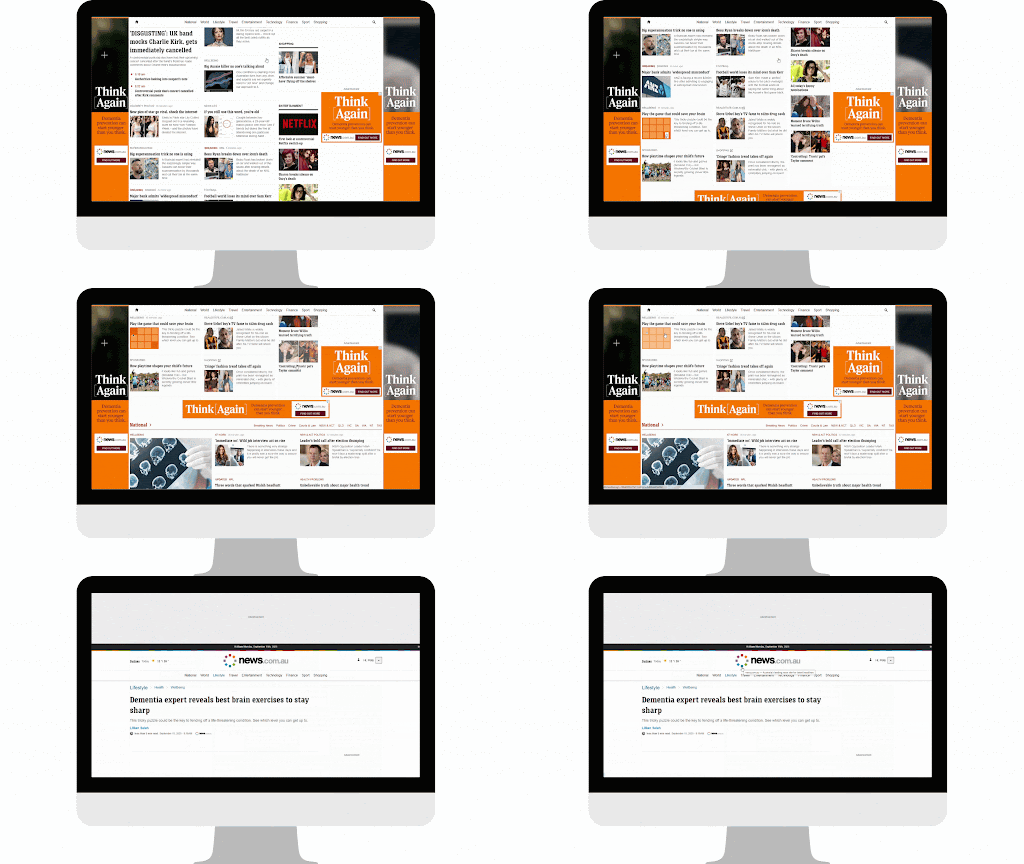
Rather than running conventional brand advertising, the campaign was anchored on news.com.au – expert voices, real family stories, practical guidance.
The editorial instinct was deliberate. Grabbe explains why: “Here at News, we tell the stories that matter. You see that our audience, when they visit, isn’t just skimming or passively browsing. They want to educate themselves.” That trust in the publisher environment was considered part of the strategy.
Grabbe is also direct when asked why Australians continue to tune in to the content despite an increasingly overcrowded marketplace.
“People come to Australian publishers like News Australia because they trust that it’s going to be accurate information – that it’s going to inform in a way that’s credible.”
The result: from overwhelmed to empowered
The 252% traffic increase was not passive. Australians were actively seeking out content, educating themselves on risk factors, and moving toward action. The dual-pathway strategy of mastery and purpose worked in tandem, delivering what case studies rarely admit is actually hard: behaviour change at scale.
For Grabbe, the campaign’s success came down to bravery and alignment of values – on Specsavers’ part as much as News Australia’s.
“Specsavers was really brave to be part of this campaign. Australians are really concerned about dementia – it’s a growing problem, cross-generational, it’s the impact on individuals, on family, on community. Being really clear, having trustworthy information on those early signs, the risk factors, and what people could actually do about it: gives the knowledge and the confidence to act,” she said.
The commercial rationale is just as clear. News Australia’s growth research, Fuel for (Brand) Fandom, argues that brands which authentically support what people care most about – including the health of the people they love – generate deeper loyalty, stronger advocacy, and greater share of wallet.
Passion, in other words, is not a soft metric.