


Nine apologises over Cathy Wilcox cartoon following Bondi backlash
The media giant also defended the role of editorial independence across its mastheads.

Nine has issued a formal apology for publishing a cartoon by Cathy Wilcox, acknowledging the distress it caused members of the Jewish community following the Bondi Junction attack, while defending the role of editorial independence and free expression across its mastheads.
In a statement, Nine said the cartoon, which ran on January 7, had prompted significant hurt, particularly among Jewish readers, despite the company’s intention to scrutinise what it described as the rapid politicisation of the tragedy.
“We have heard their distress, and for this pain, we sincerely apologise,” Nine said.
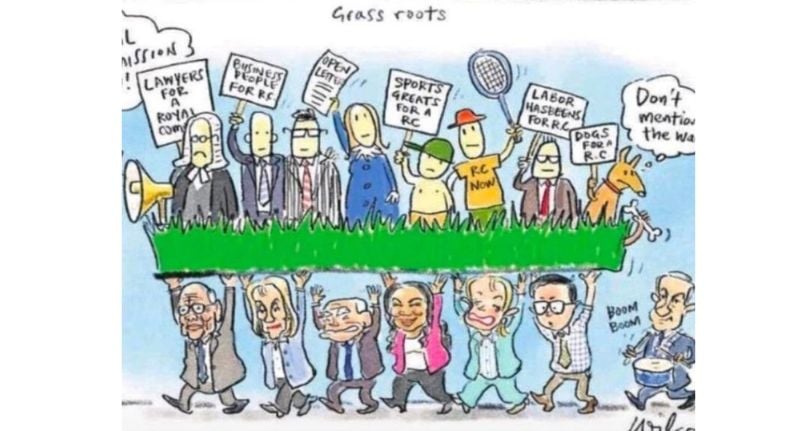 The cartoon in question.
Editorial intent and the Royal Commission push
In its statement, Nine outlined the editorial context surrounding the publication, noting that in the days following the Bondi massacre, it had taken the decision across its mastheads to lead calls for a royal commission into what it described as a “murderous attack on the Jewish community”.
“As the nation continued to mourn, we began 2026 with an editorial calling on Prime Minister Anthony Albanese ‘to announce a Commonwealth royal commission that investigates every aspect of the events leading up to Bondi, with the scourge of antisemitism front and centre’,” the statement said.
Nine argued that only a royal commission would have the scope required to address what it described as the accelerating rise of antisemitism in Australia following the Hamas attacks of October 7, 2023, and Israel’s subsequent bombardment of Gaza.


The leading media trade publication in Australia.
Get our top stories straight to your inbox daily by signing up to our Newsletter
By providing your information, you agree to our Terms of Use and our Privacy Policy. We use vendors that may also process your information to help provide our services.
In the weeks that followed, Nine said it published thousands of names of Australians calling on the Prime Minister to establish a federal royal commission, including prominent business figures and sporting identities.
It also backed a fundraising campaign by the Bondi Response group, which raised money for media advertising in support of an inquiry.
“They did it because it was the right thing to do – and we supported them for the same reason,” the statement said.
Cartoon backlash and apology
Nine acknowledged that while the editorial case for a royal commission was strongly argued in its pages, not all readers - or Australians more broadly - agreed with that position.
Those dissenting views, it said, were also published as part of a national debate over how best to respond to the tragedy.
The Cathy Wilcox cartoon, however, proved a flashpoint.
“For decades, the Herald’s cartoonists have held up a mirror to reflect hypocrisy in public life,” Nine said, describing cartoons as opinion pieces intended to offer “a first impression of major news events".
Nine said Wilcox’s intention was to interrogate what it characterised as the immediate politicisation of the attack, not to cause harm to the Jewish community.
It pointed specifically to her depiction of Benjamin Netanyahu, which it said was based on his public condemnation of Albanese following the attack.
“Many of our readers found the cartoon thought-provoking,” the statement said. “It is undeniable, however, that many others in the community, particularly Jews, were deeply hurt and offended by it.”
 Cathy Wilcox.
Free speech, harm and industry tension
The apology comes amid a broader media and cultural debate about free speech and its limits, which Nine acknowledged would intensify as Royal Commissioner Virginia Bell begins her inquiry.
It also referenced the recent withdrawal of multiple writers from Adelaide Writers’ Week following the removal of Palestinian writer Randa Abdel-Fattah from the festival program - an episode Nine described as an act of support for free expression rather than an endorsement of her views.
“This masthead stands in support of free speech, but it acknowledges the harm it is capable of causing,” Nine said. “There is no place in this country for hate speech. There must, however, be room for people to express their views on politics and world events.”
Industry scrutiny follows
According to The Australian, the apology sat uneasily alongside the position taken by Nine’s own editors, who had publicly backed a royal commission and criticised Albanese’s argument that such an inquiry would take too long - claims they described as “out of step with public expectations” and “incomprehensible”.
Nine chairman Peter Tonagh also added his name to an open letter published across major mastheads urging the Prime Minister to establish an inquiry, later writing online: “I signed – because accountability and safety matter”.
The Australian Press Council has since confirmed it is investigating whether the publications breached industry standards of practice, after receiving multiple complaints about the cartoon.
That process is ongoing.
More from Mediaweek
The leading media trade publication in Australia.
Get our top stories straight to your inbox daily by signing up to our Newsletter
By providing your information, you agree to our Terms of Use and our Privacy Policy. We use vendors that may also process your information to help provide our services.


