

By David Webster, chairman of Vault47 Group, V47 Entertainment, and CEO and co-founder of The Carrot Collective
Somewhere in development right now is a show you are going to love, characters you will quote, a world you will want to live inside, a fandom you will happily join. There is a rising chance it will not be funded by a studio or a streaming service, but by a brand. Not as a sponsor stitched into the credits, but as the principal investor.
A decade ago that sentence would have sounded absurd. Today it is one of the more visible markers of a larger structural shift, one in which the line between marketing and entertainment is slowly dissolving, and what each is for is being quietly rewritten.
Culture stopped organising itself around campaigns
There is a comfortable story the advertising industry still tells itself: that the campaign stopped working because the creative got weaker, the channels got noisier, or audiences simply got harder to reach. It is a reassuring story, because every version of it implies an easy fix: sharper creative, smarter targeting, a fresher channel mix. But it is the wrong diagnosis.
The truth is structural. Advertising did not stop working overnight. Culture stopped organising itself around campaigns.
Audiences now spend their lives inside persistent ecosystems – creator communities, gaming worlds, fandoms, entertainment IP, the behaviours that ripple across a social graph. These are not destinations people visit and leave. They are environments people live inside. A campaign, by contrast, has a start date, an end date and a media plan. It is an event.
The ecosystems it competes with never switch off. The traditional campaign, meanwhile, still behaves like a temporary interruption arranged around those environments, while the attention it is chasing has already moved within them.
That mismatch is not a creative problem. It is an architectural one. Most marketing models were built for an era of scarce distribution and captive attention: a world in which a brand could buy its way to an audience that had nowhere else to go. That world is gone. Distribution today is audience-led, algorithmically amplified and socially reinforced. The audience decides what travels, and how far.
So the more useful question is no longer “how do we advertise better?” It is: how do brands become structurally relevant to the ecosystems where audiences already spend their time?
That single shift in framing explains almost everything happening at the ambitious edges of the industry right now, the move from sponsorship to participation, and ultimately toward principal investment in intellectual property itself. The logic is simple, and it is unforgiving: campaigns decay, IP compounds.
Entertainment needs new funding models. Marketing needs new relevance models. And those two pressures are now colliding into something that looks less like a passing trend and more like a new operating system for both industries.
From sponsor to infrastructure
It is tempting to file all of this under “branded content”, but that label conceals the most important distinction of all.
Branded content, in most of its forms, is still marketing pretending to be entertainment. The message comes first; the entertainment is the wrapper built around it.
What is emerging now starts from the opposite direction. Call it brand-enabled entertainment. The priority is to create something audiences would genuinely choose to engage with, regardless of who financed it. In that model, the brand’s role shifts from message owner to ecosystem enabler.
That is a fundamentally different mindset, and it changes the founding question. Instead of asking “how do we insert a brand into culture?”, you begin asking “how do we help culture exist at all?” The difference sounds subtle. In practice it is enormous.
The bigger change is what happens to the content itself. It stops being promotional output and starts becoming an actual product. Something with genuine audience utility, fandom potential and monetisation pathways that extend well beyond media impressions. Content as product, not content as promotion.
Which raises a sharper question: at what point does a brand stop behaving like an advertiser and start behaving like a studio? The honest answer is that the line is crossed the moment a brand stops optimising for awareness alone and starts thinking in terms of long-term IP value.
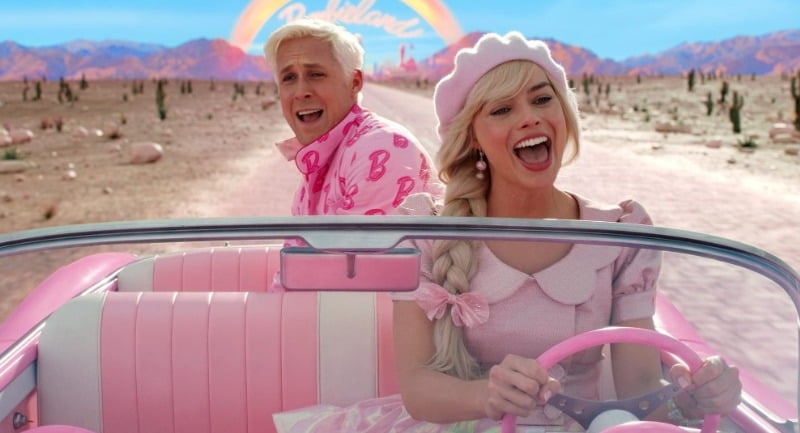
Mattel offers the cleanest current example. The company built Mattel Films, stepped in as the principal IP partner on Barbie, generated roughly $1.4 billion at the box office, and now has more than a dozen brand-IP projects in active development. Mattel did not advertise alongside culture.
It produced it.
Studios think in ecosystems. They think about audience ownership, distribution mechanics, format extensibility, community behaviour, licensing, commerce, data, live experiences and platform-native expansion. Traditional advertising rents attention temporarily. Studios build systems that continuously generate it.
Red Bull has been demonstrating that logic for four decades. The brand built a fully owned media operation alongside the drink: a film and documentary library, a broadcast network, an athlete ecosystem, the Stratos jump, a Formula One programme that is itself a piece of long-form content. The marketing is no longer the work. The IP is.
That is the realisation spreading across some of the most forward-thinking brands; that owning a stake in culture can be more strategically valuable than perpetually buying access to it. An advertiser who pauses spend disappears. A studio that has built an audience, a format and a piece of IP still owns something the morning after the budget runs out.
We are no longer talking about content as a set of isolated assets. We are talking about interconnected cultural ecosystems shaped by platforms, creators, audience data and participatory behaviour.
Entertainment is emotional infrastructure, not media inventory
If there is one misconception that consistently trips brands up as they move into entertainment, it is the belief that entertainment is simply another marketing channel.
It is not.
Entertainment is not media inventory; it’s emotional infrastructure. Audiences do not build fandom around campaigns. They build it around identity, participation, characters, narratives and shared worlds. The brands that succeed here will be the ones that understand they are no longer just distributing messages, but helping to enable environments in which audiences create meaning for themselves.
That has a profound consequence for how marketing is understood as a discipline. When brands move from renting attention to enabling stories to exist at all, marketing stops behaving like communication and starts behaving like investment.
Historically, marketing was treated as a cost centre: money spent, attention acquired, the cycle repeated. But if a brand is financing IP, participating in its upside, building owned ecosystems and generating downstream monetisation, the activity starts to resemble infrastructure investment far more than advertising spend.
That is where an idea such as self-liquidating marketing becomes real rather than aspirational. Instead of spending purely to acquire temporary attention, brands can help finance assets that generate ongoing cultural, commercial and audience value that, over time, can pay back the investment that created it.
Underneath all of this is a convergence that is easy to miss if you only watch the creative output: the convergence of content, data and technology. Audience behaviour now shapes development upstream. Distribution is increasingly audience-led. Algorithms influence what gets greenlit. Social signals influence financing confidence. Creators influence platform velocity. Communities influence longevity.
None of those forces operates in isolation. The future competitive advantage will not simply be creative excellence, though creative excellence still matters enormously. It will be the ability to understand and orchestrate these interconnected systems.
The hybrid future
So where does this leave the relationship between brands and entertainment five years from now? The most likely outcome is that the lines blur between entertainment company, platform, community and brand. The strongest brands will operate less like advertisers and more like cultural ecosystems in their own right, with their own audiences, IP, distribution mechanisms and monetisation layers.
To get there, marketing has to absorb the one thing entertainment has always understood about audiences: that they do not want messaging, they want participation. Entertainment is built around emotional investment. Marketing, too often, is still built around the delivery of information.
It would be naive to pretend the outcome is guaranteed. Both futures are genuinely possible.
There is a real risk that brands entering entertainment simply produce higher-budget advertising disguised as culture. But there is an equally real opportunity: to tell new kinds of stories that would not otherwise get told, precisely because traditional financing systems are under such strain.
The question was never whether brands participate in entertainment. That is already happening, across every category and at every budget level. The real question is how they participate: as extractive advertisers chasing a more sophisticated impression, or as long-term enablers of culture, building content products and worlds that audiences genuinely want to be part of.
The first approach buys a slightly better version of what already exists. The second creates something that did not exist before, and that can keep paying back long after the launch.
And no, this does not mean brands become the new Hollywood. The future is not a takeover. It is a hybrid ecosystem in which brands, creators, platforms, communities and IP owners become increasingly interdependent. The advantage will belong to whoever can orchestrate those relationships most intelligently.
That is the real shift underway. Not the cinematic rebranding of advertising, but the slow, structural conversion of marketing into something that builds, owns and compounds.