






‘The barriers got too big’: why Triple M’s Pilot Week is a reset for radio
It's about about rewinding the industry’s thinking, and lowering the drawbridge.

Triple M has always traded on familiarity. Big voices. Big personalities. Big habit.
But for this week, the network has deliberately stepped away from the known and let the unknown take the mic.
Its first-ever Pilot Week threw the studio doors open to everyday Australians with a breakfast show idea, inviting them to pitch not a podcast or a social channel, but proper, old-school radio.
The response was immediate and overwhelming, with applications flooding in from across the country and a final Top 10 shortlist emerging.
For Triple M Melbourne content director Jay Mueller, Pilot Week was about rewinding the industry’s thinking - and lowering the drawbridge.
“So when I was thinking about radio, we really wanted to find a way to uncover new talent and find new voices for not only Triple M specifically, but radio in general,” Mueller told Mediaweek.
“And acknowledging that, you know, Lou and Jarch worked for commercial radio and then had to leave to build an audience in order to be noticed and come back to commercial radio.”


The leading media trade publication in Australia.
Get our top stories straight to your inbox daily by signing up to our Newsletter
By providing your information, you agree to our Terms of Use and our Privacy Policy. We use vendors that may also process your information to help provide our services.
That journey - leave, build elsewhere, then return - helped spark a bigger question.
“When Lou and Jarch joined, it was a really exciting time for Triple M,” Mueller said. “And it just sort of like, well, who else is out there who wants to do radio?”

Breaking the pipeline - on purpose
Pilot Week wasn’t designed as a casting call. It was a deliberate experiment.
The finalists span ages, backgrounds and experience levels - from first-time audio creators to established regional announcers. There’s an AFL Norm Smith medallist in the mix, alongside comedians, content creators and people stepping behind a microphone for the very first time.
Mueller says that diversity was the point.
“If you're a creative person in Australia right now, you might be tempted to focus on podcasts or videos, YouTube, social media, all of that,” he said.
“We wanted to make sure that we put our hand up to say, hey, this is still something that can be really fulfilling and really exciting, and you should consider it.”
Behind the scenes, applications were assessed by SCA’s senior content leadership - chaired by Mueller, with oversight from SCA head of content Matthew O’Reilly, metro and regional content directors and senior executives.
Chemistry, storytelling and fit with Triple M’s entertainment DNA mattered more than polish. Because polish, Mueller admits, has often been radio’s problem.
“We made it hard as an industry. We made the barriers to entry too big,” he said.
“Some people just started going, well, you know what, I don't need a radio studio, I've got my phone.”
Pilot Week, then, was about pulling radio back into the conversation - not as a relic, but as a living medium.
“There's still a massive audience listening to the radio,” Mueller said. “It is still a direct way to reach somebody where they are living their life.”
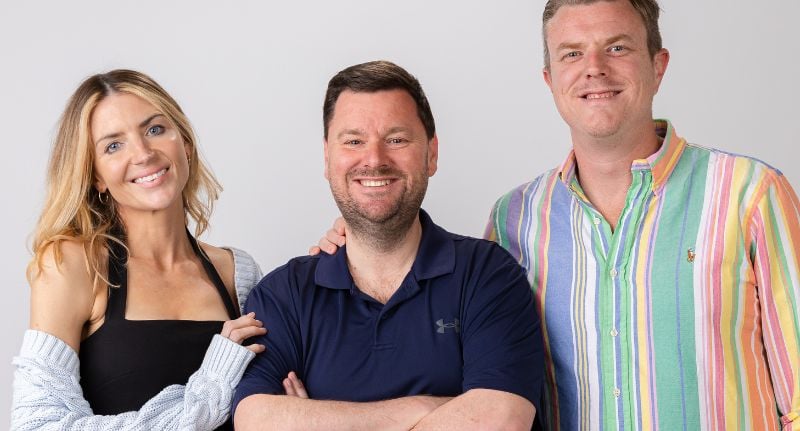 Jean Margaret, Tim Mountford and Mark Pepper.
Jean Margaret’s long way back to the mic
Jean Margaret didn’t take the direct route into radio. She took the sensible one - law, stability, a decade in the workforce - and parked the dream somewhere in the background.
“I did that for 10 years,” she said of her legal career. “I fell into the area of law that suited my personality, because I wasn't in a law firm where I had to bill hours. And I was amongst our working construction unions.”
There were parts of the job she genuinely loved. The people. The conversations. The cut and thrust of ideas.
“My favourite part, honestly, about the law was the banter I had in the office with the colourful people and the intellectual discussions I had with my lawyer colleagues,” she said. “So just the talking and the presenting in court.”
But everything else chipped away at the spark.
“The rest is just paperwork. And I hate paperwork,” Margaret said. “It just wasn't giving me the fire in my belly that I wanted.”
Radio, meanwhile, never really left her. It sat in the muscle memory of daily life - a constant companion rather than a career path.
“I remember getting ready for school every morning with Hughesy & Kate in my bedroom,” she said. “And then we'd get in the car, and then we'd listen to Jon Faine on the ABC.”
Triple M’s Pilot Week gave her the nudge she’d been waiting for.
“I'm like, I'm out. I want to do something that I've always wanted to do,” she said.
She’s now wrapped her Pilot Week show alongside Tim Mountford and Mark Pepper, discovering chemistry the way radio always has - by turning the microphones on and seeing what happens.
“Through this process, we're the only ones that have been thrown together,” Margaret said. “I'm finding out things about these guys that I love.”

Not a finish line - a starting gun
For Mueller, the week isn’t about crowning winners or fast-tracking replacements. It’s about visibility.
“This is an opportunity to go, here are these interesting, talented, fun people that deserve your time and your attention,” he said.
“We forget that there are actually real opportunities and value in what's already there.”
And the ambition goes beyond Triple M.
“I think that it's a great opportunity for the industry if everybody is paying attention to Pilot Week,” Mueller said. “Because they're going to hear six incredible shows.”
For Margaret, the stakes are simpler and more personal. “I think they'll be entertained and have a laugh,” she said. “I think we're relatable.”
Pilot Week may only run for a few days. But for radio, and for people who once thought that door’s probably closed, it’s opened something much bigger.
As Mueller puts it: “The end result will hopefully be the beginning of something great.
More from Mediaweek
The leading media trade publication in Australia.
Get our top stories straight to your inbox daily by signing up to our Newsletter
By providing your information, you agree to our Terms of Use and our Privacy Policy. We use vendors that may also process your information to help provide our services.


