

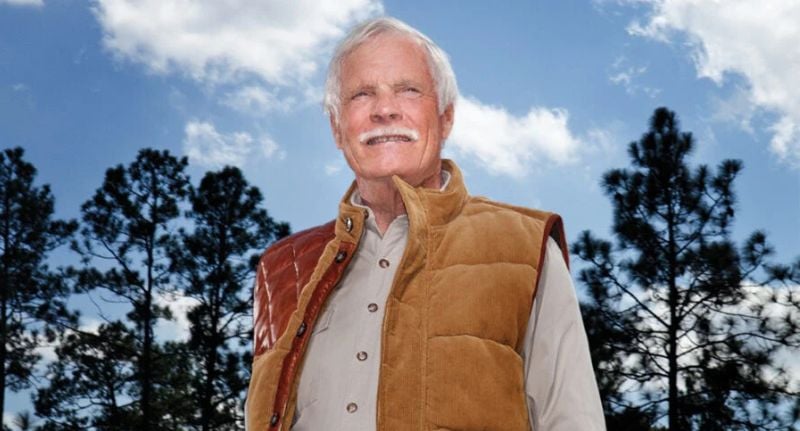
Ted Turner, the outspoken broadcasting pioneer who launched CNN in 1980, transformed rolling news coverage worldwide and has died aged 87.
The news was confirmed by Turner Enterprises and CNN on Wednesday morning, US time. Turner died surrounded by family, according to a statement from the company overseeing his business interests and investments.
A billionaire businessman, environmentalist and philanthropist, Turner built a sprawling media empire that stretched far beyond news television. Alongside CNN, he founded and owned channels including Cartoon Network, TBS, TNT, and Turner Classic Movies, while also holding stakes in professional sports teams and vast landholdings across the United States.
Known as both “Captain Outrageous” and “The Mouth of the South,” Turner cultivated a reputation as one of the media industry’s most unpredictable and larger-than-life figures.
His blunt delivery and appetite for risk helped define not just his public image, but the aggressive expansion strategy behind Turner Broadcasting.
The man who made news a 24-hour business
Turner’s signature achievement was the creation of CNN, the world’s first 24-hour television news network.
At the time, the concept was widely mocked. Critics derided the channel as the “Chicken Noodle Network” and questioned whether audiences would watch news around the clock. Turner pushed ahead anyway, recruiting journalists and technical crews with the promise of building something entirely new.
The gamble changed television permanently.
CNN’s model, continuous live coverage of wars, political crises, natural disasters and breaking events, became the blueprint for modern rolling news channels worldwide.
The network’s profile surged during the 1990-91 Gulf War, when CNN reporters remained in Baghdad as many other broadcasters withdrew, delivering live coverage that captivated global audiences.
Turner later reflected that his frustration with traditional evening news bulletins had partly inspired the network.
He often worked beyond the nightly broadcast windows of America’s major networks – ABC, CBS and NBC – and saw an opportunity to create a channel where news never signed off.
From billboard business to global media empire
Born Robert Edward Turner III in Cincinnati in 1938, Turner moved to Savannah, Georgia, as a child before later joining his father’s billboard business, Turner Advertising, after being expelled from Brown University.
Following his father’s suicide in 1963, Turner took control of the business and began building what would become Turner Broadcasting.
In 1970, he acquired a struggling Atlanta television station and transformed it into the TBS SuperStation, distributing programming nationally via satellite, a move that helped pioneer the superstation television model.
The company later expanded into film and entertainment, including Turner’s debt-fuelled acquisition of Metro-Goldwyn-Mayer assets, which provided the library underpinning channels such as TNT and Turner Classic Movies.
By the time Turner sold Turner Broadcasting to Time Warner in a landmark 1996 deal, he had built a global conglomerate spanning cable television, sport and film.
Turner later described surrendering control of the company as one of his greatest regrets.
“The mistake I made was losing control of the company,” he said.
Tributes flow from across media and politics
US President Donald Trump paid tribute to Turner following news of his death, calling him “one of the Greats of All Time.”
“Whenever I needed him, he was there, always willing to fight for a good cause!” Trump wrote on social media.
President Donald J. Trump on the passing of Ted Turner: pic.twitter.com/OwIwl58CRT
— The White House (@WhiteHouse) May 6, 2026
CNN chief executive Mark Thompson described Turner as “a giant on whose shoulders we stand,” while CNN anchor Christiane Amanpour said Turner “changed not just the world, but all of our lives, too.”
In a family statement, Turner was remembered for his “no-holds-barred delivery, endearing sense of humour, and undying loyalty to those around him.”
“He charmed people he met with his warmth and general lack of conceit, despite his many successes and celebrity.”
A legacy beyond television
Outside media, Turner became one of America’s most prominent philanthropists and conservationists.
He donated $US1 billion to United Nations causes in 1997 and later co-founded the Nuclear Threat Initiative alongside former US senator Sam Nunn.
Turner also amassed millions of acres of ranchland and became one of the largest private landholders in the United States, helping support conservation efforts, including the preservation of bison populations.
In later years, Turner revealed he had been diagnosed with Lewy body dementia and stepped back from public life, focusing increasingly on philanthropy and environmental work.
Still, his influence over modern television remained impossible to ignore.
As Time magazine noted when naming him Man of the Year in 1991, Turner had succeeded in “turning viewers in 150 countries into instant witnesses of history.”