

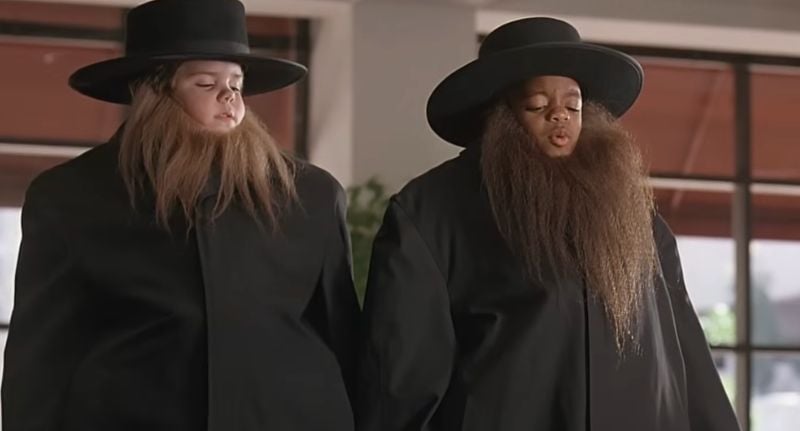
In a sure sign that creativity is not dead, children have been caught drawing fake moustaches in order to bypass online age checks in the UK.
Not since Spankie and Buckwheat stood on the shoulders of their fellow Little Rascals, donned an oversized coat, fake beard and attempted (and succeeded) in applying for a bank loan, has the world been gifted with such youthful ingenuity.
A report from Internet Matters, based on a survey of more than 1,000 school-aged children and their parents, found widespread awareness of workarounds.
In one example cited, a mother said her 12-year-old son used an eyebrow pencil to draw a moustache to pass a platform’s facial age-estimation check, and was verified as 15. Overall, 46 per cent of respondents said age checks are easy to bypass, while 32 per cent said they had done so.
Posts on Reddit, meanwhile, have outlined methods to circumvent restrictions, including using printed mesh face masks purchased on Temu to interfere with facial recognition systems. Other users reported using virtual private networks (VPNs) to mask their location.
Australian data points to continued access
Local findings show similar trends. A survey conducted last month by the Molly Rose Foundation of 1,050 Australians aged 12 to 15 found more than 60 per cent of respondents who had social media accounts prior to the ban still had access to at least one platform.
Platforms including TikTok, YouTube and Instagram were found to have retained more than half of their users under 16. Around two-thirds of respondents said platforms had taken “no action” to remove or reactivate pre-existing accounts.
Meta moves in
Curiously, Meta today announced it is expanding measures to detect and remove underage users in Australia as part of its compliance with the legislation.
The company said it already uses systems to identify and remove accounts belonging to users believed to be under 13 on Instagram and Facebook, and under 16 in Australia.
It has also restricted access to Instagram, Threads and Facebook for users it understands to be under 16, including through age assurance technology provided by Yoti.
Additional measures are set to roll out over the coming months, including AI-powered textual analysis of profiles for age signals and visual analysis tools designed to detect age-related cues in images and video.
The company said it will begin testing visual analysis tools in the US, with plans to expand globally for under-13 detection, before extending to under-16 users in Australia.
Meta said it has also introduced simplified reporting tools for underage accounts, supported by AI-led review systems, alongside measures to prevent users from returning after accounts are deactivated.
Regulators step up enforcement
Meta’s latest developments come on the back of the Australian government’s flagging potential legal action against major platforms over alleged breaches of the under-16s ban.
In March, the eSafety Commissioner confirmed it had launched investigations into several platforms for suspected non-compliance, three months after the restrictions came into effect.
Platforms under review include Meta’s Instagram and Facebook, Google’s YouTube, and Snapchat and TikTok.
At the time, Communications Minister Anika Wells said the government is compiling evidence to support potential court action.
“We have spent the summer building that evidence base of all the stories that no doubt you have all heard … about how kids are getting around that,” she said.
Well, at least now, we have some semblance of an idea.
Main image: Spankie and Buckwheat from the 1994 movie The Little Rascals.