

For most executives, wrapping a national roadshow would signal the end of a long, punishing run, the kind that calls for a dark room and a few days off-grid.
Not for Nova Entertainment’s Chief Commercial Officer, Nicole Bence.
“I feel super energised,” she tells Mediaweek literally minutes after stepping off a plane.
“For me, it’s not just a national event and roadshow, it’s been an opportunity to get in front of customers and play back to them what we believe are the challenges that they’re currently facing, and really talk to them around how it is that we have aligned, the strategic play and how we want to help and how we want to support.”
It’s hard not to be inspired by Bence. It’s clear that her energy isn’t just post-event adrenaline but rather the signal of something more deliberate taking shape inside Nova.
The company is keen to be seen as so much more than a radio network and more as a modern, data-led audio business built for brands trying to navigate a fragmented media market.
A challenger brand grows up
Bence doesn’t shy away from Nova’s identity: “I think we’ve always been very humble at Nova, but we’ve also been a real challenger brand.”
That challenger mindset has underpinned a period of change that, internally, has been anything but incremental.
“It’s the culmination of much of the work we’ve been doing, some of which I began discussing when I first joined three years ago.
“But I think really in the last 18 months, we’ve tackled some big, hairy, audacious goals,” she said.
As part of that broader transformation, Nova recently overhauled its programming line-up, most notably reshaping its Sydney and national schedules by moving Ricki-Lee Coulter and Tim Blackwell from the national Drive slot to the Sydney Breakfast slot, while shifting the long-standing trio Ryan ‘Fitzy’ Fitzgerald and Michael ‘Wippa’ Wipfli, alongside Kate Ritchie, into a national Drive position.
For Bence, it all forms part of the same picture, a series of interconnected changes designed to modernise the business and bring multiple strands of work together into a single, more cohesive offering.
That culmination was on full display at Nova’s 2026 Infronts, the largest showcase the company has staged to date.
“It’s the first time Nova’s done something of this scale.
“We did something last year, and it was very much about what we were working on and what was coming up, but I think this year we’ve really nailed, ‘this is what we said we were going to do last year, guess what, we’ve actually got something to show you.
“Plus, we had content announcements and talent on stage, and having that scale of local and national talent on stage at the same time doesn’t happen very often.”
If last year was a promise, this year was the proof.
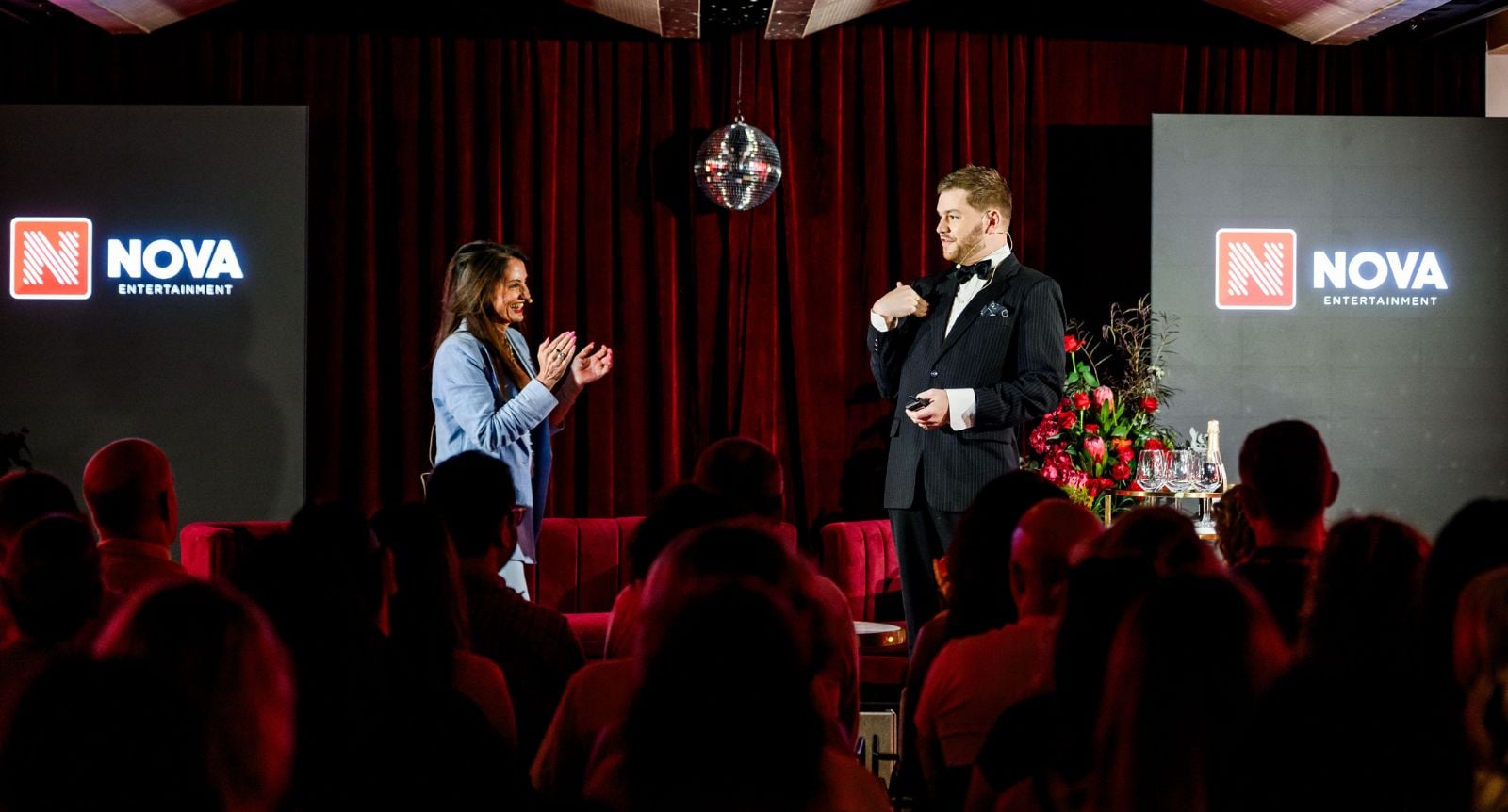
Nicole Bence on stage at Nova’s Infronts with Joel Creasey.
Closing the gap between attention and accountability
At the heart of Nova’s 2026 strategy is a clear commercial tension: marketers want outcomes, but audio hasn’t always been able to show its working.
Bence is blunt about why.
“I think that unless you’ve invested time, energy, and money and therefore seen results as a client in audio, it’s a little misunderstood.
“For example, you know, I think out-of-home is obvious. Television’s been the cornerstone of marketing plans of predominantly big clients forever, but I think audio’s been the opposite.
“Audio has been the cornerstone of many smaller brands that have grown into international brands by using radio and now audio.”
That disconnect is exactly what Nova is trying to close.
Through its new ‘Path to 11%’ measurement framework and a $1 million innovation fund, the company is attempting to give advertisers a clearer line of sight between investment and impact, aligning with broader industry benchmarks suggesting audio’s optimal share of spend is around that level.
The timing is deliberate.
Research presented earlier this year at HEARD 2026, drawing on eight years of Effie data, showed that campaigns that include audio deliver significantly stronger outcomes in new customer acquisition, brand distinctiveness, and emotional engagement.
Bence sees that as both a challenge and an opportunity.
“We have been underrepresented, whether it’s in the minds of clients or agencies, as only being an effective reach medium.
“We’re really starting to see that the opportunity for brands, and the shift that we are a full funnel medium.”
Making audio behave like a modern media channel
If measurement is one half of the equation, usability is the other.
“Radio has not been easy to trade and plan as it becomes audio. It’s different currencies, it’s different formats. You know, we’ve done so much work in the last 12 to 18 months.”
That work has materialised in Nova’s new planning and optimisation platform, designed to give agencies a single, de-duplicated view of audiences across broadcast, streaming and podcasts.
“We have to show up like a modern media business. We have to meet the market. We have to appear like a digital platform business.
“We need to be able to, you know, integrate data into the planning tools. We’ve got to be able to show up with measurements that deliver and improve outcomes.
“We’ve got to do all of that stuff.”
In other words, the pitch is no longer about radio versus digital. It’s about audio behaving like both.
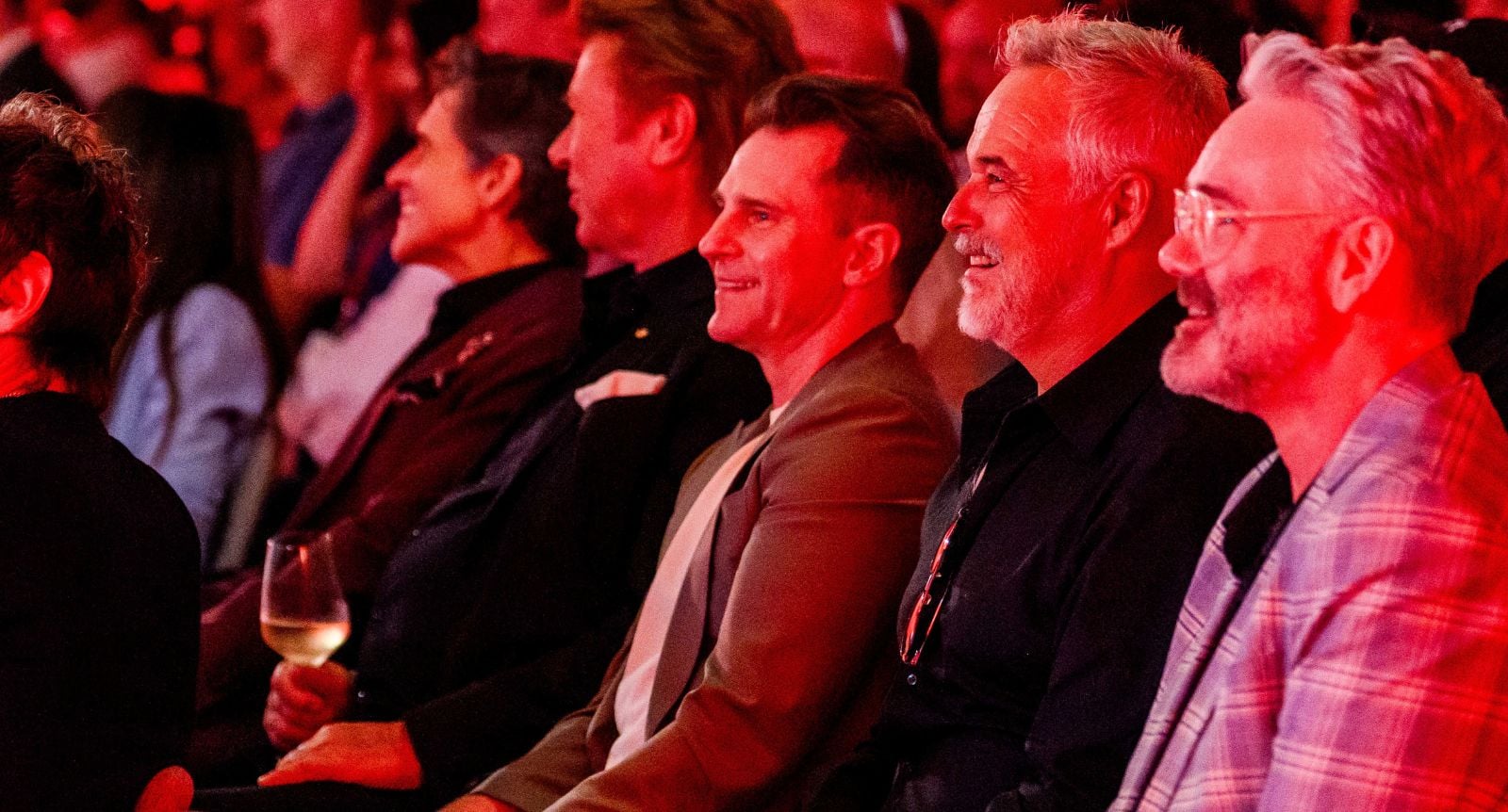
The audience at Nova’s Sydney Infronts, including Nova Podcast host Osher Günsberg and smoothFM presenters. L-R:, Richard Wilkins, David Campbell, Cam Daddo and Ty Frost.
From ads to influence
Where Nova is leaning hardest, though, is in how brands show up inside that ecosystem.
“I think unless you’ve really been in and around audio and you’ve played with it as a brand, it’s been misunderstood.
“I think as more brands come into it, they’re realising the power of talent. They’re realising the power of being inside the content, in the conversation, not just their ads wrapped around it.”
That thinking underpins Nova’s expansion into creators, podcasting, and live experiences, as well as partnerships such as its deal with BrandSpace, which connects audio campaigns to Westfield’s retail network.
“We’ve never had greater scale at Nova; however, we’re always on the lookout for partners who can help us drive greater scale and amplification. Partnering with Brandspace means we can take a single idea and extend it seamlessly to over 15 million Australians – connecting influence to action across the full consumer journey.
“We need to be able to show brands how we can take one idea, blow it out, and scale it everywhere.”
It’s a model that increasingly places Nova inside the creator economy, rather than adjacent to it.
“So the ask is simple: Stop briefing us as a channel. Start briefing us as creators. Give us the opportunity to respond to influencer briefs – because what we offer is reach, trust and the ability to scale ideas across platforms in a way few others can. This isn’t radio versus digital. It’s audio behaving like both.”
A medium hiding in plain sight
If there’s a through line to Bence’s strategy, it’s this: audio hasn’t changed as much as the market thinks, but how it’s framed needs to.
“As radio has evolved into total audio, one thing remains constant: the majority of consumption is still live.
“It’s the same consumer listening to the same content just on a different device.”
Podcasting, she argues, has only amplified that.
“I think the explosion of podcasting has brought a few things to the table.
“One, we’re able to have mass reach, scale conversations that we’ve always had in radio about being a really effective reach medium.
“But the fact is that now podcasting boosts communities that are small, medium, and large, which are very loyal and return.
“It also boasts so many passion points now. You’ve got these very niche, contextual influencer-led podcasts that sit right alongside bigger news-focused ones.”
For Bence and the rest of the team at Nova (not to mention the entire radio industry), audio has always delivered scale, long positioned as a powerful reach medium.
Now, that reach can be layered with highly engaged, contextual communities, allowing the channel to move from broad, mass audiences through to niche, passion-led environments and operate across the full funnel.
For Bence and co, that shift is opening up a significant opportunity.
At the top end sits the scale and trust of live content, while further down the funnel, podcast creators bring depth, influence and a stronger sense of connection.
The nodding in the room
For all the data, platforms and product updates, Bence keeps coming back to a more human signal.
“The nodding in the audience has been insane,” she laughed.
It’s a small detail, but a telling one.
Because for Nova in 2026, the job isn’t just to build better tools or bigger partnerships. It’s to shift perception, to move audio from a line item to a strategic lever.
The strategy is now in place. The proof points are building. The question, as always in this market, is whether brands will follow.
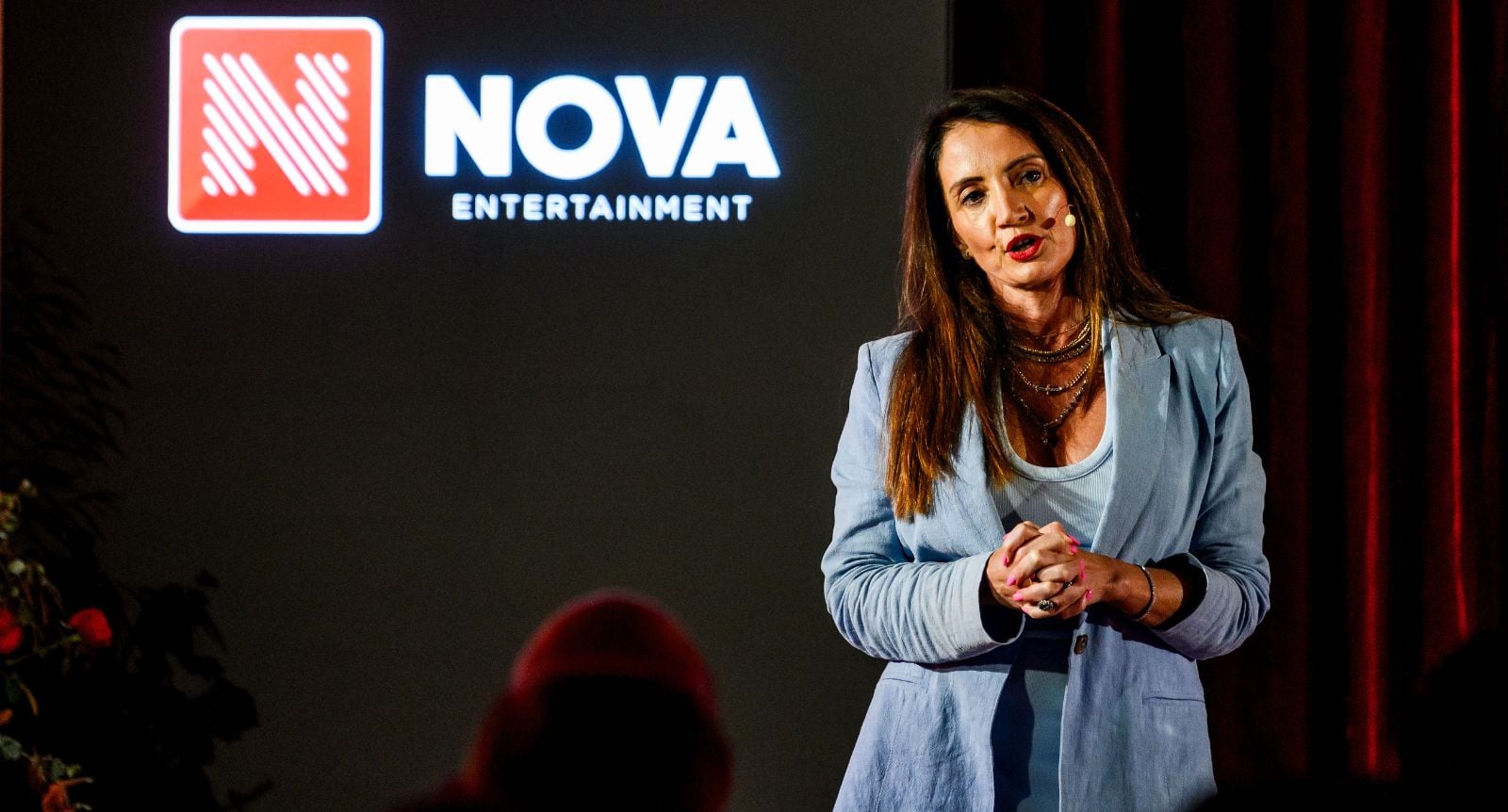
Main image: Nova’s Nicole Bence on stage at the company’s Infronts.