

Latitude Finance Australia (Latitude) has paid a $3.96 million penalty after the Australian Communications and Media Authority (ACMA) found the company breached Australia’s spam laws more than 2.7 million times.
The ACMA investigation found that between March 2024 and April 2025, Latitude sent more than 2.3 million marketing messages without accurate contact information, of which 344,416 messages also lacked a working unsubscribe function.
This is the second time the ACMA has taken enforcement action against Latitude for spam breaches. In 2022, the company paid a $1.55 million penalty for similar contraventions.
The latest breaches were identified through Latitude’s mandatory compliance reporting under a court‑enforceable undertaking entered into following the previous investigation.
ACMA member Samantha Yorke said the size of the penalty reflected Latitude’s repeated compliance failures.
“Latitude is now a two‑time offender and it is disappointing that it let consumers down again,” Ms Yorke said.
“The spam laws have been in place for more than 20 years, and there is simply no excuse for ongoing non‑compliance, particularly after a prior enforcement action.”
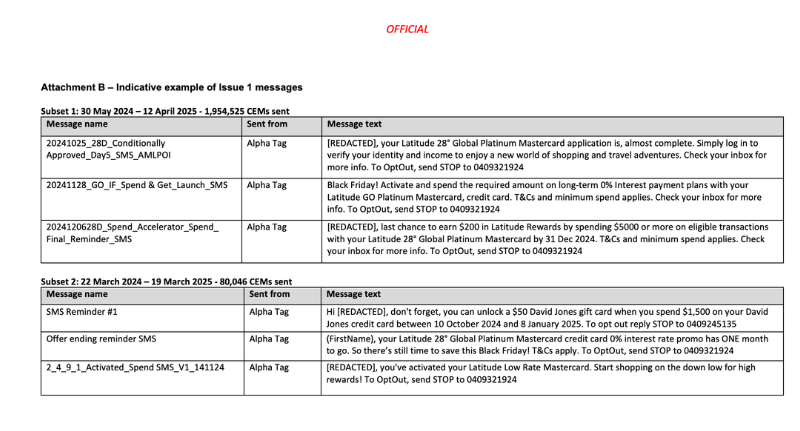
Examples of the messages Latitude sent. Image: ACMA
The messages promoted Latitude credit card products and financial services.
For example, one automated text read: “[REDACTED], last chance to earn $200 in Latitude Rewards by spending $5000 or more on eligible transaction with your Latitude 28° Global Platinum Mastercard by 31 Dec 2024. T&Cs and minimum spend applies. Check your inbox for more info. To OptOut, send STOP to 0409321924.”
While recipients were told they could reply ‘STOP’ to unsubscribe, many messages were not capable of being used in this way.
“Under Australia’s spam laws consumers have the option to unsubscribe from commercial messages, and that process must work,” Ms Yorke said.
“They must also provide accurate information within the message about how the sender can be contacted.”
View this post on Instagram
The ACMA has accepted new court-enforceable undertakings from Latitude requiring it to appoint an independent consultant to further review its compliance with the spam laws and to undertake regular and comprehensive reporting to the ACMA.
“Given Latitude’s history of non-compliance, we will be very closely monitoring how it meets its obligations,” Ms Yorke said.
The ACMA has published guidance to assist businesses in understanding and meeting their obligations under the spam rules here.
Lululemon pays massive fine after 370 000 emails breach the Spam Act
In March, clothing company Lululemon Athletica Australia Pty Ltd paid a $702,900 penalty after sending more than 370,000 emails with commercial content that did not contain a way to unsubscribe.
An Australian Communications and Media Authority (ACMA) investigation found that between 1 December 2024 and 5 January 2025, Lululemon mischaracterised service messages, including delivery and order confirmation emails, that also had a clear marketing purpose.
Authority Member Samantha Yorke said the spam rules are clear that if an electronic message contains any promotional or sales content, it is considered commercial regardless of whether the message has any other purpose.
“In this case Lululemon sent service emails such as shipping updates that also contained sales material and direct links to promotions,” Ms Yorke said.
“This was an easily avoidable error that has led to hundreds of thousands of marketing emails being sent without a way for people to opt out.
“Businesses need to understand that marketing messages must have an unsubscribe option and the simplest way to comply is to keep transactional or service messages separate from sales content and links.
“This is the fifth enforcement action the ACMA has undertaken in the last 18 months against businesses that have incorrectly treated messages as non-commercial even though they contained or had links to clearly commercial material.
“The law is clear – providing the ability to opt-out is mandatory for marketing messages,” Ms Yorke said.
Top image: Latitude’s Instagram page