


The ongoing legal drama surrounding Jackie ‘O’ Henderson, Kyle Sandilands and ARN took yet another turn yesterday, when Henderson’s full Statement of Claim was filed with the Federal Court.
In them, Henderson accuses ARN Media of failing to act on repeated complaints about Sandilands’ on-air behaviour, as part of Federal Court proceedings seeking more than $82 million in compensation.
Henderson also alleges she raised concerns with senior executives months before the February 20 incident that ended the pair’s long-running partnership, warning the on-air dynamic was being perceived as an “abusive relationship” and detailing a series of incidents across August and September 2025.
To help make sense of the never-ending legal drama, Mediaweek spoke with Michael Byrnes, a partner at Swaab and workplace relations lawyer.
Workplace lawyer Michael Byrnes
Mediaweek: Firstly, was there anything in Jackie’s Statement of Claim that, I guess, shocked you?
Michael Byrnes: I wasn’t shocked because it had been reported that Jackie had expressed concerns about Kyle’s conduct in the past and that Jackie had reservations about the way in which Kyle was treating her.
There had been talk of a dossier or a log going back 14 months, but it seems that isn’t the case; rather, there have been a limited number of incidents she raised.
Those incidents occurred in 2025: one in August, one in September, and then again after the now-notorious February 20 incident. So I wasn’t shocked by it, but it is clear that her case rests on her having previously raised issues. Albeit on only two occasions.
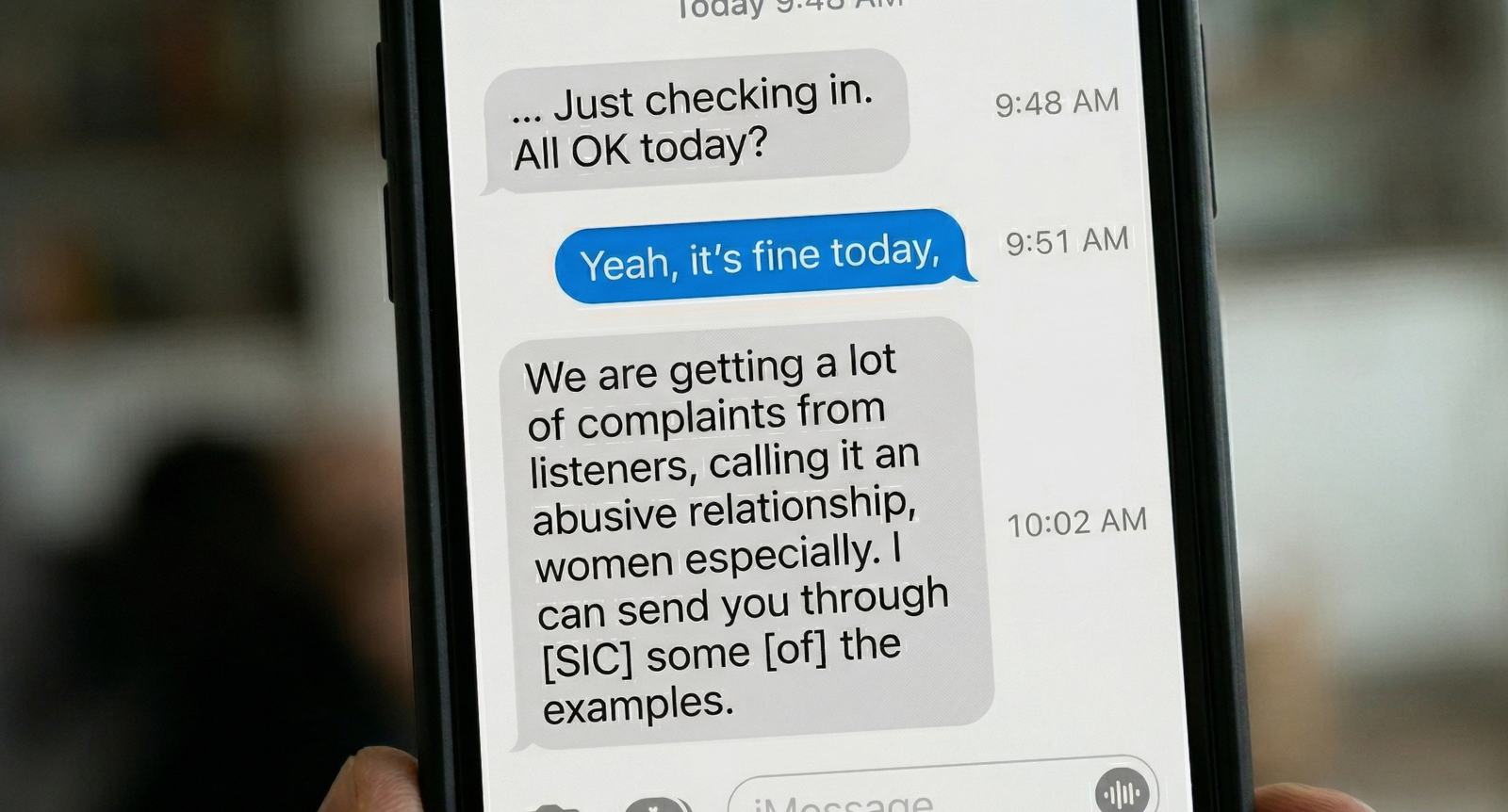
An AI recreation of an alleged SMS exchange between Jackie and senior management about Kyle’s behaviour.
MW: What are the main allegations Jackie is making?
MB: There are really three elements to it. One is a misrepresentation element, which is probably the least significant aspect, and it relates to ARN’s market statement to the ASX on the 3rd of March, which asserts that misrepresentations were made in that statement. In particular, regarding the offer of an alternative programme to her.
The claim also alleges that representations in ARN’s statement that implied she initiated the termination of her services agreement are misleading.
Then there is what is perhaps the most complex technical aspect of her claim: the Fair Work Act claim. That is a breach of the general protections provisions of the Fair Work Act. Jackie claims that because she exercised workplace rights, ARN terminated the services agreement.
In this regard, ARN bears the onus and must prove or demonstrate that it did not terminate the services agreement for a prohibited reason.
Then there’s the contractual aspect, which has been a bit overlooked and overshadowed by the Fair Work Act claims, but I think, objectively, it seems that could be her strongest limb.
In this element, Jackie claims that ARN terminated her agreement after she sent a letter stating that she could not continue working with Mr Karl Sandilands.
They then treated that as a repudiation of her services agreement, that is, that she no longer intended to be bound by the services agreement, and terminated that agreement.
Jackie is saying that the termination was wrongful and she should receive damages for the balance of the contract, which is $82 million.
It’s a relatively straightforward contractual argument about whether or not that letter constituted a repudiation of the contract and whether ARN was therefore entitled to terminate as they did, or whether, as Jackie asserts, no, they did not have the right to do that because Jackie’s proposition is that the services agreement was about more than just presenting the breakfast show.

Image: Kyle and Jackie O on KIIS
MW: What, in your opinion, is Jackie’s strongest position in this case?
MB: The spotlight is on what ARN did in response to those matters raised in August and September.
If ARN didn’t take action, then that supports Jackie’s assertion in the complaint letter, which is the February 26 letter, which included the words she cannot continue working with Mr Sandilands, and it provides context to that statement. It also supports the assertions in that letter that ARN had failed to address safety concerns she had previously expressed, and that they had failed to provide, or to discharge their obligations to provide, a safe workplace under the Work Health and Safety Act.
MW: OK, I’m going to ask you to put your psychic hat on for this one. How do you see this all unfolding?
MB: Well, at the moment we’re yet to hear from ARN, so in fairness this analysis has all been pretty one-sided, but it strikes me that both Kyle and Jackie have a credible case.
However, there are aspects of Jackie’s case that might act to the detriment of Kyle’s case because if ARN took Jackie’s complaints or the issues that she raised in August and September had spoken to Kyle about it and issued him with some warning about this is and Kyle had persisted with his conduct in February that could could potentially weaken his argument that he did not engage in serious misconduct, and strengthens ARN’s argument that he did.
Now, ARN foreshadowed at the first case management hearing in Kyle’s matter that they would go back beyond February 20 and look at some previous incidents as well, which might have been a reference to the matters Jackie had raised in August and September. But if ARN did nothing, it may well be that they’ve let down Jackie, as set out in her Statement of Claim.
It may also make it far more difficult for them to argue that Kyle engaged in serious misconduct if they let these matters go to the keeper.
Main image: Jackie ‘O’ Henderson. AI-generated (would you believe?)