


It is a universally accepted truth that when it comes to concerts, women do all of the planning. Now, for the first time, the live music industry has the data to prove it.
The Her Frequency report compiled by The Collective and THE·TEAM’s music group surveyed nearly 15,000 live music fans across 12 markets and 18 genres.
Its findings are not subtle: women are the economic engine of live music, and the industry has been quietly taking them for granted.
“We’re really driving the economy,” says Thayer Lavielle, Managing Director of The Collective at THE·TEAM told Mediaweek.
“Eighty-six per cent of us said we would spend more money if we felt like this were more immersive, easier logistically, and more rewarding. And that is what we should be striving for as an industry – to try to get more women there.”‘

Thayer Lavielle
The mental load nobody was measuring
The research is the first of its kind to examine, at a global scale, how women engage with, plan for, and spend on live music. And the picture it paints is one of enormous enthusiasm met with enormous friction.
Globally, 64% of women identify as fans of live music. But their path to the venue is rarely straightforward. It winds through caregiving calendars, group logistics, transport planning, budget considerations, and – most critically – an invisible weight that the report names the “mental load.”
“Women don’t have as much time as men to fan,” Lavielle said plainly. “We’re dealing generally with a mental load that men in society aren’t dealing with. And that’s not meant to be a slate against men – it’s a social construct that’s been in operation for millennia.”
Globally, women spend 2.5 times as many hours per day on unpaid care and domestic work as men. Nearly four in 10 women report feeling chronically time-stressed. For them, a concert is never just a concert.
“It comes down to: will we have a great time? Are we set up for success? Can I actually emotionally relax into this experience?” Lavielle says. “The emotional pull of an artist is often not enough on its own.”
Architects of the Experience
If the barriers are significant, so is the payoff – for everyone.
The report finds that 83% of women fans play a key role in creating the group experience, with 35% identifying as the person who actually initiates attendance. They are not merely ticket buyers. They are, as the report puts it, “experience architects.”
“In the main study, it’s 83% of women who are architects of the group experience, which is no surprise,” Lavielle explained.
“They are the ones who will rally a group. But then there are all these questions, like: ‘How do I make this logistically possible for me from a caregiving perspective?’ Even little things – walking the dog, watering the plants. Will I be travelling for work? Do I have homework to do with my kids? All of these logistical elements are beyond her in making the decision.”
More than half of women (54%) spend $100 or more beyond the ticket price at live events, with 11% spending more than $500.
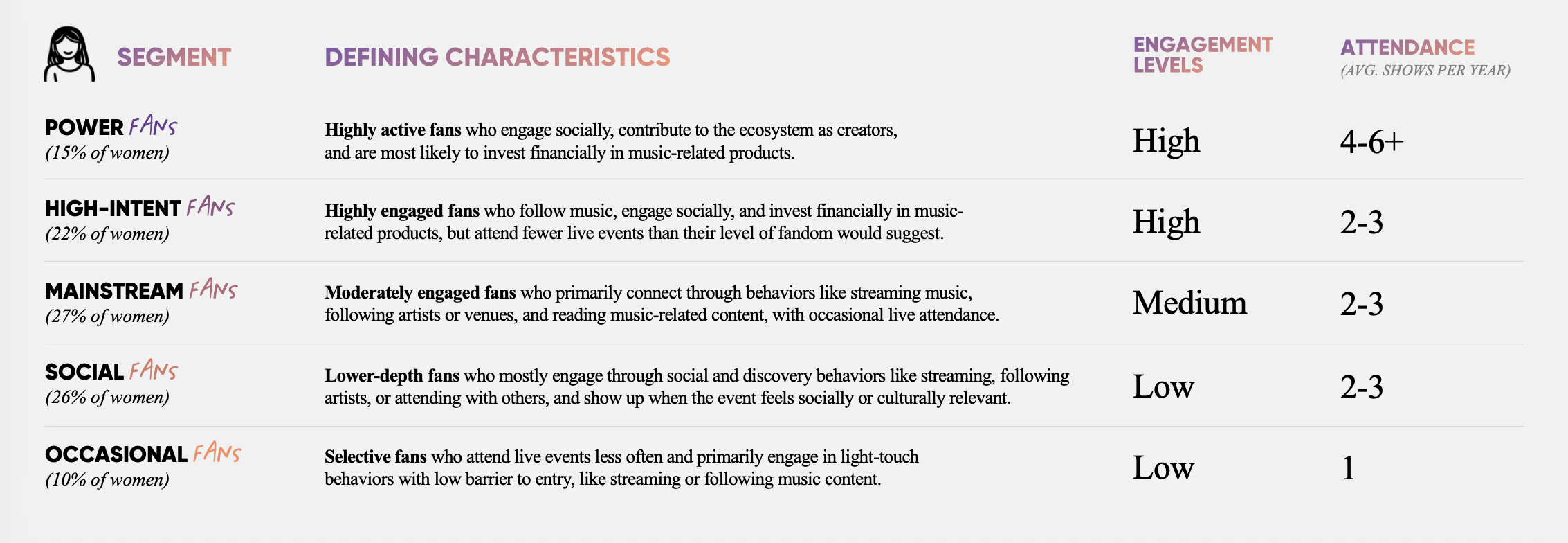
Power Fans – the most engaged 15% – spend an average of $121 more per event than Mainstream Fans.
And yet only 8% of High-Intent Fans and 13% of Mainstream Fans say they currently spend as much as they want to. The gap between what women would spend and what they do spend is the entire opportunity.
Not a monolith
Nick Hudson, Vice President – Australia at THE·TEAM, has watched the conversation around women fans evolve across sport and entertainment for years. What has been missing, he says, is not goodwill – it’s granularity.
“I don’t think it’s that brands aren’t listening,” Hudson told Mediaweek. “I think it’s that there hasn’t been enough available information for them to make better informed decisions – to be able to really lean in, to be able to better serve her as a fan and a consumer.”
The report addresses this directly. Rather than treating women as a single audience, it identifies five distinct segments of female fans: Power Fans, High-Intent Fans, Mainstream Fans, Social Fans, and Occasional Fans. High-Intent and Mainstream Fans together represent 50% of women and the clearest commercial opportunity.
“Brands know that women are a massive consumer segment to chase, to pursue, to win over,” Lavielle said. “What we’re saying is: we’re not one woman. I might like all of those bands and feel like a different identity when I go to those different shows. We’re not a monolith.”
Hudson echoes this: “This research has gone that extra level deeper and looks more at the psychographic and the emotional relationship with music – what that actually means in terms of the way that you serve the audience. That’s an important step.”
What women actually want from brands
Here’s the thing – women fans are not hostile to brands. Quite the opposite: 94% say they are open to brand presence within the live music experience. They just want that presence to earn its place.
Women surveyed cited convenience, fun, surprises, and memorable moments (46%), comfort, hydration, rest, and wellness (43%), and shared experiences (42%) as their top priorities for brand involvement.
“They want brands to show up,” Lavielle said.
“The role that brands can play is not just at the venue. It can be throughout that entire journey. And if you can find a way to add utility to her experience throughout that, and do so in a way that’s authentic to your brand, the research shows that women fans are incredibly receptive to that.”
The report spotlights some examples of brands doing it right. Beyoncé’s partnership with the Washington DC Metro – in which the tour funded extended rail services after a weather delay – offered real, meaningful relief to fans navigating a late finish in an unfamiliar city. Always and Secret’s “Refresh Room” at Coachella provided period care, hydration, and recovery essentials.
“That’s just one example,” Lavielle said of the Metro partnership. “They’re also receptive in a way that sets them up to potentially be further down the consumer funnel, or more loyal to your brand post-experience.”
The Australian angle
The research also reveals significant variation across markets – and Australia offers a revealing picture.
Women live music attendees here skew heavily toward venue-based shows, with 68% attending large venue concerts. Australia is also home to a uniquely embedded live music culture, one where the communal experience is central.
For Hudson, the Australian context makes the global findings feel even more urgent. “Across the entire sport and entertainment industry, there’s been growing recognition of the need to think about women as a distinct fan group that behaves differently and values experiences differently,” he said.
“And if you’re not addressing that group in a really strategic and thoughtful way, then you’re probably leaving something on the table.”
The ask is simple – and the reward is enormous
The Collective, which helped unlock more than AU$750 million in incremental investment for women in sport through similar research, is now making the same call to action in music.
“We wanted to understand: who is she globally? How is she being served? Where does she feel content, and where does she feel there’s room for growth – from a venue perspective, a promoter perspective, an artist perspective, a brand perspective?” Lavielle said.
“And it’s been an absolutely riveting study, because I think a lot of women actually identify with it. The crux of it is universal.”
The unlock, the report concludes, is deceptively simple: increasing ease and giving women more reasons to participate more often.
“The next growth opportunity is not simply reaching women fans,” the report states. “It is designed around how they participate. Design for her fandom, not just her attendance.”
The data agrees. The question now is who in the industry will actually listen.