

We asked 12 women in media a question. Three weren't allowed to answer.
Here are the responses we didn't expect, as well as six insightful replies, to our question for International Women's Day.

It's International Women's Day on March 8th, so what better time to ask my female media friends: As a woman in media, what would you change about the media for women?
There were many insightful responses - you can read them below.
But I wasn't expecting that three out of 12 were not allowed to answer. They had to ask permission first.
You read that right. Because, apparently, as an employee, you're never allowed to speak for yourself.
"I’d have to get it approved by our managing editor and probably the communications department," one told me, who added she'd love to see more women on the boards of media companies.
A second friend said, "I would love to take part, but I'm going to be honest and say that [employer] will make me jump through so many approvals and people to get it signed off, it won't be worth it."
What would her answer be if she were allowed to speak for herself? "The gender pay gap is a huge issue in this industry, especially as men without kids who can chase stories at the drop of a hat are seen as more valuable, especially in news."


The leading media trade publication in Australia.
Get our top stories straight to your inbox daily by signing up to our Newsletter
By providing your information, you agree to our Terms of Use and our Privacy Policy. We use vendors that may also process your information to help provide our services.
And this third colleague said, "I'd want to talk about an experience about the need for more female-on-female mentorship - from a previous job. But my current workplace doesn't like us going on the record for anything personal without their approval."
Chances are, their answers would have been signed off. Maybe. But them even having to ask permission to personally talk about what women want done better in Australian media - and being concerned about their employer's response - is highly problematic itself.
This is something for us to really think about: how is it 2026 and women are not allowed to speak for themselves? If they are employed by a big publisher, they're not an individual who can share opinions, but are an employee at all times?
That's a concept that needs to evolve.
Speaking of evolving, this is what I would change: after more than a decade in the industry, I can safely say I wish diverse voices were amplified - but not in a tokenistic way. In a normalised way.
I've spent a lot of time in my career as a 'diversity hire' in jobs and projects. And while that's brilliant, and I'm so proud to REPRESENT, I still feel that people who don't look like Kyle Sandilands and Jackie O should be more common, mainstreamed, too.
Below are the strong, thought-provoking responses to the question from the women who could answer.
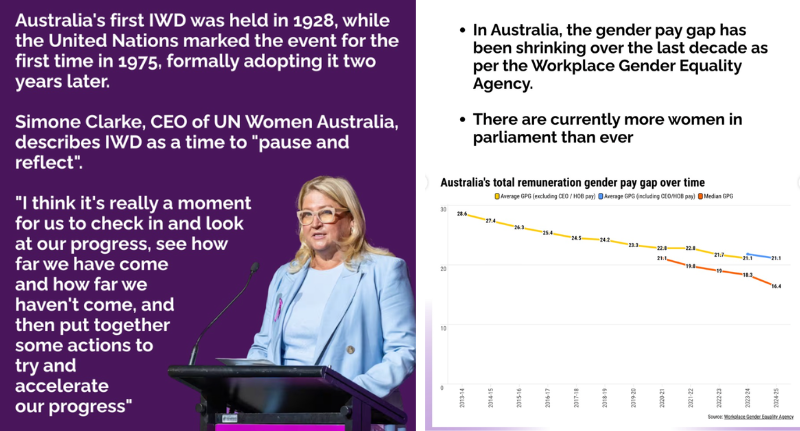 Information on IWD from She Codes Australia. Image: Instagram
What women in media would change about the media for women
Jessica Bailey - editor of ELLE Australia
"For too long, women in media have been flattened into archetypes: the girlboss, the cool girl, the trad wife, the mess. Real women contain all of those things at once. I’d push for more contradiction. More irreverence. Less earnest perfection.
"Women don’t need media that instructs them how to be better. They need media that reflects how layered, funny, ambitious, contradictory, complicated and powerful they already are."
Mary Madigan - reporter
"I think the media is still so hard on women. You’ve got to be palatable and relatable, and never make the mistake of seeming up yourself.
"You have to self-promote, but never seem like you’re bragging.
"You have to smash the glass ceiling without hurting anyone’s feelings along the way.
"I really wish the media were a kinder place for women. It’s a real minefield. How do you stay both likeable and become successful?"
Grace Lam - former editor of Vogue China
"I want the media to stop pitting women against each other. Yes, it's inevitable there’s always competition in any field.
"However, many of us also like to root for other women to succeed too."
Jane Caro - media identity
"Being an older woman in the media I sometimes wonder if I am still actually in the media! I still appear weekly on TV (paid), comment both regularly and ad hoc on radio (unpaid) and write regular and ad hoc columns & opinion pieces in major newspapers (paid). I also comment on things like this (unpaid).
"But if it wasn't for speaking gigs, the books I've written and my super, I'd be on the bloody breadline. Sexism has dogged me throughout my career in media - starting in the bad old 80s, but the double whammy of sexism & ageism was not something I'd expected, foolishly.
"Older is not seen as wiser in the media. Its seen as out of touch. Yet older people, particularly older women, have both the money, the desire and the time to engage with the news in ways younger people do not. But still we are despised, not just as practitioners, but as audiences.
"Frankly, you patronise us at your peril."
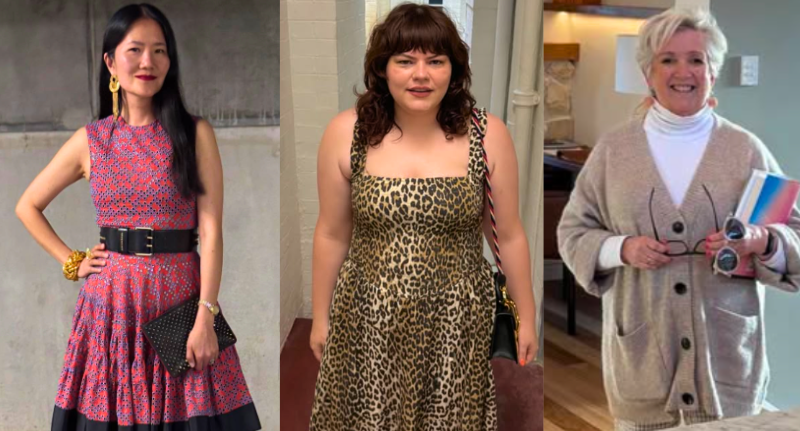 Grace Lam, Mary Madigan, and Jane Caro did speak their minds. Images: Instagram/Mediaweek
Dee Madigan - Campaign Edge executive creative director
"Being a woman in media means you spend a lot of your career simultaneously proving you belong and pretending you don't need to. I've sat in rooms where my ideas landed in silence, only to be enthusiastically repeated by the man next to me minutes later.
"I've learned to read the temperature of a pitch meeting not just by the work, but by who's in the room and whether they're ready to hear a woman's voice leading it. It's not always overt. The industry has moved past a lot of the old, obvious stuff. But there's still this low hum of having to work a little harder, be a little sharper, and take up space more deliberately than your male counterparts.
"What I've come to understand is that visibility matters enormously, not just for your own career, but because every time a woman holds her ground in a media space, she's quietly rewriting what's possible for the women coming up behind her.
"That's not a burden. It's actually the most meaningful part of the work."
Ceci Jeffries - Femme Collective - fertility advocate
"One challenge I constantly face is having to prove credibility. As a woman building an online platform, l've found that my authority is often questioned in a way that I don't see happening to men doing the same thing.
"There's this underlying expectation that we're building something 'passion-driven' rather than strategic or scalable. A man with the same vision is often seen as ambitious - a woman is asked to justify why she deserves the space.
"That extra layer of validation can be exhausting, but it's also why creating spaces that amplify women's voices feels so necessary."
Feature image: AI generated. Any similarity to actual persons is purely coincidental.
More from Mediaweek
The leading media trade publication in Australia.
Get our top stories straight to your inbox daily by signing up to our Newsletter
By providing your information, you agree to our Terms of Use and our Privacy Policy. We use vendors that may also process your information to help provide our services.

.png%3Fv%3D1788141081939&w=3840&q=75)


