



This was Australia's most complained-about ad in 2025
From flipping the bird to digging for gold, it turns out we might be bigger prudes than we think.

If 2025 proved anything, it’s that Australians have plenty of opinions about advertising.
From zombie-proof electric cars to questionable hygiene habits and a blurred middle finger, more than 5,200 complaints were lodged about ads nationwide last year.
According to the Ad Standards Annual Report 2025, the complaints spanned more than 1,000 different campaigns, offering a revealing snapshot of the moments when marketing pushed too far - or simply struck a nerve.
Ad Standards Executive Director Greg Wallace said the volume of complaints highlights how closely Australians are watching the industry.
“In 2025, Ad Standards received more than 5,200 complaints, reflecting both evolving community expectations and strong public engagement with the system. This level of activity reflects a community that is paying close attention to advertising and expects standards to be upheld.
“It reinforces the need for a system that is efficient, transparent and delivers timely outcomes for the community and industry alike.”


The leading media trade publication in Australia.
Get our top stories straight to your inbox daily by signing up to our Newsletter
By providing your information, you agree to our Terms of Use and our Privacy Policy. We use vendors that may also process your information to help provide our services.
Kia tops the complaint charts
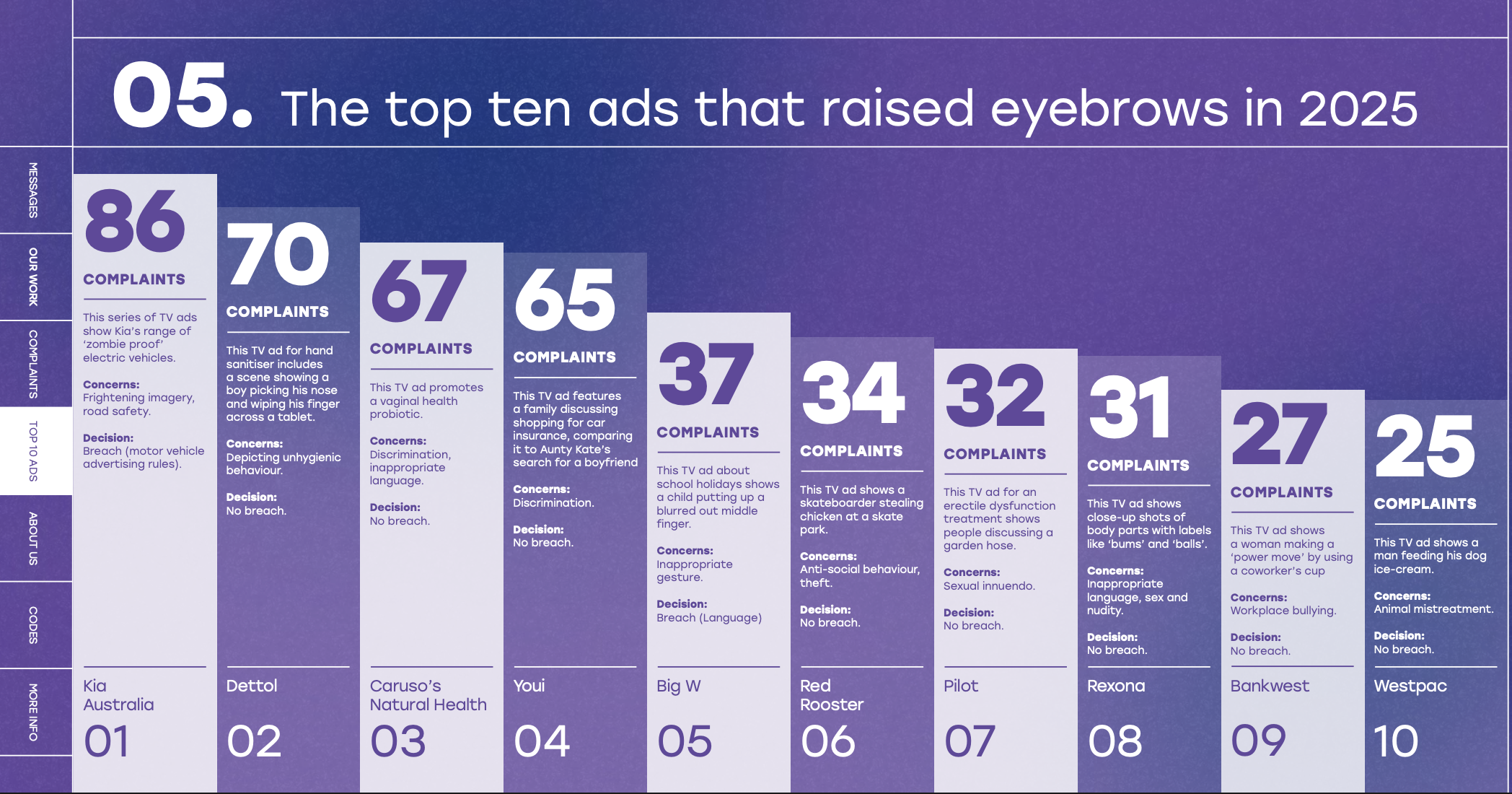
Leading the pack was Kia Australia, whose series of “zombie-proof” electric vehicle ads generated 86 complaints, making it the most contested campaign of the year.
Viewers raised concerns about frightening imagery and road safety.
Ad Standards ultimately ruled that the campaign breached motor vehicle advertising rules.
Not every ad that sparked complaints resulted in a breach.
A Dettol hand sanitiser commercial showing a boy picking his nose and wiping his finger across a tablet drew 70 complaints about unhygienic behaviour, but the panel determined the ad did not breach the codes.
Similarly, a Caruso’s Natural Health commercial promoting a vaginal health probiotic received 67 complaints (ladies, don't mention the v-word!), while a Youi insurance ad featuring a family comparing insurance shopping to a relative searching for a boyfriend drew 65 complaints - both ultimately cleared.
Big W among the few found in breach
Only a handful of campaigns were formally found to breach advertising standards.
A Big W back-to-school holiday campaign generated 37 complaints after a child was shown raising a blurred middle finger gesture.
Ad Standards ruled the campaign breached rules relating to language.
Other campaigns that sparked complaints but avoided breaches included:
• Red Rooster, whose skate park chicken theft scene attracted 34 complaints about anti-social behaviour
• Pilot, whose erectile dysfunction ad used a garden hose metaphor that prompted 32 complaints about sexual innuendo
• Rexona, which drew 31 complaints over body-part language such as “bums” and “balls”
• Bankwest, criticised by viewers for perceived workplace bullying in a cup-stealing office scene
• Westpac, where a man feeding ice cream to a dog triggered concerns about animal treatment.
In each case, the Community Panel ruled the ads did not breach the codes.
Free-to-air TV still drives the most complaints
Despite the shift toward digital advertising, traditional television remains the biggest source of complaints.
The report shows 55% of complaints related to free-to-air TV ads, followed by 17% for social media and 7% for on-demand TV.
The most common issues raised by consumers were:
• Sex, sexuality and nudity (25%)
• Violence (17%)
• Health and safety concerns (14%).
Political advertising also played a major role in the year's complaint volumes, though those ads fall outside the regulator’s formal remit.
Self-regulation under pressure
In total, Ad Standards received 5,256 complaints, with 2,326 falling within the scope of the advertising codes and the remainder relating to political ads or general dislike of content.
Of the 254 ads assessed by the Community Panel, 91 were found to breach the codes, while 163 were cleared.
Encouragingly for regulators, 88% of advertisers complied by modifying or removing ads either before or after a breach ruling.
More from Mediaweek
The leading media trade publication in Australia.
Get our top stories straight to your inbox daily by signing up to our Newsletter
By providing your information, you agree to our Terms of Use and our Privacy Policy. We use vendors that may also process your information to help provide our services.

.png%3Fv%3D1787614340422&w=3840&q=75)


