



The Indie hustle: Speed, strategy, and the $42 billion passion economy
Independent agencies turn passion data into client strategy as the News Australia Frontiers roadshow hits Sydney.

The Australian independent agency landscape operates in a competitive arena.
Agility, sharp elbows, and a constant battle for a share of voice against holding company heavyweights define the space.
But, despite the varied challenges and vastly different client needs represented by the almost 100 agency leaders packed into the room, a distinct degree of unity was palpable.
Of course, some of that unity oozes from the Independent Media Agencies of Australia (IMAA) and its CEO Sam Buchanan. His presence was impossible to ignore at the News Australia Frontiers roadshow as he held court across various corners of the heritage-listed Alpha function space in Sydney last week.
The event marked a clear shift in focus. If the first chapter of Frontiers introduced the passion framework, and the second showcased the magic of holding companies and clients collaborating, this third instalment belonged entirely to the Indies.
And the independent sector strikes a different chord.
Setting the scene for the Indies
Event host and managing director – client partnerships Lou Barrett kicked off proceedings. She acknowledged the evolution of the program over its six-year history, before introducing general manager of The Growth Distillery, Leigh Lavery.


The leading media trade publication in Australia.
Get our top stories straight to your inbox daily by signing up to our Newsletter
By providing your information, you agree to our Terms of Use and our Privacy Policy. We use vendors that may also process your information to help provide our services.
Lavery once again unpacked the polycrisis thematic and Australia's booming $42 billion passion economy.
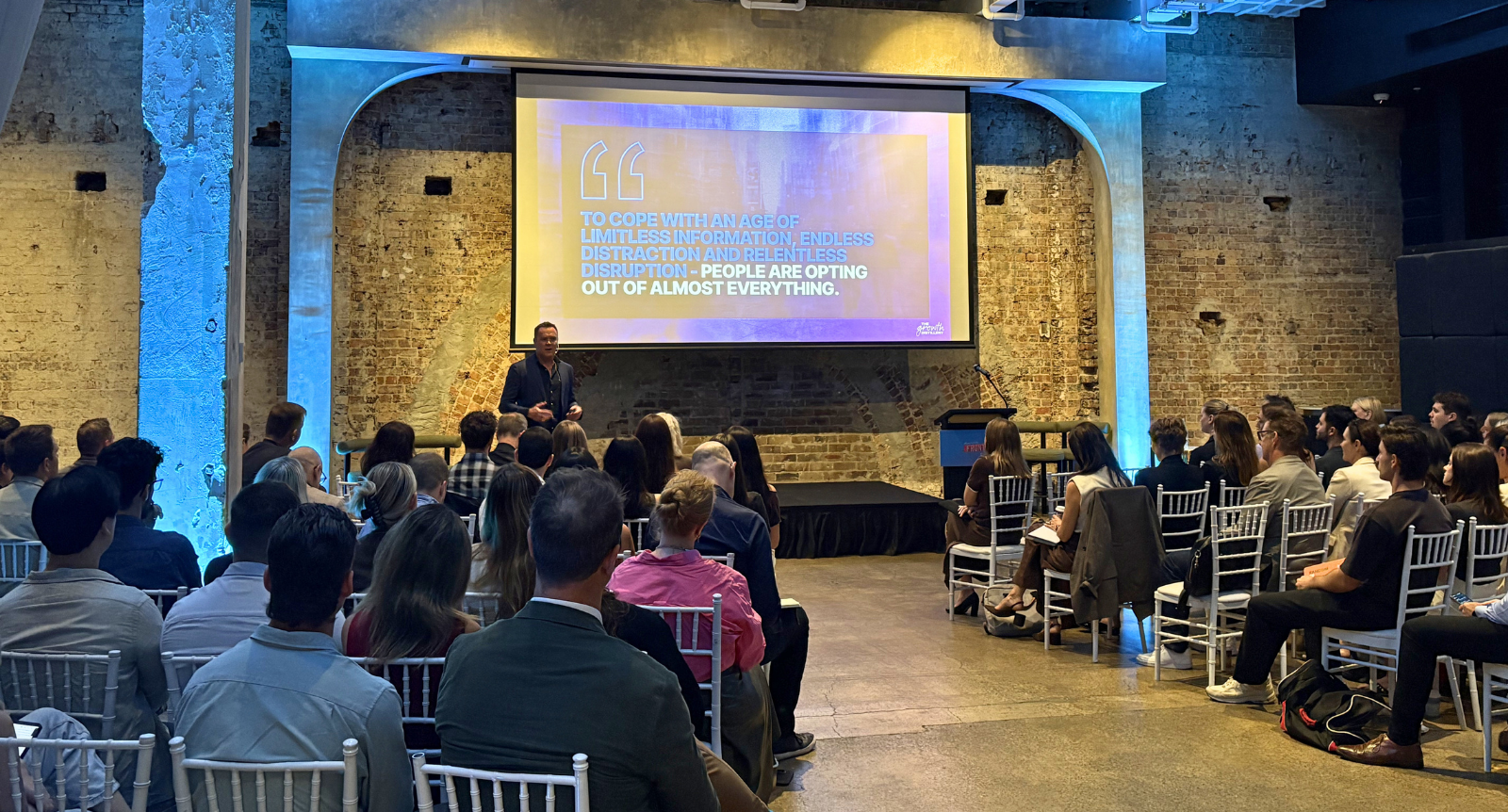 The Growth Distillery’s general manager, Leigh Lavery exploring passions and fandom with the Indies. Image: supplied
The Indie hustle: freedom and speed
Watching the presentation from the crowd, Sam Geer, managing director, media, of Accenture Song A/NZ, admitted he usually approached these pitches with a healthy dose of scepticism. “Honestly, I'm pretty cynical. And I bought it,” Geer laughed.
On a personal note he acknowledged that even as a positive person, he actively shut off from the relentless bad news cycle.
Instead, he goes on “deep spirals” to escape the world and consume content about the things he’s into. Things like the AFL, film, and music. “Consumers don’t care if they read a paper, scroll through TikTok, or watch TV; they only care that the content covers the thing they love.”
Mediaweek asked Geer how independent agencies might react to this data differently than traditional Consortium agencies. He carefully explained that independent agencies typically manage a smaller roster, which would allowed them to provide greater focus.
Although he made a point of saying that Accenture Song sits in an interesting place between the two. It's not one of the consortiums- but neither is it a textbook independent.
For an Indie, everything you do is for the client. There's no time to do things outside of that.
“If I come here for half a day, and I don't go back and give my opinion to my clients, and it doesn't manifest in some kind of strategic proposition, then I've wasted half a day,” Geer said.
 CEO of independent agency Joy., Peter Horgan and Sam Geer, managing director, media, of Accenture Song A/NZ. Image: file
CEO of independent agency Joy., Peter Horgan echoed this need for speed and execution. He told Mediaweek that media owners view this agility as a major asset. “Publishers are increasingly focusing on indies as a growth driver,” Horgan explained.
Noting that the primary advantage of the independent model is having “fewer constraints of group deals, enabling indies to move quickly and take advantage of opportunities for their clients”.
Unlocking passion and search rankings
This agility allows Indies to completely rethink rigid media plans. Geer pointed out that B2B marketing often defaulted to boring, rational advertising. “Business decision makers also watch football, also care about fashion, also go shopping and love e-commerce,” he challenged.
He reminded marketers that reaching clients through cultural passions cuts through the noise far more effectively.
Horgan agreed, noting that tapping into people's passions formed an absolutely critical part of Joy.’s targeting and planning process.
He highlighted a modern reality of media planning, pointing out that, “generating relevant content tailored for specific platforms is how we not only unlock and leverage deeper connections but also improve rankings in Gen Search.”
Editorial agility in the polycrisis
Shifting consumer behaviour fundamentally changes how News Australia shapes its journalism.
Following Lavery, general manager client partnerships NSW, Ian Paterson moderated a panel featuring some of the country’s top editors to discuss how they captured fragmented attention.
Editorial director of The Australian, Claire Harvey noted that “the wonderful thing about the internet is there is nowhere to hide”.
She stressed that modern journalism must beware of the trap of assumed knowledge. “Everything we do should be made for a highly intelligent person who has no idea about a particular topic,” Harvey stated.
She explained that reporters have to decode complex issues without patronising the audience.
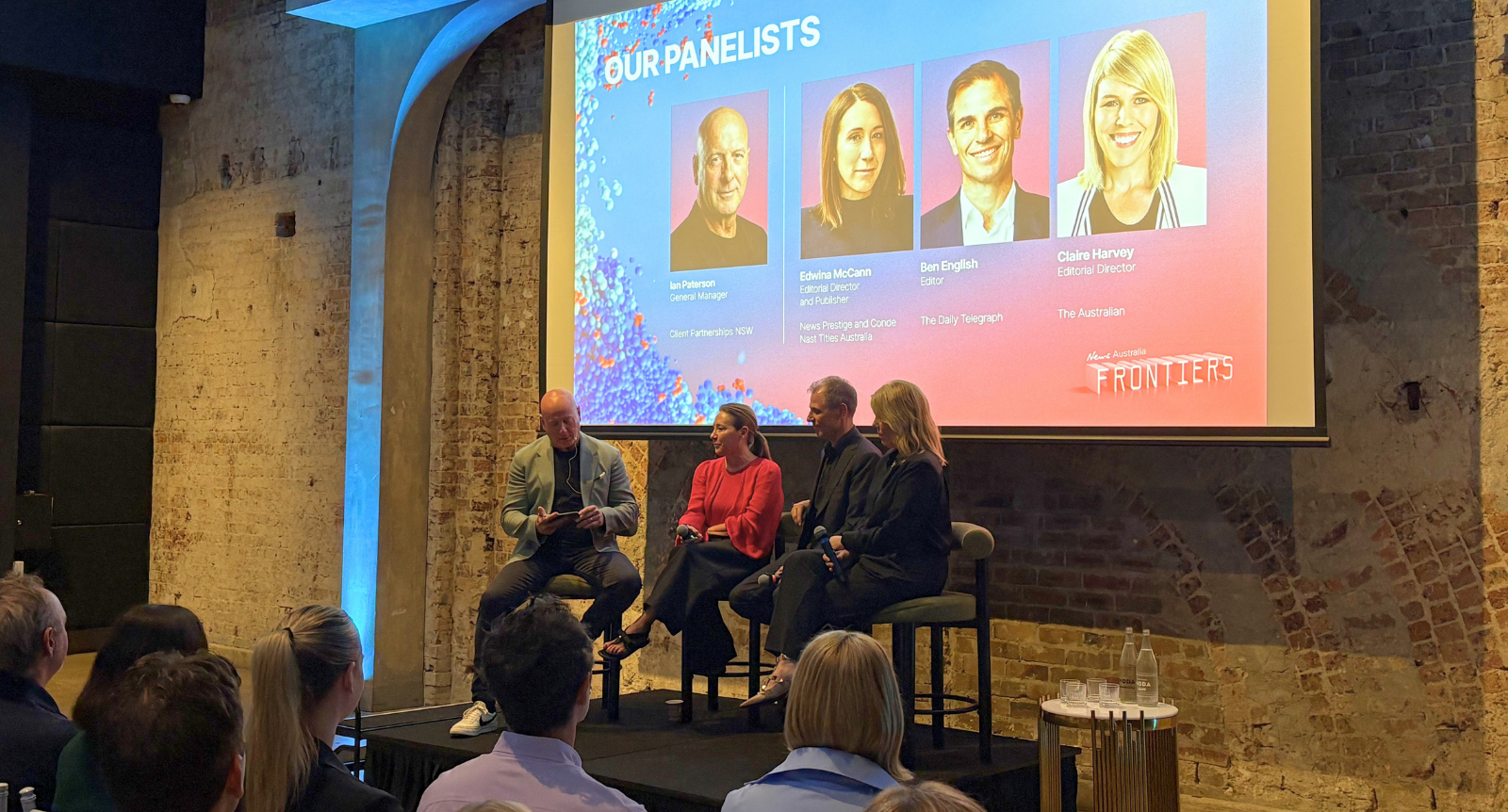 The Frontiers crowd were treated to a panel of influential editors. Image: supplied
And then she painted a vivid picture of the polycrisis coping mechanism in action.
Avid readers of The Australian would consume “7 or 8 stories about war”, but immediately following up with an article where a dietitian’s a number one tip recommended people eat an entire block of cheese.
Harvey easily landed a laugh in the room, but made the point about audiences moving rapidly from one strand to another.
Editor of the Daily Telegraph Ben English echoed this whiplash effect. He noted that readers wanted the Iran crisis decoded first thing in the morning, but they also desperately needed to know “what's going on with the Sea Eagles and why are they so crap?”.
English explained that news operates as a “two-way conversation”, rather than a “fire hose telling people from on high God's voice of what's going on”.
For instance, when readers flooded the comments asking how to identify and support local products, the Telegraph launched the massive "Back Australia" campaign to help consumers figure it out. And that, he said, gave them “permission to be patriotic again”.
Breaking down the velvet ropes
This evolution also extends into the world of luxury. Editorial director and publisher of News Prestige Edwina McCann discussed how legacy brands must meet audiences where they are.
McCann pointed out that many people refused to walk through the doors of a Chanel boutique because they feared they didn’t belong. But the luxury brands have now opened more welcoming beauty counters and shops in malls to stop “missing out on selling a lipstick” to these customers.
Watching the panel unfold, Horgan observed a sizeable cultural shift.
He told Mediaweek that seeing legacy editors directly connect with advertisers and show genuine consideration for the needs of brands represented a “significant evolution in the print and news business”.
The holy grail of collaboration
All of this ladders up to a stronger collaboration between publisher, agency and brands. And that's when the magic happens.
Referencing an NRMA campaign and the fruit of a previous Frontiers conference, Geer named, Help Our Highway, as the holy grail. “The best way to use news is not just for ads. It’s to actually drive cultural change in advocacy.”
And as the lunch plates were cleared at Alpha later in the afternoon, the message for Indies was clear.
The agencies that use their ingenuity to move quickly, tap into audience passions, and connect their clients to the things Australians actually care about, will win the day.
Feature image- Lou Barrett, managing director – client partnerships, News Australia.
More from Mediaweek
The leading media trade publication in Australia.
Get our top stories straight to your inbox daily by signing up to our Newsletter
By providing your information, you agree to our Terms of Use and our Privacy Policy. We use vendors that may also process your information to help provide our services.


