


'The flack we got was real': Ex-Clemenger and Monks leaders step out with AI production venture MC&V
It comes as agencies and brands shift from whether to use AI to how to do it without blowing timelines, budgets or reputations.

When Marie-Celine Merret and Vinne Schifferstein first started talking seriously about AI-native production, the reaction inside the industry wasn’t curiosity so much as quiet disbelief.
This was two years ago - before ChatGPT had detonated into the mainstream, before every agency deck sprouted an AI slide - and the idea that generative tools would meaningfully reshape the production pipeline sounded, to some, premature at best and reckless at worst.
Now, the former Clemenger and Monks leaders are stepping out on their own, launching MC&V AI Creative Production, an AI-native production company designed explicitly for what they see as advertising’s post-hype phase.
The company positions itself as a specialist production partner focused on judgement, craft and restraint - at a moment when agencies and brands are wrestling not with whether to use AI, but how to do so without blowing timelines, budgets or reputations.
Seeing it before it hit
Merret, who previously led creative AI production inside major agency environments, told Mediaweek the trajectory was clear long before the industry caught up.
“We saw this coming two years ago, just two years ago,” she said. “I think the talent really kind of came up globally just from the networks that we’ve got all over the world. We began to see it coming from a long way off. And it was very obvious what was going to happen.”
For Schifferstein, the inflection point came when AI’s impact stopped being theoretical.


The leading media trade publication in Australia.
Get our top stories straight to your inbox daily by signing up to our Newsletter
By providing your information, you agree to our Terms of Use and our Privacy Policy. We use vendors that may also process your information to help provide our services.
“I was consulting at the time with a client, and their business got disrupted literally from one day to the next when ChatGPT launched. And that for me was the eye-opener,” she told Mediaweek.
What followed was a rapid cascade across the production stack - first copy, then imagery, then motion, and now sound and end-to-end workflows. The tools, Schifferstein noted, weren’t ready yet - but the direction of travel was unmistakable.
“The moment we realised, well, actually the tools are not good enough yet, but they will get better,” she said. “And they’re aiming at targeting the production pipeline, every element of it.”
 A still from MC&V's 'Weis a Corn' campaign.
From experimentation to execution
Together, Merret and Schifferstein had already been operating at the sharp edge of that shift.
After establishing Monks in Australia and New Zealand, they reunited at Clemenger, where they built MADE THIS - one of the country’s earliest high-end creative AI production offerings.
Across that period, they delivered live campaigns, hybrid AI and live-action productions, and AI-enabled content systems for brands including Adidas, KFC, Afterpay, Samsung, Uniqlo and Schweppes.
That hands-on experience revealed what many agencies are now discovering the hard way: experimentation is easy; execution under real commercial pressure is not.
Imagery, Merret said, was an early lesson in both possibility and limitation.
“It started out with this wave of AI art, and everyone got caught up by the fact that it’s beautiful,” she said. “But then when you started to get into more production briefs, you’re like, oh... you’re getting six fingers. It’s a bit weird.”
The fix didn’t come from prompts alone, but from craft.
“True craftsmen, people in design or animation or whatever, would jump in and do a lot of comp work and kind of try to work out how to bend the tools to get to what we needed,” she said - always with the understanding that today’s outputs are “the worst you’re ever going to see it”.
Creatives, not coders, at the centre
One of MC&V’s core bets is that the next phase of AI adoption will be led less by technologists and more by experienced creatives shaping tools to fit real production workflows.
“What’s interesting with this now is the tech is not just shaped by engineers and PhDs in machine learning,” Merret said. “It’s now more and more artists and creatives that help them shape the tools.”
Schifferstein is blunter about the early narrative that dominated the conversation.
“That narrative got mainstream with a lot of prompt engineers jumping on the tools and pushing out AI slop,” she said. “But their backgrounds are years and years of experience in directing films or in VFX or in animation. They are craftsmen. First and foremost.”
Missing that distinction, he argues, put parts of the industry on the back foot.
“A lot of people couldn’t see through that,” she said. “And maybe MC and I were one of the first back then to say, well actually, this is what’s been pushed out now - but the potential is so much bigger.”
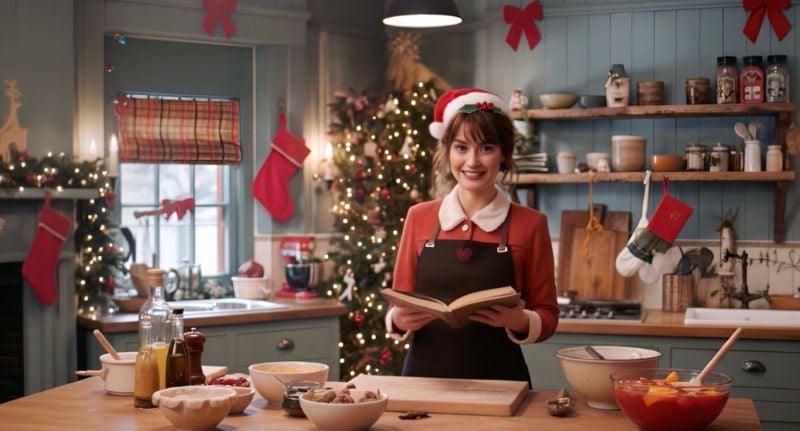 MC&V's campaign for Kitchen Warehouse, 'Mary Prepmas'.
Flack, fear and flying freelancers
Pushing that message early didn’t always land comfortably, particularly inside holding company structures.
“The flak we got, especially back then... and there are still a lot of people who are super hesitant,” Schifferstein said, recalling industry sessions where AI advocates were met with hostility.
The fear, she said, was existential: that AI meant replacement rather than augmentation. From MC&V's perspective now, the reality looks very different.
“The people who have actually embraced it, they are flying,” she said. “None of them are employed. They do not want to be employed. They just want to run their own show. They’re super busy.”
Why MC&V isn’t building its own tech
Notably, MC&V is deliberately steering clear of proprietary AI platforms - a move that cuts against the grain of many large-scale agency investments.
“We don’t believe in that,” Schifferstein said. “It’s not about the tech.”
Merret agrees, arguing that platform ownership is rarely a genuine differentiator when everyone is drawing from the same underlying tools.
“It’s not a differentiator in any way or form because everyone’s leveraging the same baseline,” she said. “Unless you’re building something specific for a brand, you’re not really differentiating yourself from one agency or holding company to the next.”
Instead, MC&V’s model centres on orchestration: designing workflows, assembling specialist talent, and making hard calls about when AI adds value - and when it doesn’t.
“We definitely won’t just pick up and do AI for the AI’s sake,” Merret said. “We have a pretty critical eye on briefs.”

Fewer promises, better outcomes
MC&V has already delivered projects with Apparent, Block (Kitchen Warehouse), Emotive (Weis) and Springboards, supporting agencies keen to push creative ambition without absorbing the operational risk of AI-led production.
The company also draws on a global talent network shaped in part through the AARON Awards - the world’s first awards program dedicated to recognising craft in AI-driven advertising.
In a market still balancing budget pressure with rising expectations, Schifferstein believes the timing is right.
“Budgets are still under pressure for brands, and they do want to do things,” he said. “This was an idea we had two years ago, but we couldn’t do it for the budget. Now we actually can.”
For MC&V, the pitch is deliberately unflashy: fewer promises, less noise, and production that holds up once the novelty wears off.
Main image: Marie-Celine Merret, Vinne Schifferstein
More from Mediaweek
The leading media trade publication in Australia.
Get our top stories straight to your inbox daily by signing up to our Newsletter
By providing your information, you agree to our Terms of Use and our Privacy Policy. We use vendors that may also process your information to help provide our services.


