



Search, scroll, settle: Ipsos iris shows women lead the great regional property chase
More than 15 million of us flocked to homes and property websites and apps in January.

There’s a moment, usually sometime after Christmas but before the credit card bill lands, when Australians start running the numbers on their lives.
What if we left? What if the mortgage was smaller, the block bigger, the air cleaner, the nearest neighbour several hundred metres away?
Alas, a girl can dream.
Meanwhile, for a large swathe of Australians in January, that quiet arithmetic went public.
More than 15 million Australians flocked to homes and property websites and apps at the start of 2026, according to Ipsos iris data released today.
That’s 15.1 million people, or 68.2% of the online population aged 14+, actively browsing listings, comparing suburbs and, perhaps, picturing a verandah instead of a balcony.
And the surge focused on one pressure point - regional.


The leading media trade publication in Australia.
Get our top stories straight to your inbox daily by signing up to our Newsletter
By providing your information, you agree to our Terms of Use and our Privacy Policy. We use vendors that may also process your information to help provide our services.
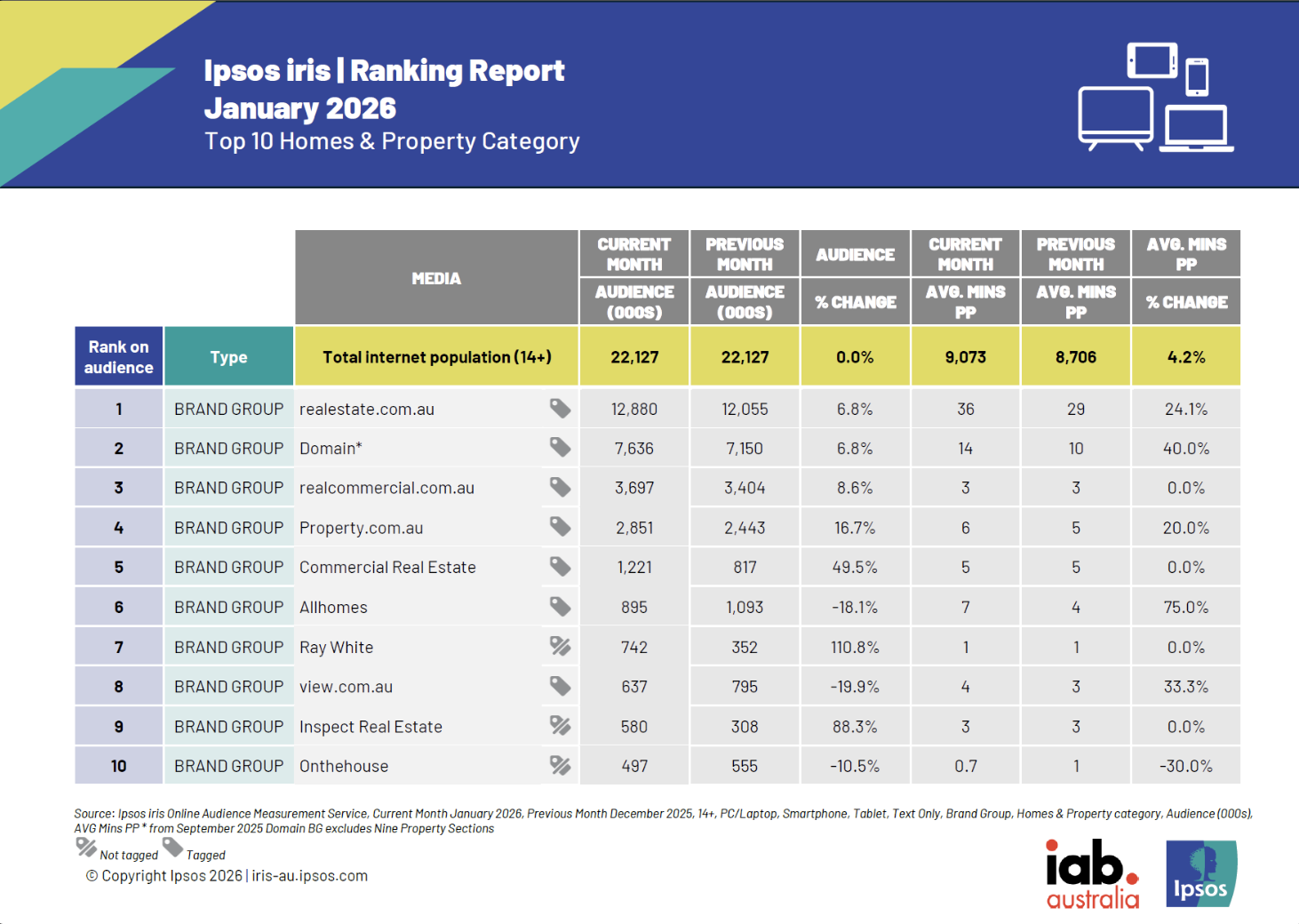
The country call gets louder
REA Group’s flagship platform pulled in 12.88 million Australians, reinforcing its status as the country’s largest digital property marketplace. Domain followed with 7.64 million users, leaving a commanding 5.24 million audience gap between first and second.
But why the sudden urge to up sticks? Well, with the prospect of paying at, well, over $2 million for a home in many of Australia's capital cities, buyers are once again looking to escape to the country.
And the data backs up the daydream.
Regional Australia led year-on-year growth in online home and property consumption. Audiences in regional NSW jumped 15%, compared to Sydney’s 3.6%. In regional South Australia and the Northern Territory, combined reach trended up 11.4%.
Victoria also saw momentum on both sides of the tram tracks. Melbourne audiences rose 12.5% year-on-year, up 7.9% in visits, while regional Victorian audiences increased 13.2%, with reach growing 6.1%.
According to Commbank, the regional property market surged in the three months to January, outpacing the capitals, according to figures from data firm Cotality. Dwelling values rose 3.2 per cent for the quarter in regional areas, compared to 2.1 per cent in the combined capitals.
AI meets acreage
REA’s dominance also stems from strategic moves designed to meet buyers earlier in their search journey.
In February, realestate.com.au launched Australia’s first dedicated property app for ChatGPT, giving seekers a conversational way to search listings directly within the AI platform.
The company also entered a new chapter on the executive level with Cameron McIntyre taking over as CEO in November 2025, succeeding Owen Wilson.
Women drive the property pulse
Another plot twist in the data? The ladies are leading the charge.
They represented 54% of the homes and property audience in January and spent an average 50.22 minutes per month consuming property content. Men made up 46% of the audience, spending 35.12 minutes per month.
Across the board, Australians spent an average of 43.2 minutes engaging with home and property content in January. The category recorded the strongest year-on-year growth of any major digital vertical, rising 5.3%, ahead of search engines and entertainment (both +3.3%), social networking (+3.1%) and retail and commerce (+3%).
Not every state joined the boom. Brisbane audiences rose 8.4%, but regional Queensland declined 3.8%. Western Australia recorded drops of 4.1% in metro and 3.6% in regional audiences. Tasmania saw audience declines too, though reach lifted 11.3% in metro areas and 4.3% regionally.
News still commands attention
While property hunters were mapping out tree changes, Australians were also glued to the news cycle.
Nearly 21 million Australians consumed online news content in January. Ipsos iris data shows 20.7 million people used a news website or app, reaching 93.4% of online Australians aged 14+, down slightly from 97.5% at the same time last year.
Time spent tells its own story. Australians averaged 5.14 hours consuming news in January, up from 5.09 hours per month a year earlier.
Locally, the 2026 Australian Open drove spikes in audience reach throughout the tournament. Weather events, particularly bushfires in Victoria and heatwaves across NSW and Victoria, sustained high engagement through rolling coverage, maps, alerts and transport updates.
Other major local stories included the Mosman Park double murder-suicide tragedy, the death of a 12-year-old Sydney boy from a shark attack, and Triple J’s annual Hottest 100.
Globally, audiences tracked stories related to reports of Home Alone and Schitt’s Creek actress Catherine O’Hara’s death, the crisis in Venezuela, including explosions in Caracas, the US operation leading to the capture of President Nicolas Maduro, a Swiss Alps ski resort bar fire, and the Nipah virus outbreak across India and Asia.
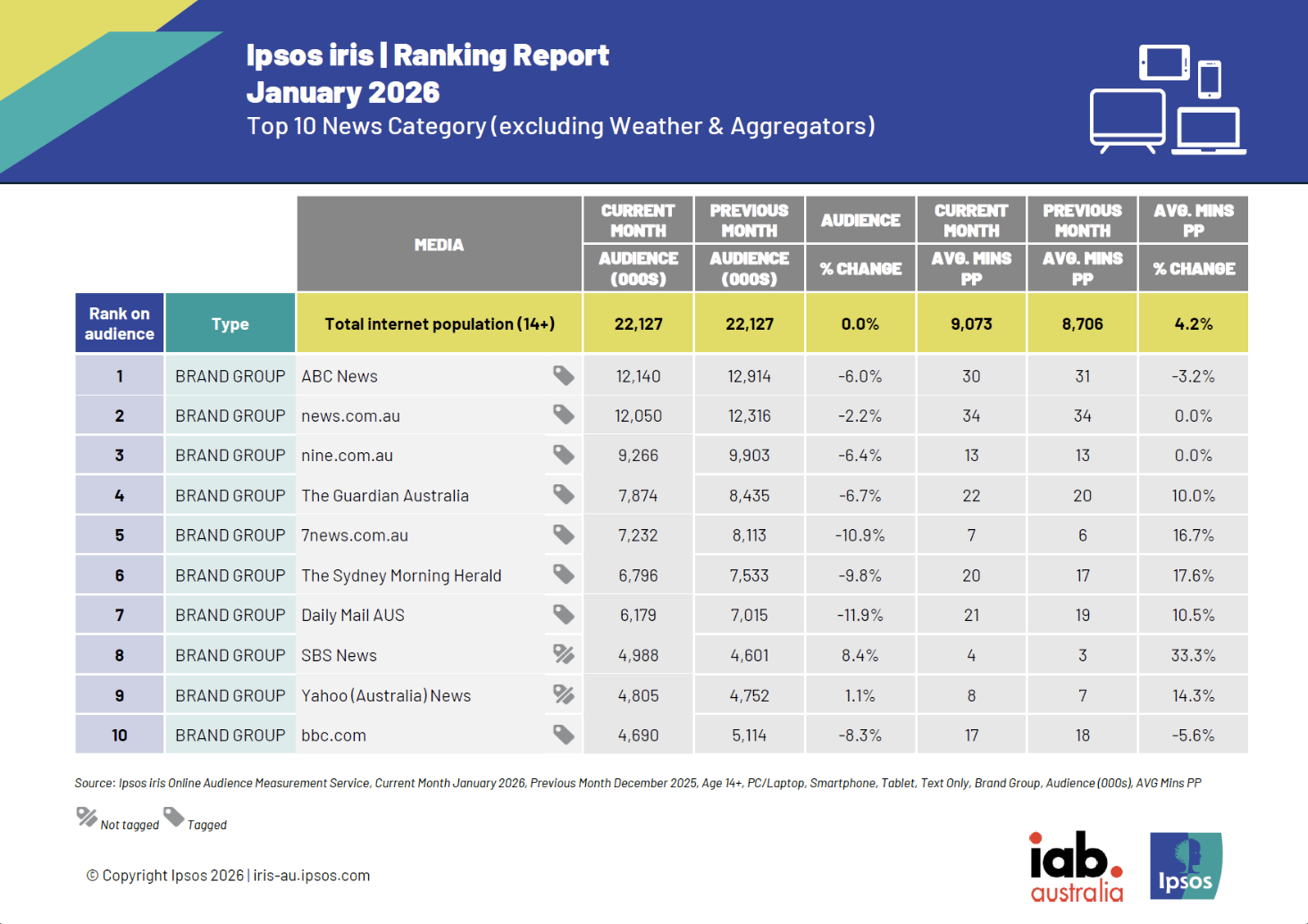
A nation online
Ipsos iris, endorsed by IAB Australia as the country’s digital audience measurement currency, reported that 22.127 million Australians aged 14+ used the internet in January, spending an average 5.06 hours daily online, up 5.1% year-on-year.
The most consumed categories were search engines (22.06 million), social networking (22.05 million), online media (22 million), technology (21.9 million), and retail and commerce (21.8 million).
But it was homes and property that posted the biggest audience increase.
In a month defined by resolutions, heatwaves and headline tennis, Australians weren’t just refreshing news feeds. They were refreshing their idea of home.
More from Mediaweek
The leading media trade publication in Australia.
Get our top stories straight to your inbox daily by signing up to our Newsletter
By providing your information, you agree to our Terms of Use and our Privacy Policy. We use vendors that may also process your information to help provide our services.

-1.png%3Fv%3D1790650590033&w=3840&q=75)


