



Fake paper, real problem: RPA trolls UK MPs with ‘The Misleading Times’
It's a provocative campaign targeting Members of Parliament.

Reform Political Advertising took a dig at the United Kingdom Members of Parliament via irony and sarcasm.
RPA, working with creative agency Clemenger BBDO Australia, has launched a provocative campaign targeting Members of Parliament ahead of the United Kingdom government’s upcoming Elections Bill.
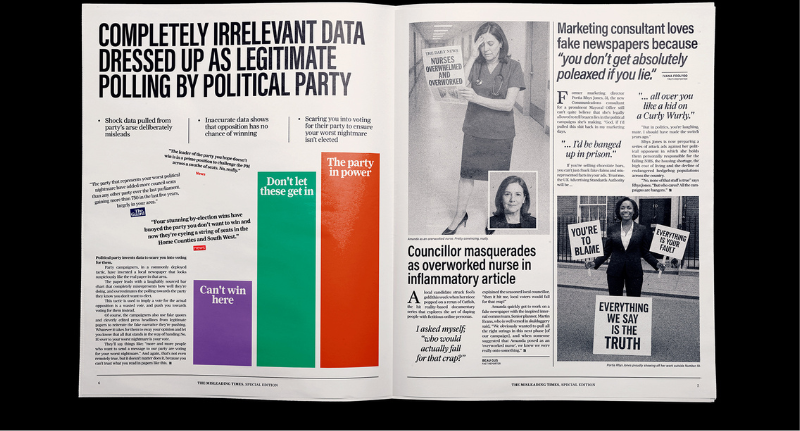
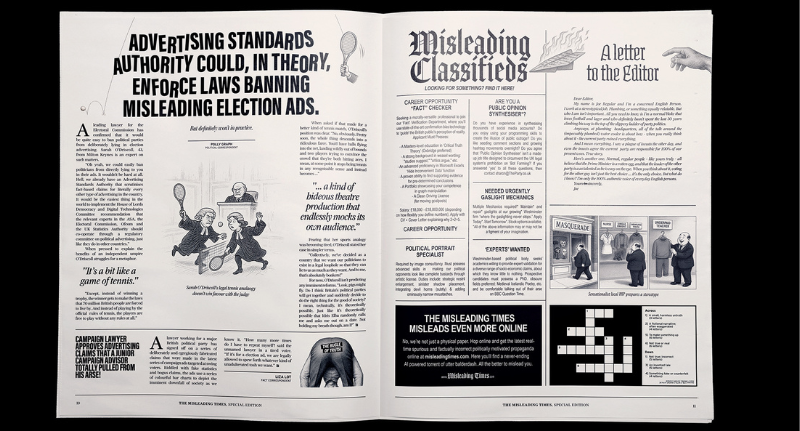
The campaign delivered a deliberately fake newspaper to Westminster.
Titled, The Misleading Times, the publication mimics the look and tone of local newspapers that political parties have been accused of using during election periods to covertly push partisan messages.
Using the loophole to expose the problem
Under current UK law, election advertising is exempt from the factual accuracy standards that apply to commercial advertising regulated by the Advertising Standards Authority.
Reform Political Advertising argues this has enabled political parties to distribute misleading content, including fake newspapers that imitate trusted local mastheads.
 The Misleading Times.


The leading media trade publication in Australia.
Get our top stories straight to your inbox daily by signing up to our Newsletter
By providing your information, you agree to our Terms of Use and our Privacy Policy. We use vendors that may also process your information to help provide our services.
The campaign leans into that tactic by producing a 100% fabricated newspaper, filled with deliberately absurd headlines designed to demonstrate how easily misinformation can be presented as fact.
Among the satirical stories included are:
“CAMPAIGN ANALYST NOT SURPRISED AT HOW DIRE THE PROBLEMS ARE THAT HE JUST MADE UP”
“COMPLETELY IRRELEVANT DATA DRESSED UP AS LEGITIMATE POLLING BY POLITICAL PARTY”
“POLITICIAN RUSHED TO HOSPITAL AFTER TROUSERS SPONTANEOUSLY COMBUST”
While intentionally over the top, the paper’s editorial makes a blunt point: “It’s perfectly OK for political parties to lie and deceive you as much as they like.”
A push to influence the Elections Bill
The campaign lands as the Labour government prepares to introduce a new Elections Bill, which RPA says represents a rare opportunity to modernise Britain’s electoral advertising laws.
The group is lobbying for four specific amendments, including extending imprint rules to all election advertising, banning deceptive political deepfakes, creating a public repository of election ads, and introducing a formal code of practice enforced by regulators.
Two of those proposals - a global ad repository and a code of practice - were previously recommended by the cross-party House of Lords Democracy and Digital Technologies Committee in 2020.
‘A packet of crisps has more rules than an election ad’
Alex Tait, co-founder of RPA, said the campaign was designed to force lawmakers to confront the issue directly.
“We created The Misleading Times to hold a mirror up to the system. It is ludicrous that in 2026, if you advertise a packet of crisps, you have four sets of rules to ensure that your advertising is accurate, but if you are advertising to influence a vote in an election, there are none,” Tait said.
 The Misleading Times.
“The new Elections Bill is a once-in-a-generation opportunity to close these loopholes. We are asking MPs to see the funny side of our newspaper, but the serious side of our message: it is time to stop the rot and protect our democracy from disinformation.”
Clemenger BBDO: ‘The power is now in their hands’
Psembi Kinstan, chief creative officer at Clemenger BBDO Australia, said the agency deliberately replicated the techniques used in real-world political misinformation campaigns.
“We looked at every trick and tactic the political parties employ in their fake newspapers, and used them to make our point,” Kinstan said.
“We’re educating both the MPs and the public on the deceptions to look out for, with dozens of articles, intricately researched and crafted. Every British MP has now received this paper, and the power is in their hands to outlaw this egregiously undemocratic behaviour.”
More from Mediaweek
The leading media trade publication in Australia.
Get our top stories straight to your inbox daily by signing up to our Newsletter
By providing your information, you agree to our Terms of Use and our Privacy Policy. We use vendors that may also process your information to help provide our services.


