


Is Snapchat stopping under-16s from using the app under Australia’s new social media minimum age laws?
Early signs suggest enforcement is patchy, with families telling the Australian Financial Review that teens are finding simple ways to regain access after account deactivations.
The minimum age obligation began on 10 December 2025 and requires designated platforms to take “reasonable steps” to prevent Australians under 16 from having accounts. Companies that fail to comply face penalties of up to $49.5 million.
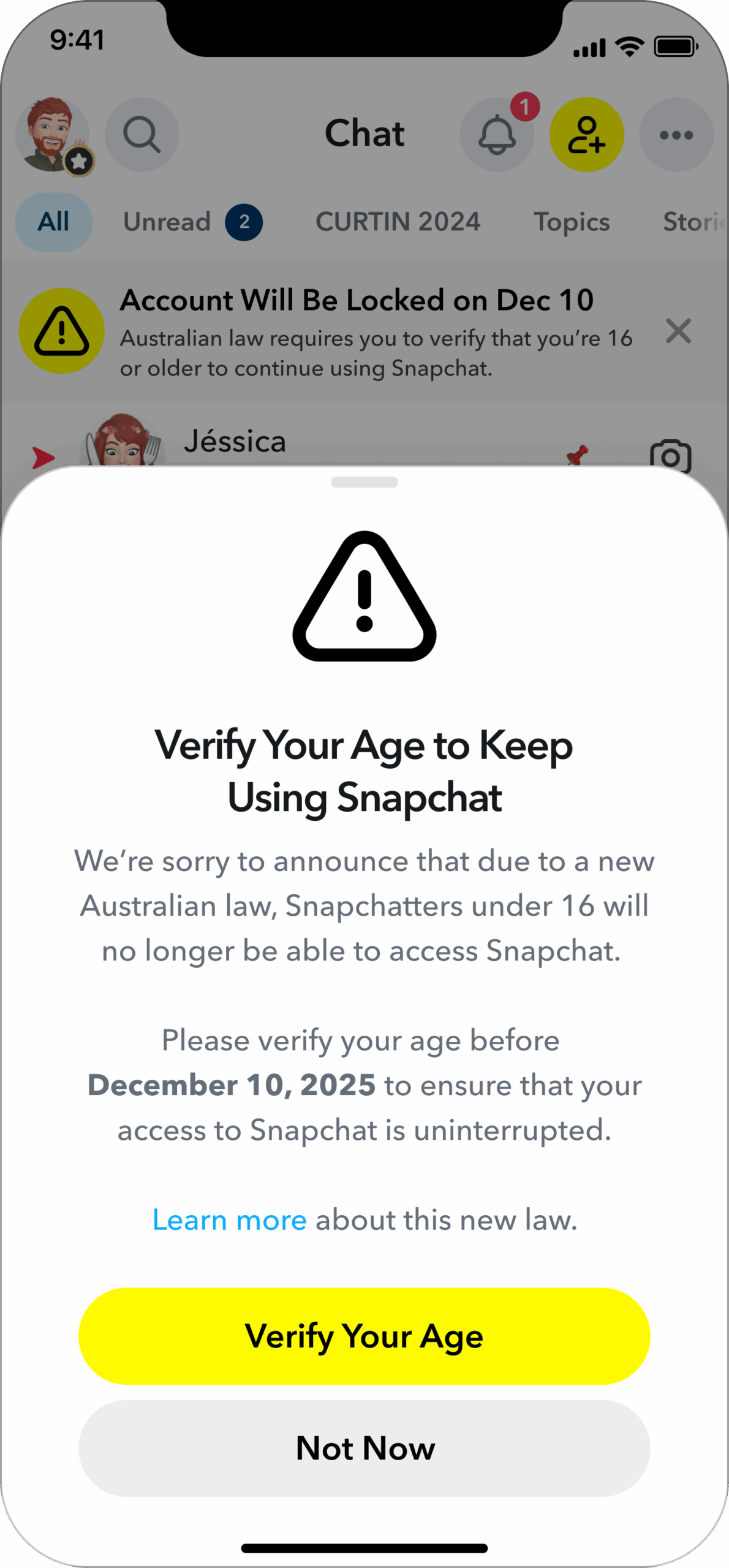
The prompt on Snapchat that accounts detected as being under-16 saw before the social media ban.
What the early data shows
Federal government figures released in January said about 4.7 million accounts were deactivated, removed, or restricted across the initial group of age-restricted platforms.
Prime Minister Anthony Albanese and Communications Minister Anika Wells have pointed to the headline number as early evidence that the policy is shifting behaviour, although no platform-by-platform breakdown has been released publicly.
Julie Inman Grant, Australia’s eSafety Commissioner, has also described the first wave of deactivations as an important starting point, while cautioning that the harder task is stopping new underage accounts from being created and re-created.
Why Snapchat is emerging as a flashpoint
In its report, the Australian Financial Review said Snapchat is proving among the easiest services for teens to access again, even after initial lockouts. The paper described teenagers creating new accounts using fake birthdates and bypassing age checks without needing more advanced workarounds.
The AFR also reported claims that some users can bypass facial age checks by using another person’s face, such as an older friend or sibling. Those accounts can then be used to reconnect with the same peer groups, undermining families attempting to enforce the ban at home.
What ‘reasonable steps’ means in practice
The law does not mandate a single verification method. Platforms can use a mix of approaches, including signals from account data and behaviour, as well as age-assurance tools such as facial estimation, depending on their systems and risk settings.
eSafety’s guidance also puts weight on preventing “recidivism” and circumvention, meaning platforms are expected to do more than remove existing underage accounts. They must also address repeat sign-ups and other common bypass routes as their systems mature.

Julie Inman Grant, Australia’s eSafety Commissioner
Where parents fit in
While the legal obligation sits with platforms, eSafety has urged parents to report suspected underage accounts to services and to the regulator, particularly where children are bypassing restrictions against family rules.
Under-16s and parents are not the targets of penalties.
For media, marketers and platforms, the next phase will be whether “reasonable steps” becomes a higher bar in practice, especially if anecdotal reports of easy re-entry persist and enforcement action begins to test what compliance looks like in the real world.