

Former Fisher & Paykel and Tyrrell’s Wines marketer Peter Russell never expected his next venture would land in the middle of Australia’s $1.6 billion funeral industry.
But after years spent building brands and businesses – including founding LayAway Travel before its sale to Afterpay – Russell has launched Reterniti, a company attempting to carve out a new category in what’s increasingly being dubbed ‘death tech’.
Its flagship product is what the company describes as the world’s first Cremation Stone, designed as an alternative to traditional urns, memorial boxes and fixed gravesites.
It’s a category play aimed squarely at changing consumer behaviour.
Australia’s funeral sector remains dominated by major operators, including InvoCare – owner of White Lady Funerals and Simplicity Funerals – alongside Propel Funeral Partners. But the market is shifting, with growing demand for lower-cost cremations, personalised “celebration of life” services and more flexible memorial options.
A simple no-service cremation can cost around $4,000, while a full-service burial can stretch beyond $20,000.
Reterniti’s own research, commissioned as part of the launch, found 70% of Australians believe rising burial costs and increased relocation are making gravesites harder to choose when honouring loved ones.
Russell believes modern life itself has fundamentally changed the way people grieve.
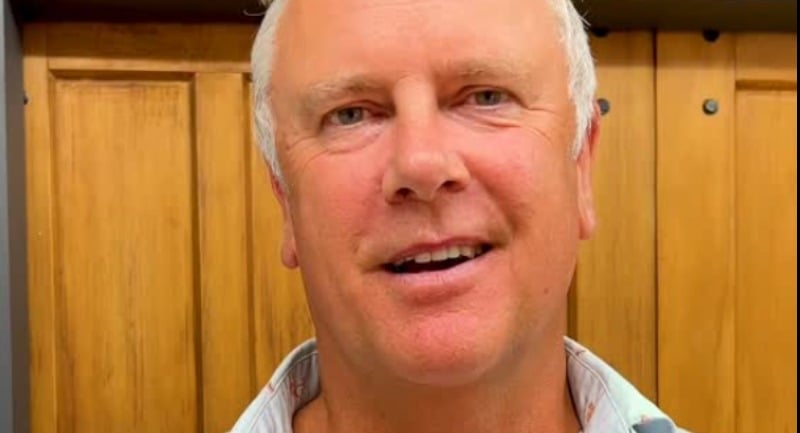
Peter Russell
A late-night trip to the park
The idea for Reterniti didn’t emerge from a strategy deck or a whiteboard session. It came after the death of the family dog.
“I honestly never thought I’d be anywhere near this industry,” Russell told Mediaweek.
“We had a golden retriever in Sydney, and when he passed away, the kids said, Dad, what are we going to do with his ashes?
“So we snuck one night down to the local park, which was our dog’s favourite place. There was a big boulder at one end, so we dug a shallow grave beneath it and put him there.”
When the family later returned, the landmark was gone.
“Then we went back one night, and the boulder had gone. We were just mortified. It was one of those shake your fist at the heavens moments.”
The experience sparked a broader question about portability, permanence and, of course, remembrance.
“It also turned into an epiphany because I thought if there was only a way in which we could have taken the ashes with us.
“All this sort of went through my mind in about a nanosecond. Then I went, hold on, and so Reterniti was born.”
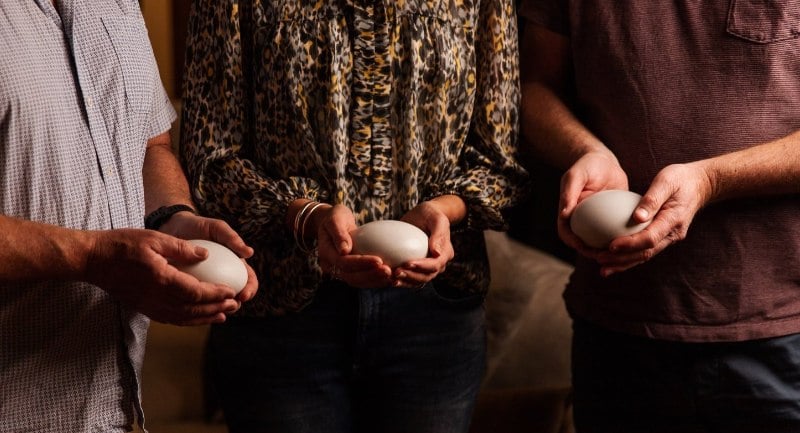
The Reternity stones.
A slow-moving industry meets modern consumers
Russell is candid about the market opportunity – and the gaps he believes exist inside the traditional funeral sector.
“The entire death care industry is just this behemoth, but it’s also slow-moving, lacking innovation, and very slow to respond,” he said.
“Not many brands cut across pets and people.”
According to the company, many households no longer feel connected to traditional urns or memorial sites, but are equally reluctant to scatter ashes, leaving many remains stored indefinitely inside homes.
COVID, Russell argues, also changed the conversation around mortality.
“I think younger people are thinking about death much earlier. It’s not the sort of thing that you talk about around the dining table, but people are quite open about it now,” he said.
“I think if I had tried to launch this pre-COVID, it may not have worked.”
Part of that shift, he says, was emotional. Another part was logistical.
“COVID has normalised talk about this sort of stuff – all the death ‘what ifs’.
“The second thing is that couriers have gotten so much better, and because our business is primarily online, we rely heavily on courier movements.”
Designed to sit quietly in the home
For Russell, the product itself had to feel less clinical and more like an object people actually wanted to live with.
“It was design-led before I even took it to market,” he said.
“I had our brand guidelines, and every touch point was researched.”
Living in Christchurch influenced the design process, though not always in the way he expected.
“I’m in Christchurch, and there are a lot of beautiful rivers around here with tumble river stones, and I thought surely that would be appealing to people, but actually it wasn’t, because it looks like a river stone, and people didn’t want them like that.”
The final design landed somewhere between a sculpture, a keepsake, and an industrial design exercise.
“No one wants to hold a cube or something man-made with sharp edges, either. And while they don’t want a ball, the most pleasing shape, curiously, was this elliptical kind of flattened spherical shape.
“So that shape and the fact that it had to fit into the palm of a hand were carefully researched. And it worked.”
Russell said Scandinavian design principles also heavily informed the product’s final aesthetic.
“I think they’re the masters of design, of materiality, of simplicity, of pairing everything.
“It will fit most people’s decor and just sit there quietly, reservedly, and discreetly. And it’s there if you want it to be. It can even sit next to your PC at work.”
View this post on Instagram
Marketing a product nobody wants to need
Reterniti’s marketing strategy is deliberately understated – less hard sell, more quiet familiarity.
“This is not the sort of campaign you would put on a bus back, or on billboards, TV, or even in a magazine. This is not that sort of product,” Russell said.
Instead, the company relies heavily on social media advertising across platforms such as Instagram and Facebook.
“And if a potential customer sees it once or twice, that’s enough,” he said.
“You only need to be tangentially aware of this, so that when the day comes, if it’s your cat or your dog, or even a friend or your parents’, at least you know enough to look into the product.
“That’s all we need. You’re planting the seed for the future.”