



Why Nano Girl wants Australia to rethink AI, kids and work
Why workplaces need failure parties as much as innovation sprints.

Dr Michelle Dickinson has spent her career championing technology, yet the people shaping today’s AI boom leave her uneasy.
The engineer and nanotechnologist, better known as Nano Girl, stepped on stage at SXSW Sydney for a live recording of Rules Don’t Apply with The Growth Distillery’s Dan Krigstein, ready to talk about innovation. Instead, she opened with a provocation.
She asked the audience to list the major AI powerbrokers - “Sam Ottman, Elon Musk, Jeff Bezos, maybe in what he did at Amazon.”
Then she dropped the line that rippled through the room: “On a hand. None of these people would I leave alone with my children.” Her concern is not the technology itself but the incentives behind it. “If you look at what they're building and what their motives are, typically power or profit or both. They're not thinking about keeping humans safe. They're thinking about scaling, expanding, winning.”
For Dickinson, that creates a widening gap between those driving AI’s trajectory and ordinary users who barely understand where their data goes or “what the world will potentially look like in a very short period of time.”
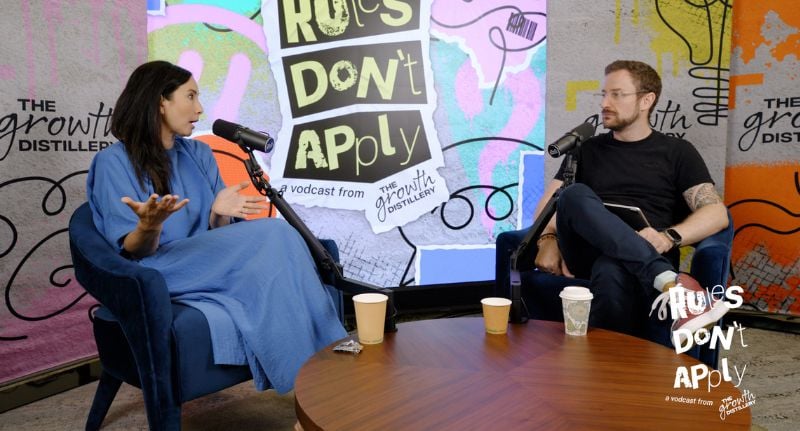 Dr Michelle Dickinson, and Dan Krigstein.
She sees a cultural blind spot, one she encounters often in her work in digital inequality. “Those who are seeing the consumer front end are still the privileged,” she said.


The leading media trade publication in Australia.
Get our top stories straight to your inbox daily by signing up to our Newsletter
By providing your information, you agree to our Terms of Use and our Privacy Policy. We use vendors that may also process your information to help provide our services.
Many Australians still lack devices or internet access, yet they are the most vulnerable to deepfakes, scams and AI-driven manipulation. As she put it: “We're not thinking about our elderly relatives who might be totally scammed soon 'cause they see a video of somebody they love in trouble and need to wire money.”
That urgency has shaped her newest initiative: a charity called Smarter with AI.
Dr Dickinson argued that the real challenge now is helping everyday people understand AI in ways that genuinely matter to them. Most, she said, “don’t care about the tech behind the scene,” but they do care about real-world consequences - how these systems might harm them and what steps they can take to stay safe.
For her, it’s an education play rooted not in hype but in survival, from protecting children’s data to understanding “how if you are gonna use AI, that you might protect your children's brains.”
When the conversation turned to young people and education, her tone sharpened. AI can transform learning, she said, but not if it replaces the cognitive labour children need to develop.
“If you said to me, write an essay on something, I'd be like, 'ChatGPT write me an essay'. But [in doing that] I don't build that foundation for my brain that I need later on in life.”
Her bluntest line came later: “I think young people's brains are gonna turn to mush if we don't help them navigate AI. We are basically gonna have a whole generation of idiots"
Her proposed fix spans teachers, parents and policy.
She wants to lift AI literacy in classrooms - “We have to empower our amazing teachers. Take away the bureaucracy, and bring their joy back to teaching” - and continue tightening age-based online protections.
 Dan Krigstein
Australia’s under-16 social media laws, she said, are “a start". But she cautioned that parents need support too.
Dickinson went on to say that she believes curiosity is both the antidote to our current tech anxieties and one of the first casualties of the systems kids grow up in.
“Kids are born with curiosity, right? We drive it out of them in school, and exams don't care about your questions.”
The best engineers, she said, are shaped by questioning rather than compliance - “people who are curious, who push the boundaries, who go, I wonder what if.”
Her advice to parents follows the same logic: “Pretend you don't know. How might we go about figuring that out?” For Dickinson, learning how to learn is the ultimate future-proof skill, and it sits at the core of the Nano Girl character she built “to help young people to find their superpowers.”
As the discussion shifted to leadership, Dickinson was no gentler with adults than she is with the tech titans shaping AI. The biggest barrier, she said, is ego.
“The higher you get up in a position, the worse you are at the ability to say, I don't know.” Conditioned from school to fill blanks rather than admit uncertainty, leaders bluff through meetings.
Inside Nano Girl Labs, Dickinson has built a culture that values thoughtfulness over noise, slowing decisions to give deep thinkers room to process.
Meetings require 24 hours’ notice, and another 24 hours are added before anything is finalised. Every Friday, the team gathers for a “failure party” - donuts included - where staff are encouraged to share what went wrong under a strict no-blame ethos: “Things are going to go wrong". Flexibility is essential (“work any hours you want”), and curiosity guides every hiring decision.
Despite the intellectual clarity, the personal toll is real. With a public profile comes constant trolling. “People hate me. I've had to grow thick skin,” she said. But she refuses to quit. Asked how she’d like to be remembered, she answered simply: “It wasn't what she did, it was how she made me feel.”
Main image: Dr Michelle Dickinson
More from Mediaweek
The leading media trade publication in Australia.
Get our top stories straight to your inbox daily by signing up to our Newsletter
By providing your information, you agree to our Terms of Use and our Privacy Policy. We use vendors that may also process your information to help provide our services.


