
Friday February 6, 2026
Fake ransom texts, and every update on Savannah Guthrie's missing mum
The mystery of the apparent abduction of Nancy Guthrie, the mother of NBC Today‘s Aussie-born host, Savannah Guthrie, continues.
Pima County Sheriff Chris Nanos updated the press with fresh information on the search for the 84-year-old, who went missing from her Arizona home five days ago.

The missing persons alert issued by police for Nancy Guthrie. Image: Pima County Sheriff’s Department
Updates on Savannah Guthrie’s missing mum
Sheriff Nanos said that a California man accused of sending fake ransom texts to Savannah Guthrie’s family has been arrested and charged, according to a criminal complaint filed Thursday, the New York Post reports.
Multiple ‘ransom notes’ have been received by police, TMZ, and the family.
Police revealed one of the ransom notes sent to local and national news outlets did not include a proof of life nor a way for law enforcement or her family to communicate with the senders.
They further shared that another ransom note set a deadline of 5 p.m. on Thursday, but that time is approaching, and there has been no further communication. There is also a “second demand” set for February 9, with the note promising “a more serious consequence.”
A $50,000 reward has been offered for any information that leads to Nancy’s recovery.
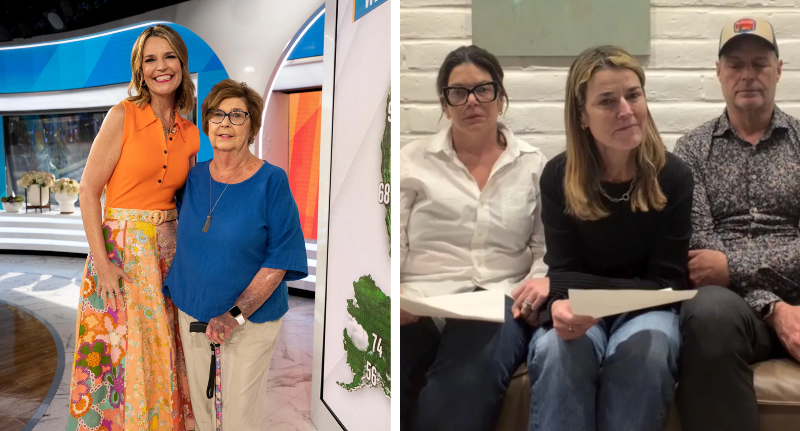
Left: Savannah Guthrie and her mum Nancy. Image: NBC. Right: The Guthrie family made an emotional plea in a video on Wednesday. Image: Instagram
Savannah Guthrie’s desperate plea
The press conference was held just hours after Nancy’s three adult children released a heartbreaking video pleading for proof that their mother is still alive. They also told her potential captors that they are “ready to talk.”
Savannah, sitting with her siblings Annie and Cameron Guthrie, said: “We need to know, without a doubt, that she is alive, and that you have her. We want to hear from you, and we are ready to listen. Please, reach out to us.”

Bunnings gets the green light to use AI facial recognition to combat store crime
Aussie hardware goliath Bunnings has won a landmark legal challenge allowing it to use artificial intelligence-powered facial recognition technology to combat retail crime and protect staff.
The new decision overturns a previous ruling by Australia’s privacy watchdog.
The Administrative Review Tribunal has found the hardware giant did not breach privacy laws during its trial of facial recognition technology, reversing a 2024 determination by Privacy Commissioner Carly Kind that Bunnings had unlawfully collected customers’ biometric data without consent.
While the tribunal upheld Bunnings’ right to use the technology for security purposes, it said the retailer should improve customer notification, signage, internal processes and its privacy policy.
The decision is expected to have broader implications for the retail sector, potentially enabling other retailers to deploy similar AI-based security systems.

Bunnings CEO, Mike Schneider
Tribunal backs limited use of facial recognition
In a statement, Bunnings managing director Mike Schneider said the retailer welcomed the decision and acknowledged areas for improvement.
“Our intent in trialling this technology was to help protect people from violence, abuse, serious criminal conduct and organised retail crime,” Schneider said.
“The tribunal recognised the need for practical, common-sense steps to keep people safe. It also identified areas where we didn’t get everything right, including around signage, customer information and our privacy policy, and we accept that feedback.”
The tribunal found that Bunnings was entitled to use facial recognition technology for the limited purpose of combating serious retail crime and safeguarding staff and customers, noting the scale of theft and abuse the retailer faced.
It also cited technical safeguards in the system, including the rapid deletion of biometric data for customers who were not flagged as known offenders.
How the technology was used
Bunnings first experimented with facial recognition technology in one store in November 2018, then expanded its use to 62 stores across New South Wales and Victoria between January 2019 and November 2021.
The system, developed by Hitachi and supplied via a third party, scanned customers’ faces in CCTV footage and compared them with a database of “enrolled individuals” suspected of theft, fraud, or threatening behaviour.
According to the tribunal, the enrolment list at times included hundreds of individuals. Facial data for customers who were not matched was automatically deleted within milliseconds.
The image database was stored on a central server in Sydney, with copies temporarily held on local store servers.
Privacy concerns remain
The case first emerged publicly in 2022 after consumer advocacy group Choice revealed that Bunnings, Kmart and The Good Guys had been using facial recognition technology.
All three retailers paused the AI practice following the report.
The Office of the Australian Information Commissioner (OAIC) said the tribunal’s ruling confirmed that privacy protections still apply to emerging technologies, even when data is collected momentarily.
The tribunal agreed Bunnings had not sufficiently informed customers that facial recognition technology was in use and needed to strengthen how it managed personal information, particularly for customers not included in the enrolment database.
“The Australian community continues to care deeply about their privacy, and is increasingly worried about the challenges in protecting their personal information.”

Amazon’s ad business jumps 23% as AWS grows fast
Amazon has reported a stronger December quarter, with advertising and AWS both accelerating as the company flagged a sharp lift in AI-led investment for 2026.
In its fourth quarter results for the period ended 31 December 2025, Amazon said net sales rose 14 per cent year-on-year to AU$307.4 billion. Operating income increased to AU$37.3 billion, up from AU$31.7 billion a year earlier.
What were Amazon’s key Q4 2025 numbers?
- Net sales: AU$307.4 billion, up 14 per cent year-on-year (12 per cent excluding FX benefits).
- Operating income: AU$37.3 billion, up from AU$31.7 billion.
- Net income: AU$31.7 billion, up from AU$29.9 billion.
- Diluted EPS: AU$2.91, up from AU$2.78.
Amazon noted its Q4 operating income included three “special charges”: AU$1.64 billion tied to tax dispute resolution in Italy and a lawsuit settlement, AU$1.09 billion in estimated severance costs, and AU$911 million in asset impairments largely related to physical stores. Excluding those items, it said operating income would have been AU$40.9 billion.
Bezos faces backlash over Washington Post job cuts
Outside the numbers, Amazon’s results landed amid growing scrutiny of founder Jeff Bezos following deep cuts at The Washington Post, which he owns.
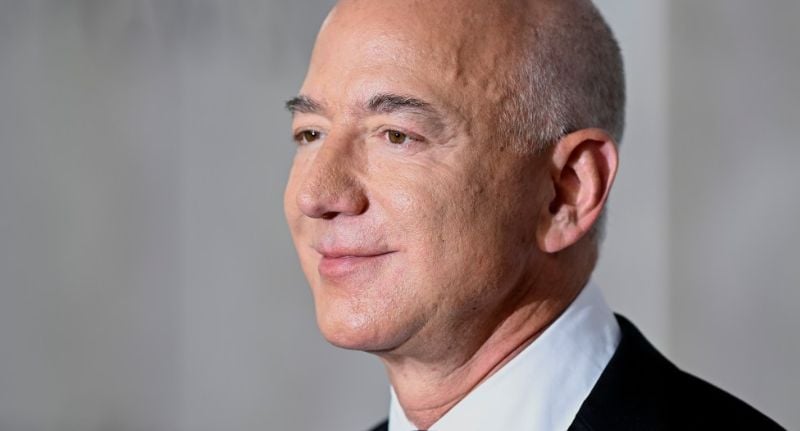
Jeff Bezos
The newspaper confirmed it is cutting more than 300 roles, around 30 per cent of its workforce, with sports, local news and international coverage among the hardest hit, according to reporting by The New York Times.
Management cited prolonged financial losses and the need to refocus the business, but the scale of the layoffs has triggered a fierce backlash from staff and former editors, who argue the cuts risk hollowing out the newsroom and damaging the paper’s credibility at a time when trust in journalism is already under pressure.
AWS accelerates, while advertising climbs
AWS revenue rose 24 per cent year-on-year to AU$53.2 billion, with operating income of AU$18.7 billion (up from AU$15.8 billion). Amazon described it as AWS’ fastest growth in 13 quarters.
Amazon’s advertising services revenue increased to AU$31.8 billion in the quarter, up 23 per cent year-on-year (or 22 per cent excluding FX). The line item covers ad sales across sponsored ads, display, and video advertising.
By segment, North America sales were AU$189.8 billion (up 10 per cent), International sales were AU$75.7 billion (up 17 per cent, or 11 per cent excluding FX), and AWS was AU$53.2 billion (up 24 per cent).
Prime Video sports and streaming highlights
For media buyers and rights watchers, Amazon’s release leaned heavily into Prime Video’s sports performance and pipeline.
- Amazon said the fourth season of Thursday Night Football averaged more than 15 million viewers, up 16 per cent year-on-year.
- It said the Packers vs Bears Wild Card Playoff game drew more than 31 million viewers, which it described as the most-streamed NFL game in history.
- Amazon also said it debuted NBA on Prime in more than 200 countries, including coverage of the Emirates NBA Cup.
- In Europe, it said it extended UEFA Champions League broadcast rights in Germany, Ireland, Italy and the UK through the 2030/31 season.
AI investment and a $200 billion capex signal
Andy Jassy, Amazon President and CEO, attributed the momentum to new products and infrastructure across cloud, retail and hardware, pointing to AI, chips, robotics and low Earth orbit satellites as long-term bets.
“AWS growing 24% (our fastest growth in 13 quarters), Advertising growing 22%, Stores growing briskly across North America and International, our chips business growing triple digit percentages year-over-year—this growth is happening because we’re continuing to innovate at a rapid rate, and identify and knock down customer problems,” Jassy said.
He added: “With such strong demand for our existing offerings and seminal opportunities like AI, chips, robotics, and low earth orbit satellites, we expect to invest about US$200 billion in capital expenditures across Amazon in 2026, and anticipate strong long-term return on invested capital.”
The company also reported a widening gap between operating cash flow and free cash flow. Operating cash flow for the trailing 12 months rose 20 per cent to AU$208.3 billion, while free cash flow fell to AU$16.7 billion. Amazon said the decline was driven primarily by a year-on-year increase of AU$75.7 billion in purchases of property and equipment, largely reflecting AI-related investment.
What guidance did Amazon give for Q1 2026?
For the first quarter of 2026, Amazon guided:
- Net sales: AU$259.0 billion to AU$266.5 billion (11 to 15 per cent growth year-on-year), including an estimated 180 basis point FX tailwind.
- Operating income: AU$24.6 billion to AU$32.1 billion, compared to $18.4 billion in Q1 2025.
Amazon said the operating income outlook includes around $1 billion of higher year-on-year costs tied to scaling “Amazon Leo” in 2026, as well as investment in quick commerce and sharper pricing in its international stores business.
TEG reloads TEG Live, poaches ex-Sony boss Vanessa Picken
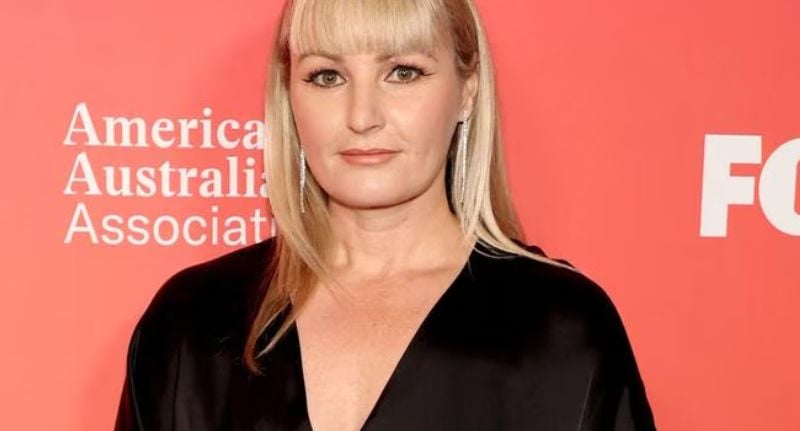
Ticketek Entertainment Group (TEG) is reshaping its touring business, appointing former Sony Music Australia and New Zealand CEO Vanessa Picken as part of a broader overhaul of TEG Live.
The move marks a strategic evolution for TEG Live, which is being repositioned as a platform model designed to bring together leading promoters and entrepreneurial talent across genres and markets, as the group looks to scale its live entertainment ambitions in Australia and beyond.
The move will see TEG Live operate as a hub that combines individual promoter autonomy with Ticketek’s technology and delivery capabilities, aiming to simplify the process of building, discovering, and attending live experiences.
The platform will be overseen by Tim McGregor, TEG’s Global Head of Touring, who will drive strategic direction and portfolio performance as the initiative scales.
“At TEG Live, we’re focused on giving promoters the freedom to grow their brands while backing them with collective resources and expertise,” McGregor said.
“Live music is evolving quickly, and touring models need to evolve with it. This platform is built for collaboration, adaptability and for setting up the next generation of live entertainment leaders for success.”
The company has announced a series of senior hires as part of the rollout. Picken joins as Global Director, Music Strategy. Former CEO of Sony Music Australia and New Zealand, she will lead music strategy and global advocacy across the platform.
She departed Sony Music Australia in November. She had taken the top job at Sony Music’s domestic operations in June 2022, following the well-publicised removal of Denis Handlin, who had served with the company for 51 years, including 37 at the helm.
Meanwhile, Sam Sharma joins as Head of South Asia & Desi Touring, focusing on expanding touring across one of the fastest-growing live music audiences.
Alex Kelsey takes the role of Head of Country Touring, with Clay Doughty supporting as Head of Strategy, Country Music.
Chris Watson has been promoted to Head of Electronic, Asia Pacific, reflecting TEG Live’s growing presence in electronic music. Toby Leighton-Pope, currently Managing Director of TEG Europe, will continue as a key advisor to the group.
Country music is a major focus for TEG Live’s growth. The company plans to open a Nashville office in early 2026, creating a dedicated base in the heart of the global country music scene. The office will focus on artist relationships, touring partnerships, and long-term pipeline development, connecting the US and Australian markets.
Beyond country, TEG Live is planning expansions across electronic, Asia-Pop, and rock & metal, supported by specialist promoters operating across multiple territories.
“This is just the beginning of a new chapter for TEG Live and Ticketek Entertainment Group,” McGregor said. “We’ll be sharing more updates soon as the platform accelerates its rollout globally.”
OpenAI CEO mocked for 'tantrum' over rival's Super Bowl ad
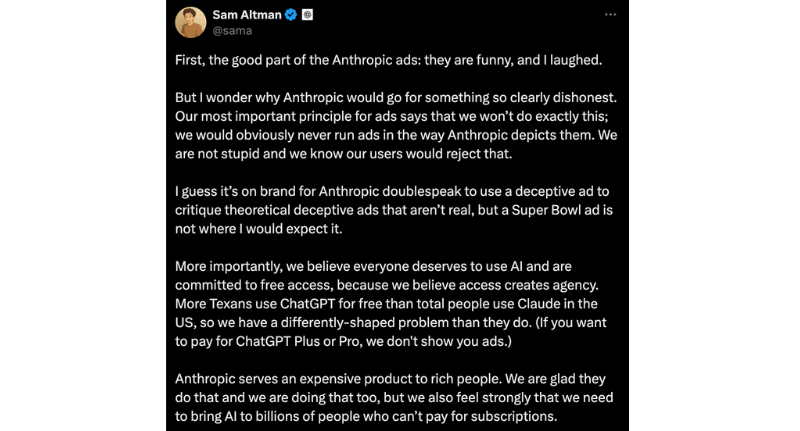
The boss of ChatGPT-maker OpenAI is being ridiculed online for a lengthy rant on a rival chatbot firm for the Super Bowl ad it’s planning to run.
Anthropic offers a free version, Claude, but users have to pay for more capable versions – as they do with ChatGPT. But in the Super Bowl ad, Anthropic launches a new product, saying, “Ads are coming to AI. But not to Claude.”
In a 420 word-long post on X, OpenAI CEO Sam Altman called its competitor “dishonest” and “deceptive”.
‘Digital equivalent of a toddler tantrum’
X users responded with typical mockery, with some describing Altman’s rant as “the digital equivalent of a toddler throwing a tantrum”.
“Looks like a nerve was well and truly hit,” read one post. Another called the reaction “hypocritical”, adding, “The reason Anthropic’s satirical ads went viral is precisely that public trust in you and OpenAI has already hit rock bottom over the past few months.”
In the lengthy post, Altman also opposed Anthropic’s decision to run the ad during the Super Bowl on February 8.
“I guess it’s on brand for Anthropic doublespeak to use a deceptive ad to critique theoretical deceptive ads that aren’t real, but a Super Bowl ad is not where I would expect it,” he said.
Altman then reasoned, “Anthropic serves an expensive product to rich people.”
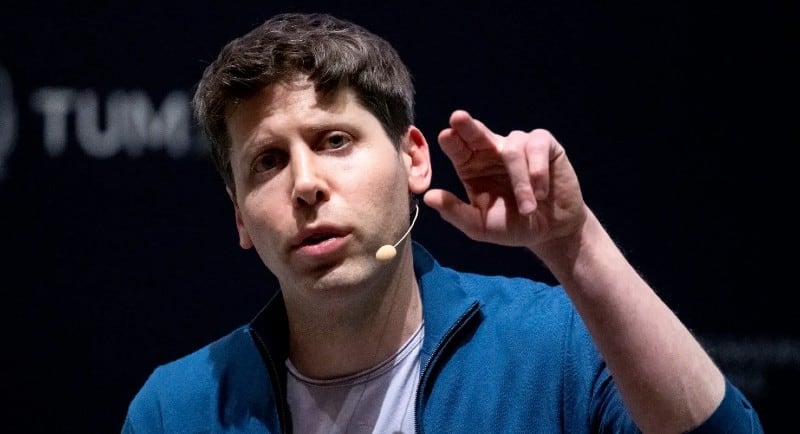
Sam Altman. Image: TED X
Nikita Bier, the head of product at X, offered Altman some simple advice for the future: “Never respond to playful humour with an essay.”
The BBC reports that it approached Anthropic for comment.
Main image: Sam Altman

North Korea executes citizens for watching Squid Game and listening to K-Pop
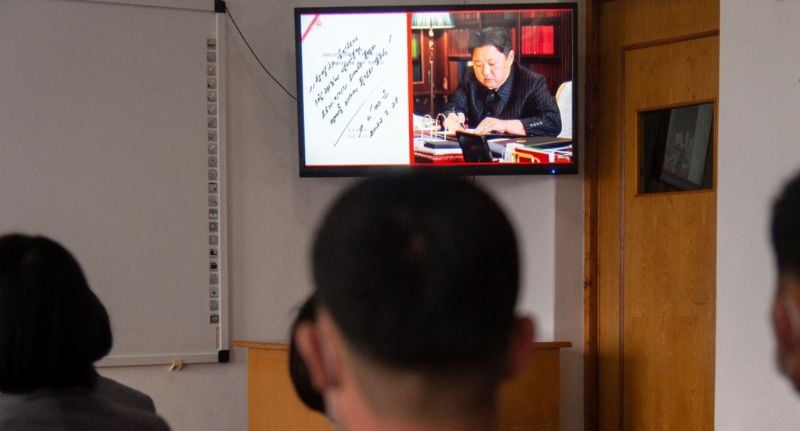
North Koreans caught watching South Korean television shows face public humiliation, years in labour camps or even execution, with the harshest punishments reserved for those too poor to pay bribes, according to new testimonies collected by Amnesty International.
Escapees told Amnesty that the consumption of South Korean dramas and films is widespread but is enforced through an arbitrary and corrupt system in which wealth and political connections determine who is punished – and how severely.
“These testimonies show how North Korea is enforcing dystopian laws that mean watching a South Korean TV show can cost you your life, unless you can afford to pay,” said Sarah Brooks, Amnesty International’s Deputy Regional Director.
“The authorities criminalise access to information in violation of international law, then allow officials to profit off those fearing punishment. This is repression layered with corruption, and it most devastates those without wealth or connections.”
Amnesty interviewed 25 North Korean escapees in 2025, most of whom fled between 2019 and 2020.
The testimonies detail severe punishment for accessing foreign media both before and after the introduction of the 2020 Anti-Reactionary Thought and Culture Act, which labels South Korean content “rotten ideology” and mandates five to 15 years of forced labour, or the death penalty in serious cases.
Despite the risks, interviewees reported that South Korean content is commonly smuggled into South Korea on USB drives from China and viewed on “notetels”.
“People are caught for the same act, but punishment depends entirely on money,” said Choi Suvin, who fled in 2019.
“People without money sell their houses to gather around AUD $7,500 to $15,000 to pay to get out of the re-education camps.”
Kim Joonsik stated that he avoided punishment after being caught three times because of family connections.
“Usually when high school students are caught, if their family has money, they just get warnings,” he said.
“I didn’t receive legal punishment because we had connections.”
The 109 Group
Interviewees consistently referenced the “109 Group”, a specialised enforcement unit that conducts warrantless searches and solicits bribes.
One escapee recalled officers saying: “We don’t want to punish you harshly, but we need to bribe our bosses to save our own lives.”
Another described the open secret behind the crackdown: “Workers watch it openly, party officials watch it proudly, security agents watch it secretly, and police watch it safely. Everyone knows everyone watches, including those who do the crackdowns.”
Several interviewees also described being forced to witness public executions, including executions for distributing foreign media, as part of “ideological education”.
“They execute people to brainwash and educate us,” said Choi Suvin.
Amnesty is calling on North Korea to repeal laws criminalising access to information, abolish the death penalty and immediately halt executions, particularly those involving children.
“This government’s fear of information has effectively placed the entire population in an ideological cage,” Brooks said.
“This completely arbitrary system, built on fear and corruption, violates fundamental principles of justice and internationally recognised human rights. It must be dismantled.”
Amnesty said the testimonies align with findings from UN agencies, including the UN Office of the High Commissioner for Human Rights, but noted it cannot independently verify the full scale of executions due to severe restrictions on access to information.

Reddit’s ad machine clicks into gear with 70% revenue surge and A$390 quarter
Reddit has delivered a breakout fourth-quarter result, cementing its shift from a conversation-driven platform to a scaled, profitable advertising business, and sharpening its appeal to global marketers looking beyond the traditional social giants.
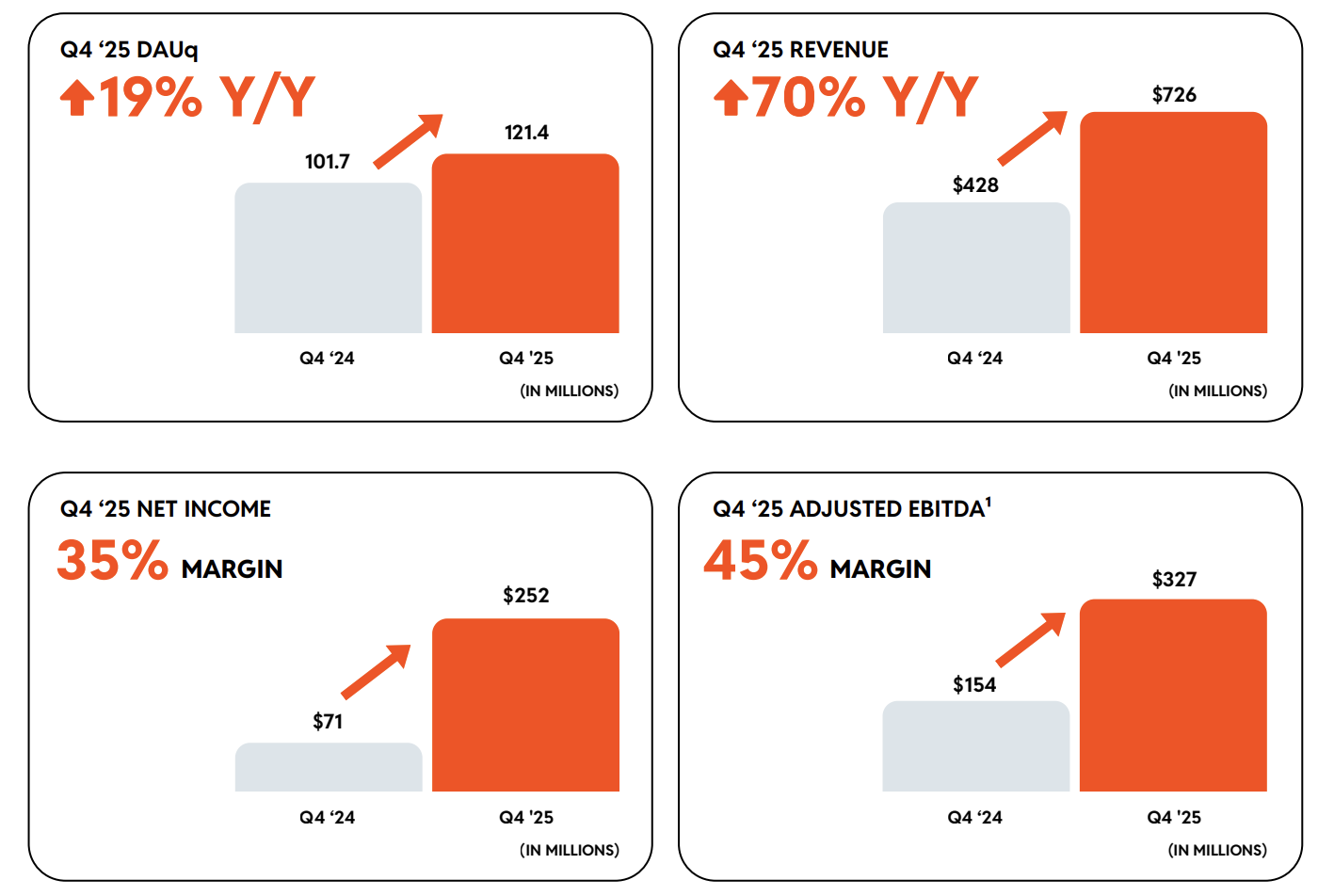
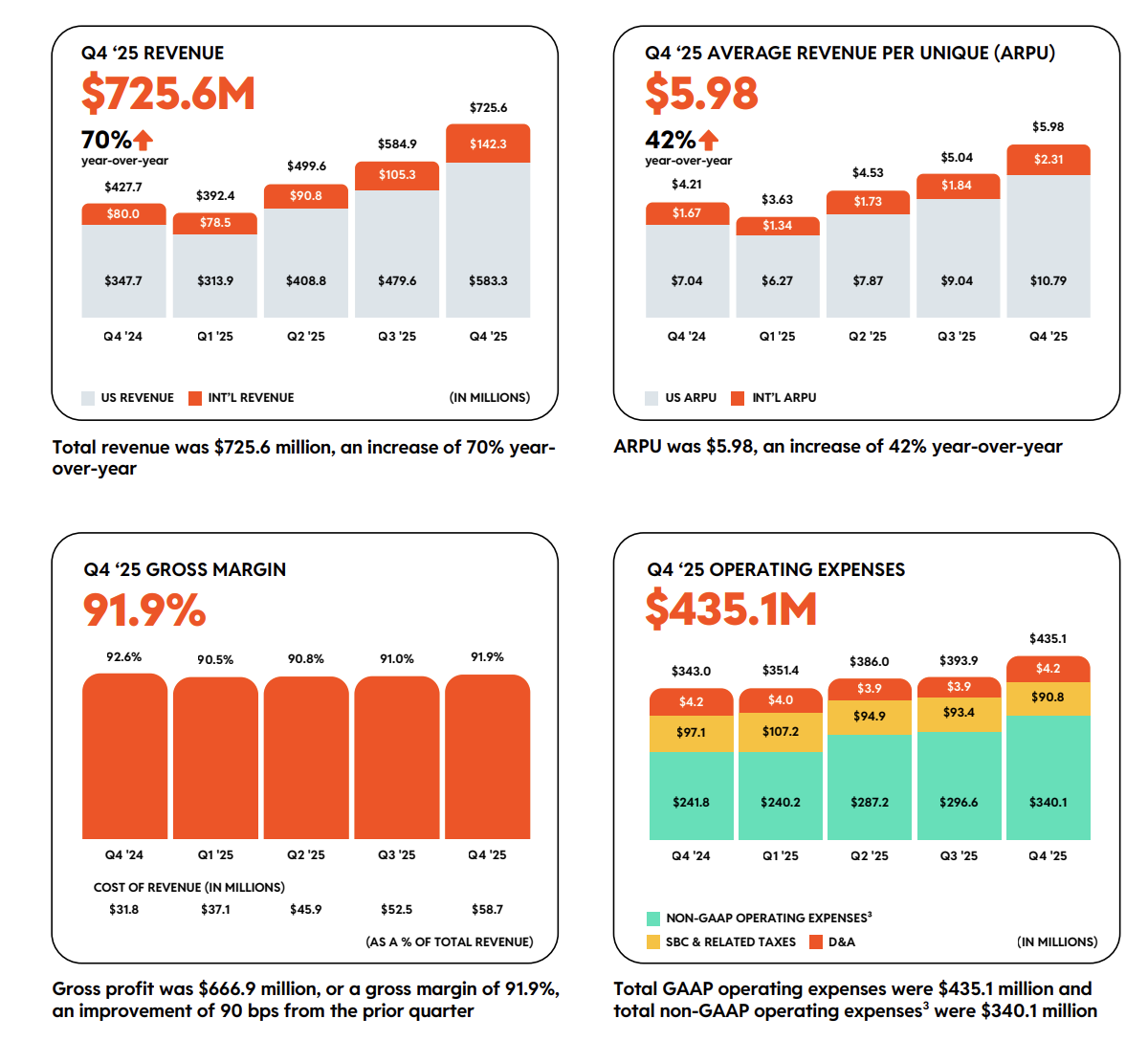
The company reported Q4 revenue of approximately A$1.1 billion, up 70% year-on-year, with advertising accounting for almost all of the growth.
Ad revenue climbed 75% to around A$1.03 billion, while full-year revenue rose 69% to approximately A$3.3 billion, including about A$3.2 billion in ad revenue, up 74%.
The result marks a decisive financial turning point. Reddit posted Q4 net income of roughly A$380 million, up from around A$107 million a year earlier, and full-year net income of approximately A$800 million, swinging sharply from a loss in 2024.
Advertising drives the growth story
From a trade perspective, the signal is clear: Reddit’s growth is being driven by advertising at scale, not experimental formats or ancillary revenue streams.
Daily Active Uniques (DAUq) grew 19% to 121.4 million, with international audiences leading the charge. International DAUq jumped 28% year-on-year, compared to 9% growth in the US, and that momentum flowed directly through to revenue. International revenue climbed 78% in Q4, reinforcing Reddit’s growing relevance outside its home market.
For agencies and advertisers, monetisation was the standout metric. Global ARPU rose 42% to around A$9.00, while US ARPU surged 53% to approximately A$16.20, highlighting Reddit’s improving ability to turn engagement and intent-rich conversations into advertising dollars.
Adjusted EBITDA for the quarter came in at approximately A$490 million, delivering a 45% margin – a level of profitability that places Reddit firmly in the top tier of global ad-supported platforms.
‘The next era of Reddit’
Co-founder and CEO Steve Huffman framed the result as a strategic inflection point for the company.
“We’re entering the next era of Reddit – defined by sharper execution, global expansion, and product innovation that puts real people and conversations at the centre,” Huffman said.
“Our focus is on turning Reddit’s authenticity into even more everyday utility.”
That positioning matters for advertisers, who are increasingly wary of brand safety concerns, signal loss, and diminishing returns across established social platforms. Reddit’s pitch – grounded in community, context, and intent – is now backed by significant revenue growth and profit.
A bigger play for brand budgets
Digging into the cost base adds another layer to the story. Sales and marketing investment increased sharply year-on-year, signalling a more aggressive push into brand advertising, agency partnerships and larger media buys.
In trade terms, Reddit is no longer circling the edges of media plans. It is moving directly into competitive territory occupied by Meta, TikTok and YouTube – particularly for advertisers seeking alternatives that still offer scale.
Confidence in the trajectory was underlined by the board’s approval of a share buyback program of around A$1.5 billion, a bold move so soon after IPO and a strong vote of confidence in the durability of Reddit’s growth and profitability.
Momentum into 2026
Looking ahead, Reddit forecasts Q1 2026 revenue of approximately A$890–905 million, with adjusted EBITDA of around A$315–330 million, setting expectations for continued momentum into the new year.
For agencies and advertisers, the takeaway is becoming increasingly difficult to ignore: Reddit is no longer a niche or experimental buy. It is fast emerging as a mainstream, global advertising platform – profitable, scalable, and differentiated by conversation-led engagement.
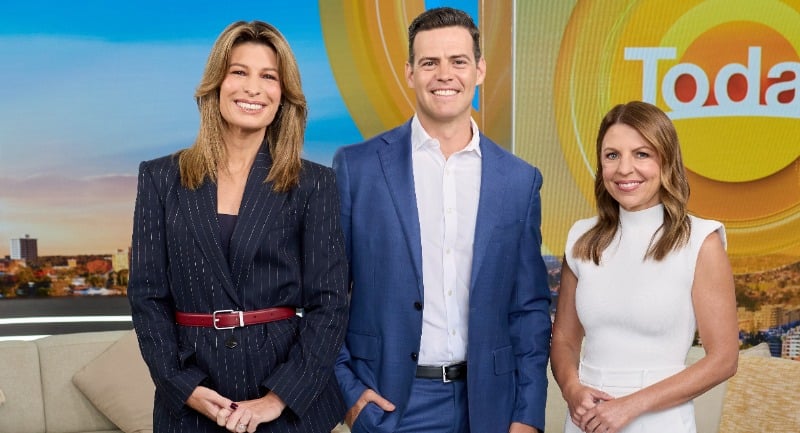
Michael Atkinson joins Weekend Today as co-host
Michael Atkinson will join Nine’s Weekend Today team as co-host alongside Alison Piotrowski, following a summer stint on the desk.
The network said Atkinson will become a permanent part of the weekend line-up, after filling in over summer. The move comes ahead of 2026, as the breakfast program refreshes its co-hosting team.
Atkinson said he was “excited and proud” to be joining the Today family, describing the weekend program as “a trusted part of Australians’ weekends”.
“I’ve always had a passion for sport and the impact it has on our lives, so I’m fortunate to be continuing to host Stan Sport’s rugby coverage,” he said, while confirming he will take on the new co-host role.
Replacing Clint Stanaway as co-host
Atkinson steps into the co-host position following Clint Stanaway’s decision to leave Nine at the end of 2025, after nearly 25 years with the network.
Stanaway, who has been Weekend Today co-host and 9News Melbourne’s Weekend Sport Presenter, said he would step away to focus on his full-time radio role on Nova’s *Jase & Lauren* breakfast show, citing workload and work/life balance.
“It’s been a huge workload juggling both TV and being part of the Melbourne Nova breakfast team over the past couple of years,” Stanaway said in his farewell statement. “I am passionate about my new found love for radio and have decided to give it priority moving forward.”
Nine’s National News Director Hugh Nailon said Stanaway’s career was “a stellar example” of what could be achieved through hard work, praising him as a “brilliant journalist and storyteller” and a mentor in the newsroom.
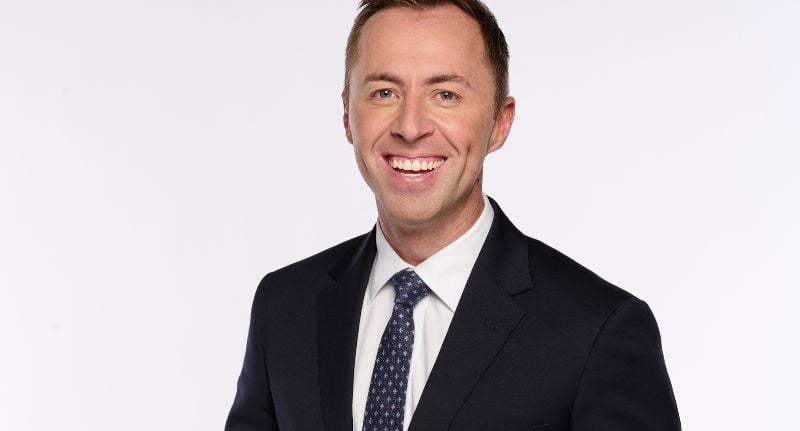
Clint Stanaway
What Alison Piotrowski said
Piotrowski said Atkinson “jumped into the hot seat over summer” and “took to the show like a duck to water”.
“He’s sports mad, incredibly knowledgeable, and has a wonderful sense of humour,” she said. “We’re looking forward to making Weekend Today even better for our viewers in 2026.”
Background and other roles
Raised in south-west Queensland towns St George and Quilpie, Atkinson’s early sporting interests included rugby league, swimming, cricket, tennis and horse racing, Nine said.
He began his media career at 29, working as a sports journalist and presenter across 9News Gold Coast and Brisbane. He has also contributed to Nine’s Wide World of Sports broadcasts, including the Brisbane International and Suncorp Super Netball.
Atkinson is also an ambassador for Youngcare, and completed a 250km trek through the Simpson Desert in 2021 to support the disability charity.
Top image: Alison Piotrowski, Michael Atkinson & Lizzie Pearl

CMO SPOTLIGHT: Ben Whitmore
Meet Ben Whitmore, CMO, East Coast Car Rentals.
Mediaweek: What’s the piece of work from the past 12 months that best captures how your brand wants to show up right now?
Ben Whitmore: Probably the work we’re putting together right now. East Coast is leaning into the nostalgia of our childhood family road trips and saluting the core memories that our customers make in the seats of our cars.
So, less about the iconic landmarks and more about the pit stops, fish and chip shops, and all the good stuff Australia has to offer that doesn’t normally have a spotlight shining on it.
MW: Where is your marketing budget working hardest today?
BW: Over the past 12 months, we’ve been investing more and more into the brand. The car rental industry is very much reliant on digital, and as an independent Australian operator, our budgets can’t compete with some of the global brands, so we really try to squeeze everything we can out of organic partnerships and authentic brand activity.
We’re excited to be investing in some above-the-line campaigns in the next 12 months and cement the East Coast brand in the Australian psyche.
MW: What’s changed most in how you balance brand and performance?
BW: The biggest change for us is simply investing in the brand, with the support of East Coast’s Managing Director and CEO.
We place great importance on channel diversification to safeguard our business, invest in brand, and support the growth and performance of all those channels, so it’s a no-brainer for us.

Whitmore is looking to cement the East Coast brand in the Australian psyche
MW: Which channel, platform or partnership is currently over-delivering for you?
BW: It’s an exciting time, and there are a few new players in this mix. AI chat platforms, in particular, are exciting as consumers increasingly use them to plan their travel. So, ensuring we’re optimising for this has been important, and we’re reaping the rewards of that work.
Affiliate networks have also been great for us, and working with genuine, respected content creators with a strong following. This has been important for us, and we want to ensure that if someone is out there spruiking our business, their audience has a fantastic experience with us.
MW: What role does creativity play in your commercial strategy right now?
BW: Quite a bit, really. Anyone who’s rented a car will know that our industry can be quite stale and transactional. That is not us. We don’t answer to a global headquarters; we are uniquely Australian and want this to shine through in the brand’s creative. We like to have fun with the brand, and we want that affinity to translate into customer experiences and interactions with our staff.
MW: How are you using data, tech or AI in a way that genuinely improves the work?
BW: We’ve developed web apps to request airport shuttles and are now evaluating how AI can improve the process. The shuttle is always the elephant in the room with off-airport car rental companies, but it’s also the gateway to consumers, saving a lot of money on their holidays, so if we can make that process smooth and friction-free, then it’s worth doing.
We’ve also been able to get a much better picture of who our customers are and what’s important to them; that data informs the brand strategy and ultimately how we message.
MW: What does a ‘good agency partner’ look like for you in 2026?
BW: Ultimately, what’s important to us, and me, is to have a trusted partner that isn’t waiting for me to instruct them and can come to me with ideas, improvements, recommendations outside of the business-as-usual that agency retainers can sometimes become. A true test of that is having partners you’ve worked with for a few years that still bring that kind of dynamic to the table.
MW: What’s the toughest call you’ve had to make as a CMO?
BW: There are plenty of tough calls, but for me, it’s probably when I’ve had to end commercial agreements with partners with whom we love to work, but are simply not the right fit with the brand or overall strategy of our business.
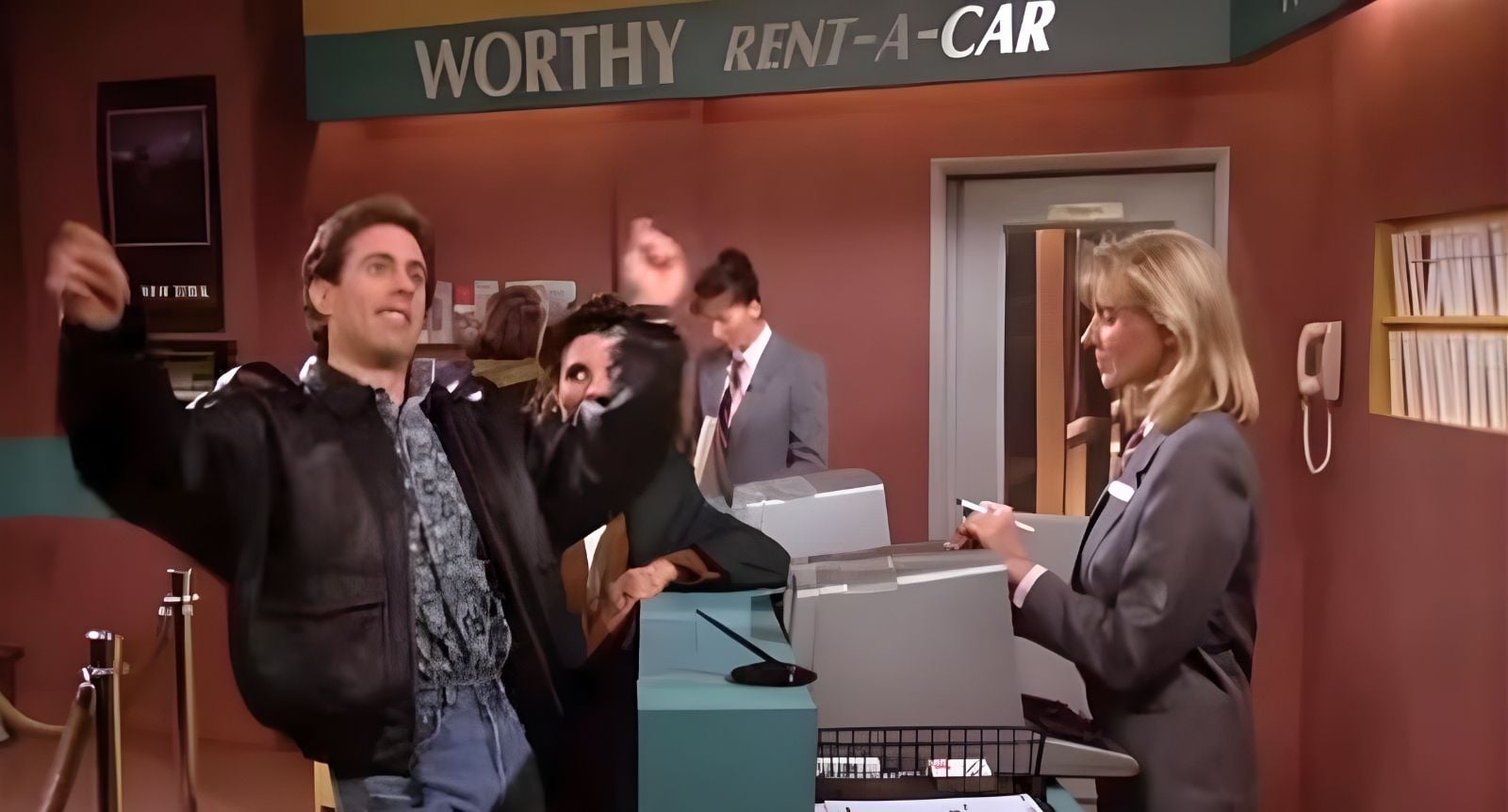
Even Jerry Seinfeld has trouble booking a rental car now and then
MW: What’s one misconception about your brand or category that your team is actively trying to unpick through marketing?
BW: Ask anyone who’s rented a car in the past 30-odd years, and they will have had a bad experience. If you’ve ever seen the episode of Seinfeld where Jerry books a car only to turn up, and the car is not available, you’ll see what I mean. It’s a hilarious spoof, but unfortunately, it’s accurate for many people.
This is what we’re trying to unpick, through marketing, through staff
training, through company culture and over-delivering on our promises.
Renting a cheaper car should not mean poor service, so we work hard to ensure that once a customer rents with us, they will continue to do so. Our reviews are a testament to that promise. And we’re proud to outrank huge global competitors in that arena.
MW: Looking ahead, where will your next big marketing bet come from?
BW: All eyes are on AI and the digital space right now. We’ve had a few predictable years and decades for performance marketing and search engine optimisation. AI’s arrival is similar to social media’s, so staying ahead of that and understanding how consumers engage with it is important.
The next immediate bet will be East Coast’s first large-scale above-the-line campaign.
Watch this space!
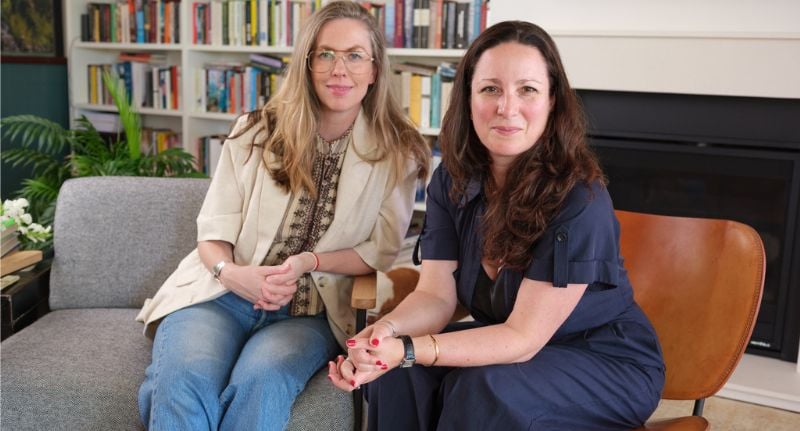
‘The flack we got was real’: Ex-Clemenger and Monks leaders step out with AI production venture MC&V
When Marie-Celine Merret and Vinne Schifferstein first started talking seriously about AI-native production, the reaction inside the industry wasn’t curiosity so much as quiet disbelief.
This was two years ago – before ChatGPT had detonated into the mainstream, before every agency deck sprouted an AI slide – and the idea that generative tools would meaningfully reshape the production pipeline sounded, to some, premature at best and reckless at worst.
Now, the former Clemenger and Monks leaders are stepping out on their own, launching MC&V AI Creative Production, an AI-native production company designed explicitly for what they see as advertising’s post-hype phase.
The company positions itself as a specialist production partner focused on judgement, craft and restraint – at a moment when agencies and brands are wrestling not with whether to use AI, but how to do so without blowing timelines, budgets or reputations.
Seeing it before it hit
Merret, who previously led creative AI production inside major agency environments, told Mediaweek the trajectory was clear long before the industry caught up.
“We saw this coming two years ago, just two years ago,” she said. “I think the talent really kind of came up globally just from the networks that we’ve got all over the world. We began to see it coming from a long way off. And it was very obvious what was going to happen.”
For Schifferstein, the inflection point came when AI’s impact stopped being theoretical.
“I was consulting at the time with a client, and their business got disrupted literally from one day to the next when ChatGPT launched. And that for me was the eye-opener,” she told Mediaweek.
What followed was a rapid cascade across the production stack – first copy, then imagery, then motion, and now sound and end-to-end workflows. The tools, Schifferstein noted, weren’t ready yet – but the direction of travel was unmistakable.
“The moment we realised, well, actually the tools are not good enough yet, but they will get better,” she said. “And they’re aiming at targeting the production pipeline, every element of it.”

A still from MC&V’s ‘Weis a Corn’ campaign.
From experimentation to execution
Together, Merret and Schifferstein had already been operating at the sharp edge of that shift.
After establishing Monks in Australia and New Zealand, they reunited at Clemenger, where they built MADE THIS – one of the country’s earliest high-end creative AI production offerings.
Across that period, they delivered live campaigns, hybrid AI and live-action productions, and AI-enabled content systems for brands including Adidas, KFC, Afterpay, Samsung, Uniqlo and Schweppes.
That hands-on experience revealed what many agencies are now discovering the hard way: experimentation is easy; execution under real commercial pressure is not.
Imagery, Merret said, was an early lesson in both possibility and limitation.
“It started out with this wave of AI art, and everyone got caught up by the fact that it’s beautiful,” she said. “But then when you started to get into more production briefs, you’re like, oh… you’re getting six fingers. It’s a bit weird.”
The fix didn’t come from prompts alone, but from craft.
“True craftsmen, people in design or animation or whatever, would jump in and do a lot of comp work and kind of try to work out how to bend the tools to get to what we needed,” she said – always with the understanding that today’s outputs are “the worst you’re ever going to see it”.
Creatives, not coders, at the centre
One of MC&V’s core bets is that the next phase of AI adoption will be led less by technologists and more by experienced creatives shaping tools to fit real production workflows.
“What’s interesting with this now is the tech is not just shaped by engineers and PhDs in machine learning,” Merret said. “It’s now more and more artists and creatives that help them shape the tools.”
Schifferstein is blunter about the early narrative that dominated the conversation.
“That narrative got mainstream with a lot of prompt engineers jumping on the tools and pushing out AI slop,” she said. “But their backgrounds are years and years of experience in directing films or in VFX or in animation. They are craftsmen. First and foremost.”
Missing that distinction, he argues, put parts of the industry on the back foot.
“A lot of people couldn’t see through that,” she said. “And maybe MC and I were one of the first back then to say, well actually, this is what’s been pushed out now – but the potential is so much bigger.”
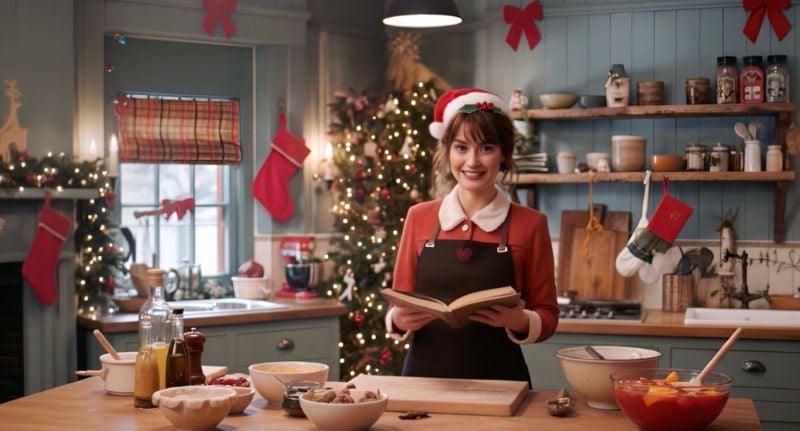
MC&V’s campaign for Kitchen Warehouse, ‘Mary Prepmas’.
Flack, fear and flying freelancers
Pushing that message early didn’t always land comfortably, particularly inside holding company structures.
“The flak we got, especially back then… and there are still a lot of people who are super hesitant,” Schifferstein said, recalling industry sessions where AI advocates were met with hostility.
The fear, she said, was existential: that AI meant replacement rather than augmentation. From MC&V’s perspective now, the reality looks very different.
“The people who have actually embraced it, they are flying,” she said. “None of them are employed. They do not want to be employed. They just want to run their own show. They’re super busy.”
Why MC&V isn’t building its own tech
Notably, MC&V is deliberately steering clear of proprietary AI platforms – a move that cuts against the grain of many large-scale agency investments.
“We don’t believe in that,” Schifferstein said. “It’s not about the tech.”
Merret agrees, arguing that platform ownership is rarely a genuine differentiator when everyone is drawing from the same underlying tools.
“It’s not a differentiator in any way or form because everyone’s leveraging the same baseline,” she said. “Unless you’re building something specific for a brand, you’re not really differentiating yourself from one agency or holding company to the next.”
Instead, MC&V’s model centres on orchestration: designing workflows, assembling specialist talent, and making hard calls about when AI adds value – and when it doesn’t.
“We definitely won’t just pick up and do AI for the AI’s sake,” Merret said. “We have a pretty critical eye on briefs.”

Fewer promises, better outcomes
MC&V has already delivered projects with Apparent, Block (Kitchen Warehouse), Emotive (Weis) and Springboards, supporting agencies keen to push creative ambition without absorbing the operational risk of AI-led production.
The company also draws on a global talent network shaped in part through the AARON Awards – the world’s first awards program dedicated to recognising craft in AI-driven advertising.
In a market still balancing budget pressure with rising expectations, Schifferstein believes the timing is right.
“Budgets are still under pressure for brands, and they do want to do things,” he said. “This was an idea we had two years ago, but we couldn’t do it for the budget. Now we actually can.”
For MC&V, the pitch is deliberately unflashy: fewer promises, less noise, and production that holds up once the novelty wears off.
Main image: Marie-Celine Merret, Vinne Schifferstein
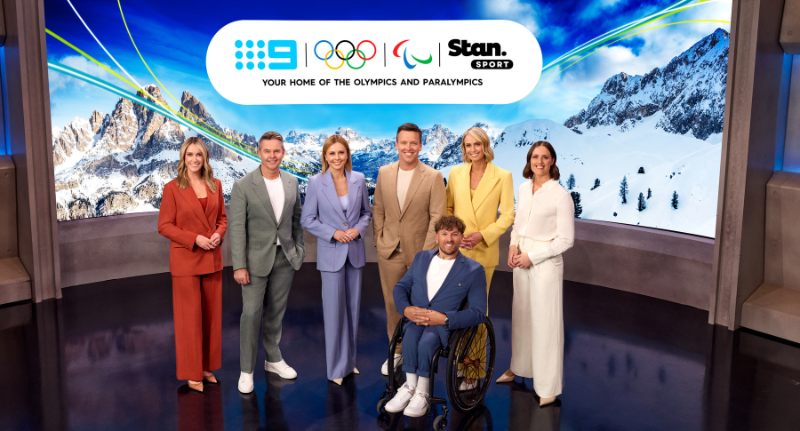
Nine unveils coverage plans for Milano Cortina 2026
The Olympic Winter Games Milano Cortina 2026 kicks off this Saturday, with the Opening Ceremony coverage from 5.30am across the 9Network, 9Now and Stan Sport.
Australia will send a squad of 53 athletes, its second-largest Winter Olympic team, primed for a massive campaign in Northern Italy.
The journey begins with flag bearers Jakara Anthony and Matt Graham leading the charge at Milan’s San Siro Stadium, while Ally Langdon, Todd Woodbridge and Lydia Lassila broadcast live from Nine’s studio in Livigno.
Following the Opening Ceremony, fans can follow the action daily.
Evening coverage, hosted by Ally Langdon and James Bracey, airs from 7.30pm to 12.00am AEDT on 9Gem, switching to Channel 9 at 9.00pm AEDT. Overnight coverage with Leila McKinnon follows from 12.00am to 4.30am AEDT.
Morning coverage, hosted by Sylvia Jeffreys and Dylan Alcott will air from 4.30am to 10.00am AEDT, starting on Channel 9 before switching to 9Gem at 5.30am AEDT.
All coverage will also be available to stream on 9Now and Stan Sport.
Main Image: Nine broadcast team
Media
Long-serving critic exits The Australian
As Calum Jaspan reports in The Sydney Morning Herald, his exit comes just months after Phillip Adams’ departure.
Social media
Radio
Television
What TV bosses are really watching at home
For people whose jobs depend on knowing what is on screen, having access to multiple platforms is part of the brief.
TV Tonight’s David Knox has spoken with all five executives from ABC, Seven, Nine, 10 and SBS, to find out which services they can’t live without.
AI
Bunnings gets green light on facial recognition
The decision overturns a 2024 ruling by Privacy Commissioner Carly Kind, who found the retailer had breached privacy laws by scanning customers’ faces without proper consent.
A review by the Administrative Review Tribunal has now reached the opposite conclusion.
Entertainment
Amazon pulls Melania documentary after marketing row
The Guardian’s Catherine Shoard reports that The Lake Theatre and Cafe claims the decision followed playful marquee lines that leaned into politics and fashion.
According to the cinema, Amazon executives objected to promotional slogans and moved to end the run early.