
Friday May 1, 2026
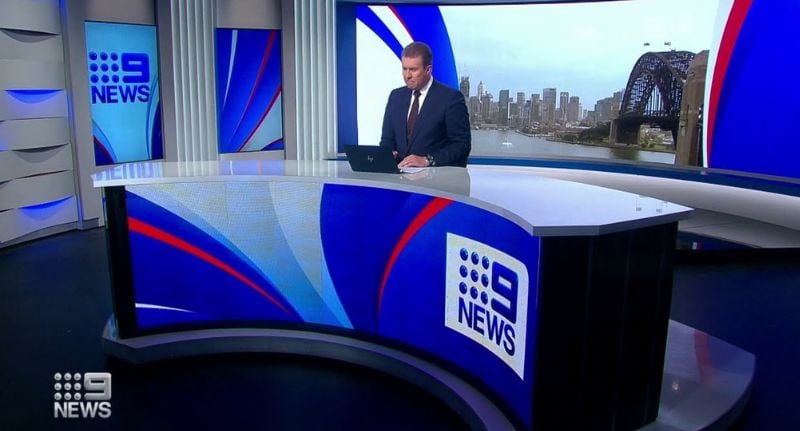
Nine slashes newsroom roles: 20 jobs cut as part of ‘Future News’ overhaul
Nine is set to cut up to 20 roles across its television news and current affairs division as part of a sweeping restructure that will consolidate job functions, overhaul workflows, and push staff into multi-skilled roles.
The changes form part of Nine’s multi-year “Future News” transformation, which will impact all roles across the division and run through to the end of the 2028 financial year.
The first phase of redundancies will affect up to 20 positions within a workforce of around 800 staff nationally, with voluntary redundancies expected to be offered.
The cuts follow earlier reductions flagged late last year, when Nine announced up to 50 roles would be axed across its streaming and broadcast division.
Under the latest restructure, more than 100 existing job titles across news and current affairs will be reduced to just nine broader roles, including story editor, digital story editor, rundown editor and multimedia journalist.
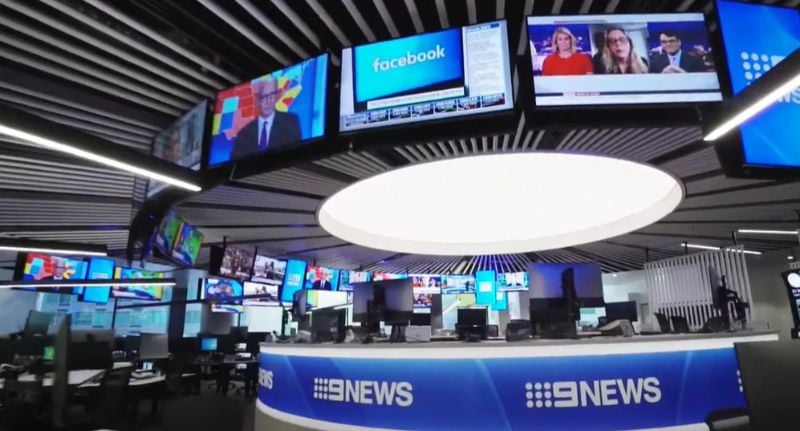
Newsrooms in Sydney and Canberra, foreign bureaus and the Today show – which employs around 315 staff – are among the first areas to enter consultation.
‘All roles are touched’
In a note to staff following a town hall briefing, Executive Director of News and Current Affairs Fiona Dear said the scale of the changes would be felt across the entire division.
“We’ve said from the beginning that this will touch all roles in some way, shape or form,” she said.
“To leverage the new technology, workflows, and the story-centric model, we must evolve our structure and the roles we perform within that structure.”
Dear sought to frame the changes as an industry-driven shift rather than a cost-cutting exercise.
“This isn’t about doing the same work with fewer people to save money; it’s about acknowledging that the work itself is changing across our industry and we must adapt to survive and thrive,” she said.
“I want to be very clear that cost is not driving our decision-making.”
Sources have told Mediaweek that while the team have known the changes were coming “for a while,” the “transparency is kind of refreshing even if it is worrying”.
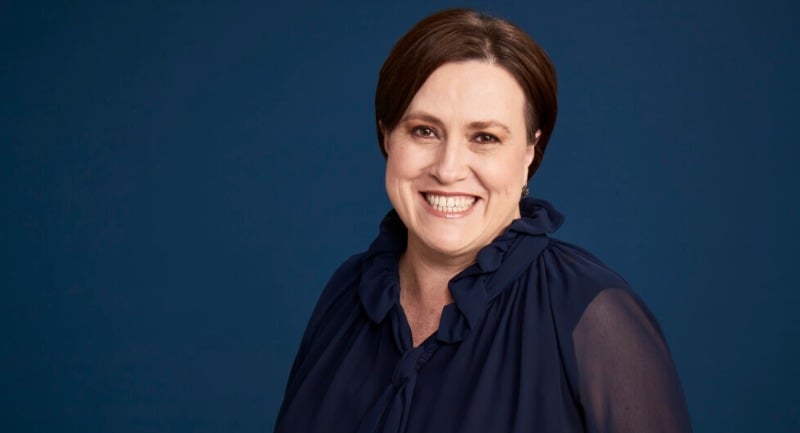
Fiona Dear
Technology, revenue and efficiencies
Nine said it has been investing in new technology, training and equipment as part of the Future News project, which aims to modernise production and enable new commercial opportunities.
“We’re investing heavily in this project – in new technology, training, equipment, and in our people,” Dear said.
“Future News will also deliver growth and revenue opportunities for us as we find new ways to commercialise our content on different platforms.”
However, she acknowledged efficiencies would come with the transformation.
“As we’ve said, all roles are touched by this program of work… we anticipate approximately 20 fewer roles will be required in our first market,” she said.
Consultation underway
The formal consultation process is now underway for Sydney News, the Video Content Team, Today, Canberra and foreign bureaus, and is expected to take up to four weeks.
Employees will go through team briefings, followed by one-on-one discussions, before final decisions are made.
Once implemented, the new structure will take effect on 5 August 2026 for most affected teams and on 21 October 2026 for the Today show.
Dear said the transition would fundamentally reshape how Nine produces and delivers news.
“The permanence and depth of the change we’re delivering will fundamentally alter the way we produce and deliver news at Nine,” she said.
Dear acknowledged the disruption but positioned the shift as necessary.
“Future News is a bold and ambitious transformation program,” she said.
“This program is going to stretch us all in new ways and will fundamentally change the things we know and have done for decades.”
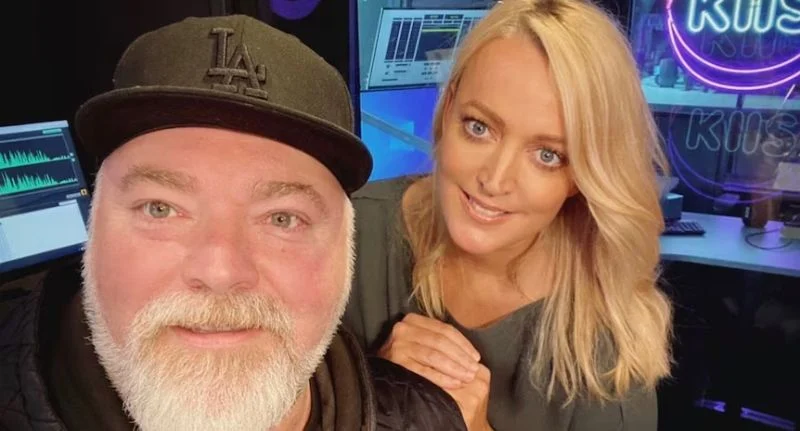
Jackie O is one of many women who’s suffered at work until she broke
This writer has requested to remain anonymous.
When Kyle Sandilands rocked up to court in a Rolls-Royce last week, it spoke volumes about what his co-host, Jackie ‘O’ Henderson, has allegedly been enduring behind the scenes.
It was an act of arrogance and defiance in the face of a very high-stakes personal situation – being counter-sued by ARN for millions. The moment was a jarring insight into the ‘real Kyle’, not just his shock jock persona.
In her own case against ARN, Henderson has alleged that Sandilands engaged in extensive workplace bullying towards her.
Watching Sandilands step out of his glamorous vehicle was a moment that highlighted the full extent of Henderson not ever really calling him out publicly until now, of not screaming his name from rooftops as her alleged workplace bully.
In her statement of claim, Henderson says ARN Media failed to act on her repeated complaints before the fatal fallout, about Sandilands’ on-air behaviour, as part of Federal Court proceedings seeking more than $82 million in compensation.
Henderson also alleges she raised concerns with senior executives months before the February 20 incident that ended the pair’s long-running partnership, warning the on-air dynamic was being perceived as an “abusive relationship” and detailing a series of incidents across August and September 2025.
My heart breaks for what Henderson must have been enduring at work. What happened to Henderson is horrifying. And for me, and so many others, it’s triggering.
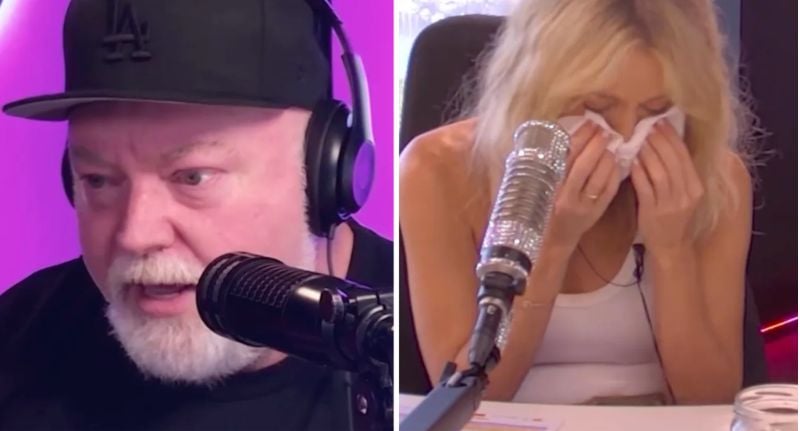
Kyle and Jackie O during the moment that saw Jackie walk in February 2026. Source: Instagram
Jackie O is one of many women who’s suffered at work until she broke
I don’t need to imagine Henderson has gone through; I know first-hand. In a job I once had, I suffered cruel taunts, snide remarks, and false accusations from managers and team ‘mates’, as I sat at my desk in the office with them.
I was regularly told off rather than spoken to constructively, and even though I had worked in the industry for years and should have earned some respect and been trusted to make decisions, as my job allowed, I was gaslit and scapegoated weekly.
It was face-to-face, in email, and in ‘private’ meetings. I say ‘private’ because others would later make references to the content of the meetings, people who weren’t even on the team. They had been told about what happened. I had been discussed. Gleefully.
I tried to explain my experience to the two managers I had at the time, who, of course, turned out to be the main bullies because they allowed the behaviour to continue.
In fact, I worked out that one of them started it. When I tried to defend myself against accusations, I was called “defensive.” That was the only conclusion – I was “defensive” when attacked. Not that anyone else needed to accept responsibility for their contribution to – nay, encouragement of – the situation.
I took the matter further to their superiors, who wanted to take action. But I stopped them, and thus stopped short of HR, who would only care about the company’s liability.
I did this mainly because I was scared of one of them. I’d never encountered such a person.
But why did I stay for so long? I loved my job – genuinely loved it. And ultimately, like most other people, I needed to work for financial reasons – and in so many other ways, it was a great job.
That’s what you tell yourself at the time.
Jackie O’ stayed for the same reason many of us stay
Now knowing that Henderson had similarly tried to get others to change the structure and dynamics of her working relationship with Sandilands, my heart breaks for her that she was experiencing something similar.
It’s something many sources say they have endured in the name of career and a reliable salary.
Until they’re utterly destroyed, that is.
Report: ABC set to part ways with Jimmy Kimmel as contract expiry looms
ABC is expected to part ways with Jimmy Kimmel when his contract expires in May 2027.
The claims come from celebrity gossip columnist Rob Shuter, who wrote that the network is unlikely to renew the late-night host’s contract despite publicly backing him amid the network’s latest controversy.
The development comes as the Federal Communications Commission orders an early review of ABC’s broadcast licence, intensifying scrutiny on The Walt Disney Company-owned network following political backlash over Kimmel’s on-air remarks.
Contract end date shapes strategy
Kimmel remains on air, with Jimmy Kimmel Live! continuing production as scheduled. However, according to Shuter, ABC’s support reflects a short-term holding pattern rather than a long-term endorsement.
Shuter also said the network has no immediate plans to remove Kimmel but is also not expected to pursue an extension beyond his current deal.
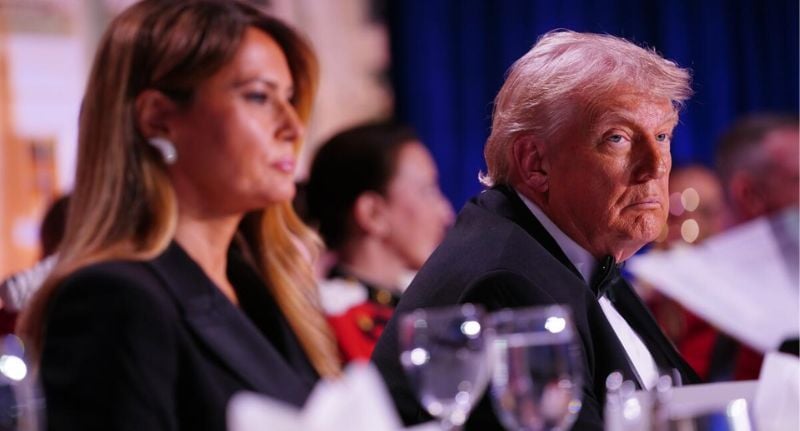
Melania and Donald Trump.
FCC review adds pressure
The FCC’s decision to conduct an early licence review follows calls from Donald Trump and Melania Trump for the comedian to be removed.
The criticism concerns a segment in which Kimmel, serving as MC for the upcoming White House Correspondents’ Dinner, joked: “Mrs Trump, you have a glow like an expectant widow.”
Trump called for Kimmel’s dismissal, while Melania urged ABC to “take a stand” against the host.
The controversy escalated in the days surrounding an alleged assassination attempt on the president, adding further political weight to the situation.
Pattern of controversy weighs on network
Shuter goes on to write that the latest incident is being viewed as part of an ongoing pattern rather than an isolated issue.
Kimmel responded to the backlash on air, defending the remark as satire.
“It was obviously … a joke about their age difference,” he said.
“It was a very light roast joke about the fact that he’s almost 80 and she’s younger than I am.”
Kimmel’s future has also been complicated by softer ratings and ongoing affiliate concerns, according to sources familiar with the matter.
The White House has continued its criticism, with Communications Director Steven Cheung describing Kimmel as a “s**t human” for “doubling down on that joke instead of doing the decent thing by apologising”.
Jimmy Kimmel is a shit human being for:
#1. Making a disgusting joke about assassinating the President
#2. Doubling down on that joke instead of doing the decent thing by apologizing
ABC needs to fire him immediately and he should be shunned for the rest of his life. https://t.co/utaB6gQFyb
— Steven Cheung (@StevenCheung47) April 28, 2026
According to Shuter, ABC will manage Kimmel through to the end of his contract before making a clean break.
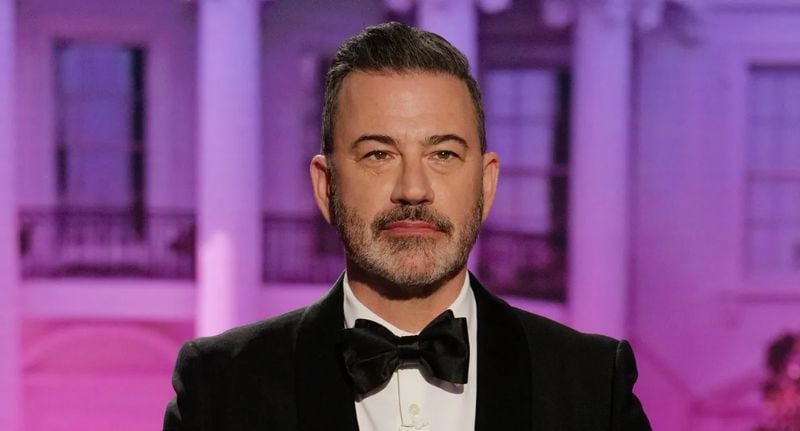
Main image: Jimmy Kimmel
Tapt Media launches as Laundy Family Office completes Nine acquisition
Tapt Media has officially launched as a new independent audio business following the Laundy Family Office’s acquisition of key talk radio assets from Nine Entertainment Co.
The new entity includes stations 2GB in Sydney, 3AW in Melbourne, 4BC in Brisbane and 6PR in Perth.
Arthur Laundy said the acquisition aligns with the group’s existing focus on local communities.
“There is a natural synergy between the live, local pulse of 2GB, 3AW, 4BC, and 6PR and the communal spirit of Australian hospitality,” he said.
“Our venues have always been the heartbeat of their neighbourhoods – a place where Aussies come together to talk about the news, cheer on their team, and debate the issues of the day. Talk radio is the natural extension of that local conversation; it is the voice of the community, just as our venues are a second home.”
“We are confident that our ownership provides the stability, excitement and shared long-term vision to grow this business, and couldn’t be more excited to see these iconic stations continue to thrive.”
Read more: EXCLUSIVE: The deal, the room, the name: Inside Tapt Media’s Vegas origin
Read more: Nine sells radio empire to billionaire in multi-million dollar deal
Strategy to expand distribution and commercial operations
Incoming Tapt Media CEO Tom Malone said the company would focus on its distribution and commercial strategy.
“What you’ll see in the coming months is a transformation of our distribution and commercial strategy to realise the full potential of the incredible content our teams create around the clock,” he said.
“Our ambition is to evolve into a digital media business – with live radio at our core, complemented by short and long form audio and video, distributed where and how people want to consume.”
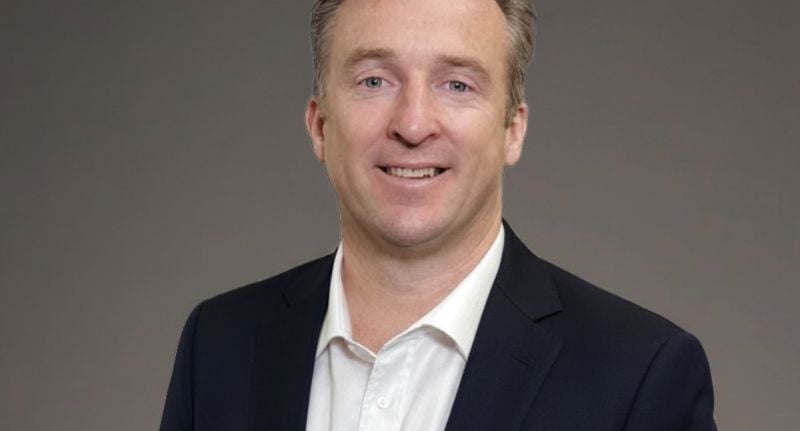
Tom Malone
Rebrand and positioning
Malone said the rebrand reflects the company’s focus.
“We have a century of heritage behind these microphones, and our future potential is only limited by our imagination. We’ve rebranded as Tapt because we are exactly that – tapped into the news, opinions and issues of the cities we serve.
“Our stations are more ubiquitous and more relevant today than they’ve ever been. With the Laundy family, we have backers who are investing over the long term. We’re tapped in, and we’re just getting started.”
Tapt Media said its stations lead in live audio streaming nationally and hold leading positions in ratings across Australia’s two largest markets.
The business will operate across radio, streaming and podcasts.

Reader’s Digest drops Australia's Trusted Brands winners for 2026
Dettol has once again been named as Australia’s most trusted brand, according to the Reader’s Digest Trusted Brands survey.
The 27th annual study, conducted by Catalyst Consultancy and Research and based on responses from 4,187 Australians across 67 categories, highlights a clear shift in consumer behaviour as economic pressures reshape purchasing decisions.
Panadol came in second, while Toyota maintained its position as the most trusted car brand for the 27th consecutive year. Bunnings remained the most iconic brand.
Weber climbed to sixth overall and secured the BBQ category for the 13th consecutive year, reflecting Australia’s strong backyard culture.
Commonwealth Bank was again named Bank of the Year, reinforcing its position in the financial sector.
Singapore Airlines also continued its strong performance, securing its fourth consecutive year as the most trusted airline.
Loyalty no longer guaranteed
The findings suggest trust is no longer built on brand familiarity alone. Instead, consumers are placing greater emphasis on whether brands consistently deliver on their promises.
Cameron Gentle, managing director of Catalyst Consultancy and Research, said tightening household budgets is driving more deliberate decision-making.
“Blind brand loyalty is no longer enough; instead, consumers are conducting a much more careful assessment of whether a brand truly delivers on its word,” he said.
New challenges and rising players
The survey also highlighted emerging competition and shifting priorities across categories.
Among internet service providers, Telstra took the top spot, followed closely by Aussie Broadband, which gained recognition for its local customer service and approachable brand tone.
In a newly introduced category, Solahart was named the most trusted solar panel brand, reflecting Australia’s growing adoption of renewable energy solutions.
Trust as the ultimate currency
Algy Pereira, CEO of Direct Group, incorporating Reader’s Digest, said trust is becoming a defining factor in today’s market.
“Commonwealth Bank’s repeat success as Bank of the Year is a powerful reflection of the deep-seated trust they have built with the public. In today’s market, trust is the ultimate currency.”
The broader results show that when times are challenging, consumers reassess where they spend, rewarding brands that deliver consistent quality, affordability and care.
Full top 20 trusted brands
This year’s top 20 includes Dettol, Panadol, Toyota, Bunnings, Dulux, Weber, Cadbury, Royal Flying Doctor Service, Vicks, Twinings, Bridgestone, Selleys, Vanish, Samsung, Singapore Airlines, Victa, Sanitarium Weet-Bix, Sealy, Yates and Daikin.
Main image: Reader’s Digest

Reddit Q1 revenue climbs to A$921 million
Reddit has reported first-quarter revenue of about A$921 million, up 69 per cent year-on-year, as its advertising business continued to scale.
The company’s ad revenue rose 74 per cent to about A$869 million for the quarter ended 31 March 2026. Other revenue increased 15 per cent to about A$54 million.
Steve Huffman, Founder and CEO of Reddit, said the result reflected the platform’s position in online communities and AI-era search behaviour.
“Reddit is a one-of-one business powered by deeply engaged communities and authentic human conversation,” Huffman said. “That foundation is driving a rare combination of growth, profitability, and efficiency, and giving Reddit a unique advantage in the age of AI.”
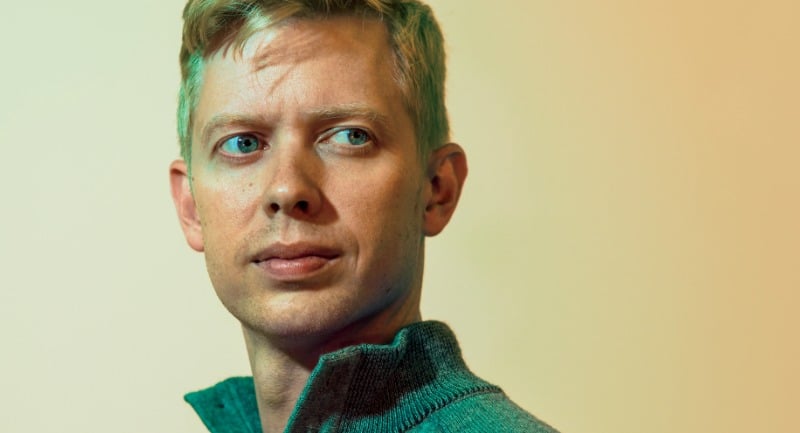
Steve Huffman, Founder and CEO of Reddit
What did Reddit report in Q1 2026?
Reddit posted net income of about A$284 million, up from about A$36 million a year earlier. Adjusted EBITDA reached about A$370 million, representing a 40 per cent margin.
Operating cash flow rose 145 per cent to about A$434 million. Free cash flow was about A$432 million.
Daily active uniques increased 17 per cent to 126.8 million. Weekly active uniques reached 493.1 million, up 23 per cent.
International growth outpaces the US
Reddit’s international audience continued to grow faster than its US base. International daily active uniques rose 26 per cent to 73.3 million, while US daily active uniques increased seven per cent to 53.5 million.
International revenue grew 76 per cent to about A$192 million. US revenue rose 67 per cent to about A$731 million.
Average revenue per unique user climbed 44 per cent to about A$7.27 globally. US ARPU was about A$13.39, while international ARPU was about A$2.81.
Advertisers lean into shopping and AI tools
Reddit said advertising growth was driven by increases in impressions and pricing, with broad strength across its top 15 industry verticals.
The company also highlighted momentum in shopping ads, including its integration with Shopify to simplify catalogue and measurement setup for advertisers.
According to Reddit’s own research, 84 per cent of Reddit shoppers said they felt more confident in their purchases after researching products on the platform. The study was conducted in the US by Attest in February 2026 among 1,004 adults who use Reddit monthly.
The company expects second-quarter revenue of between about A$994 million and A$1.01 billion. It also forecast adjusted EBITDA of between about A$396 million and A$410 million.
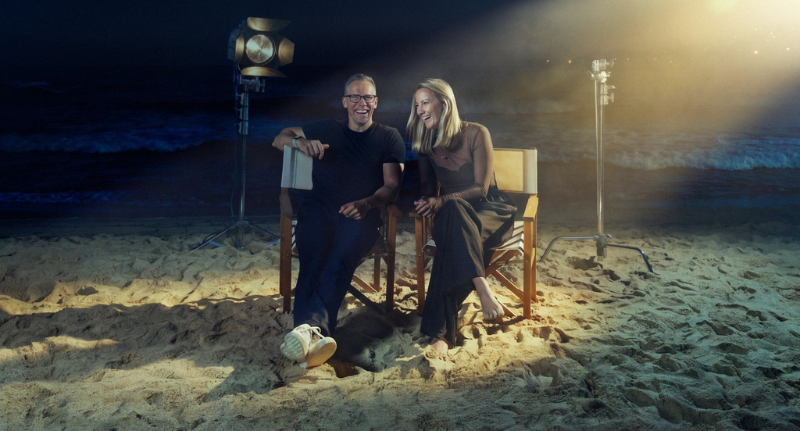
'Creatives become creators': Emotive's Simon Joyce on the agency's new production arm
Emotive has introduced Emotive Productions, a new production arm designed to bring creative and execution together from the outset, shaped by the agency’s experience delivering more than 130 productions across film, content, and brand experiences.
The independent agencies‘ new business is built on a simple premise: the best work happens when ideas and making stay connected throughout the process.
Built for modern content
The model reflects how production is evolving beyond traditional TV, with a focus on social-first content and the growing role of AI. The new arm is structured around five core pillars: AI production, motion and static, branded entertainment, events and experiences, and influencer co-production.
Hayley Ritz Pelling has been appointed general manager, stepping into the role after more than a decade with the business, accompanied by a core team including Sam Gadsden (head of post), Sophia Del (integrated executive producer) and Rebecca Love Williams (post producer), alongside new hire Kimm McTavish (integrated producer).
Why now?
Speaking to Mediaweek, Simon Joyce, founder and CEO of Emotive, explained why this was the right time to launch.
“This is a whole new discipline,” Joyce said.
The first factor, he said, is the evolution of AI, where “creatives become creators” in terms of production capabilities. Because of that, production, which once sat downstream, now needs to be integrated so that production thinking can influence ideas and vice versa.
The second driver is the fragmentation of media channels and the pace at which modern ideas travel, prompting a deliberate focus on the agency’s production pillars.
“We’ve been very deliberate with the disciplines. The best ideas are travelling across more touchpoints and needing more platform intentionality,” he said.
“You need the left arm talking to the right, because creatively, it’s all happening together. Before, it was more of a pass off, especially when ideas were dominated by one channel.”
The final factor is a shift in client needs, particularly as more brands build stronger in-house creative teams.
“We’ve always had the creative agency, but some clients have really good in-house creative teams. At times, they only need a production offering and don’t need the full agency service,” Joyce said.
Traditional production model under fire
Joyce said the shift toward integrated production is also being driven by the fact that ideas are increasingly coming to life outside traditional formats.
“I can’t speak for them. I do know that if you look at the shape of how our ideas are coming to life, more and more they’re coming to life in what we call non traditionally,” he said.
He pointed to a significant shift over the past 18 months.
“If you go back 18 months, probably 70% of the ideas we were bringing to life were more through core film and static, very much TVC-led and then iterating for social. Now, 70% of our ideas are coming to life with more of an earned first lens and travelling through a really non-traditional idea ecosystem.”
Despite the shift, Joyce said craft and talent remain central.
“It’s unquestionably shifting, but that doesn’t mean we don’t want to have craft and amazing talent to push what we do. We’re just doing it in slightly different ways.”
He added that traditional production is not disappearing, but becoming less dominant.
A shift in creative process
Joyce said AI production is now playing a central role in shaping ideas.
“More content doesn’t equal more connection. It’s making it harder for brands to connect, because we’re just bombarded with stuff where we’re asking, ‘Is it real? Is it not?” he said.
He added that the agency’s AI production capability is already contributing to new business, including a major AI-led motion project set to launch in May in partnership with AI Candy, Australia’s first AI-powered film production company.
Mediaweek had early access to the spot, which targets Gen Z around sexual health.
“It’s been six months of prompting, a tech stack of 10,000 to 15,000 plus prompts, an amazing process, and a lot harder than what everyone realises,” he said.
A key consideration when using AI, Joyce said, is transparency.
“Never try to dupe the audience. Don’t try it.”
He concluded that AI should only be used when it genuinely adds value: “Only use AI production if it’s going to improve your concepts or unlock something that you couldn’t without it.”
Top image: Simon Joyce and Hayley Ritz Pelling
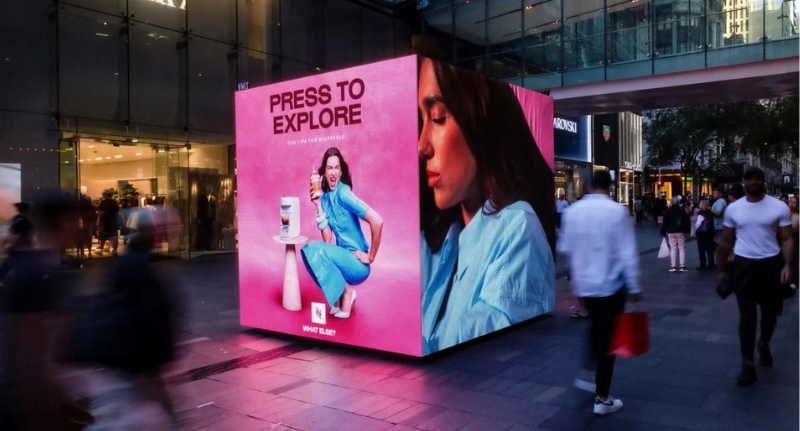
VMO brings Nespresso’s ‘Vertuo World’ to life
VMO has launched its immersive format, The Cube, at Sydney’s Pitt Street Mall, with Nespresso as the first brand to activate the site.
Positioned in the heart of the CBD, the installation places the experiential screen within one of Australia’s busiest retail environments, connecting directly with shoppers and commuters.
A high-impact retail moment
The Cube transforms traditional out-of-home into an immersive experience, with Nespresso’s latest global campaign taking over the format to introduce its new Vertuo World platform.
Burcu De La Cruz, ANZ marketing manager for brand, communications and sustainability at Nespresso, said the activation reflects a broader shift in media strategy.
“We are evolving our media strategy to embrace true variety, with one of the ways this comes to life being through The Cube on Pitt Street, just metres from our newly launched flagship boutique,” she said.
“We’re inviting people to explore Vertuo Up and challenge routine by asking ‘What Else?’, discovering our range of origins and blends in a bold new era for Nespresso.”
Built for attention and conversion
Paul Butler, managing director of VMO, said the placement combines visibility with immediate commercial impact.
“The presence of The Cube in Pitt Street Mall puts brands at the centre of one of the country’s most active retail environments,” he said.
“With a Nespresso store located just metres from the site, it’s the perfect solution combining big brand impact while driving an immediate sales opportunity.”
Media and execution
OpenMind led the campaign’s activation, leveraging the high-traffic location to maximise launch impact.
Harpreet Chahal, head of implementation and activation, Oceania at OpenMind, said the site delivered scale and visibility.
“We were looking to launch with maximum impact. Being the first brand on this immersive screen in Sydney’s busiest retail hub, right next to the Nespresso store, was the perfect high-visibility strategy for our campaign launch,” she said.
The campaign is supported by on-ground ambassadors directing customers to nearby Nespresso boutiques, alongside a national path-to-purchase rollout across VMO’s retail network.
Main image: VMO
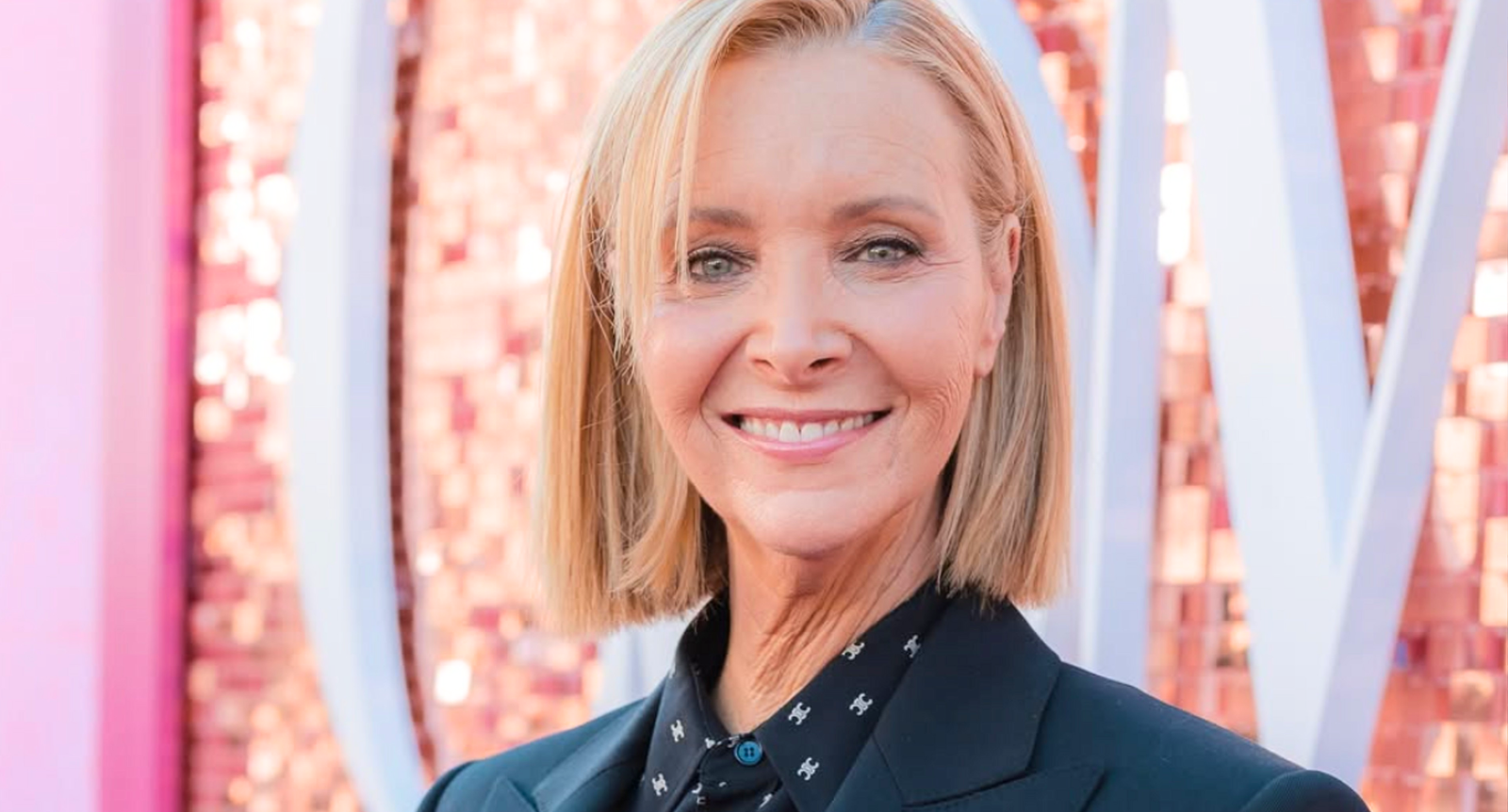
Friends' cast's multi-million dollar yearly residuals revealed
Lisa Kudrow has revealed that she and her Friends co-stars earn a gigantic $AUD27 million in residuals every year, decades after the show ended.
The Emmy-winning actress made the surprising admission in an interview published by the Times of London last week.
It’s widely known that the six co-stars were all friends in real life, and during pay negotiations agreed to present a united group to have an equal salary. They went from earning $AUD32,000 per episode in Season 1, to $AUD1.3 million per episode during Seasons 9 and 10.
The news of the staggering amount in residuals still paid 22 years later has gone viral, prompting Mediaweek to compare the residuals to that of other hit shows of the time.
Jerry Seinfeld reportedly still earns a solid income from his namesake show Seinfeld, but apparently not the other cast members.
Similarly, IMDb reports about The Big Bang Theory: “Parsons, Galecki, and Cuoco own one percent shares of the show… If the series makes one billion dollars a year, that’s an extra $10 million for the lead actors.”
However, the recent death of Dawson’s Creek star James Van Der Beek – whose wife controversially used a public fundraiser to secure their home afterwards – has highlighted that not all cast members of hit series have such lucrative residual deals.
View this post on Instagram
Lisa Kudrow reveals Friends residuals
Kudrow, 62, further said in the Times story that she “will never say anything bad about Friends” because the show is “still incredible work”.
Perhaps justifying the extraordinary residuals, she added, “There are plenty of shows with big-name comedians from that time, and they are not funny, but Friends is.”
Kudrow played Phoebe Buffay for all 10 seasons of Friends from 1994 to 2004. She shared that she rewatched the entire series after co-star Matthew Perry’s passing in 2023 at 54.
“After Matthew died, I watched the show again,” she said.
“Before, I only saw what I did wrong or could have done better. But for the first time, I truly appreciated just how great it was.
“There was a genius at work. And whatever any of us do in the future, we will never experience something like that again.”
Top image: Lisa Kudrow. Image: Instagram

IAS drops a flashlight into the murky waters of CTV
For years, media buyers have poured premium dollars into connected TV environments, essentially crossing their fingers and hoping their expensive campaigns do not end up running next to a show that makes their brand manager weep.
Now, Integral Ad Science has found a way to turn the lights on.
The global measurement giant has launched IAS Total TV. This new suite of solutions gives marketers the “linear-like” transparency they have begged for in the streaming era.
The tool unlocks show, genre, and rating data across heavyweights like Disney, NBCUniversal, Paramount, and Prime Video, plus a host of opted-in publishers using Publica.
Ending the blind buy
According to Nielsen data from late 2025, ad-supported viewing now makes up 74.2% of all television consumption in the US.
Streaming accounts for nearly half of that pie at 45.6%. Despite these massive audiences, media buyers often struggle to access a unified and reliable source of truth regarding exactly where their high-CPM ads actually land.
Stitching together siloed data to prove the value of premium spend remains a massive headache for the industry.
The high cost of the channel makes wasting budgets on unsuitable content or non-CTV devices a fireable offence.
Disney Advertising senior vice president of data and measurement science Dana McGraw noted the launch brings much-needed accountability to the space. “As advertisers continue to double down on connected TV, the need for greater visibility and performance insight has never been more important,” McGraw said. “By collaborating with IAS, we’re helping provide advertisers with clearer, more actionable insights about their campaigns and where they’re deriving the most value.”
The streaming safety net
The new Total TV tool funnels content insights, media quality, supply path, and outcomes into a unified dashboard within the IAS Signal platform.
This setup allows advertisers to dictate exactly when and how their advertising runs alongside CTV content.
Integral Ad Science chief product officer Srishti Gupta framed the tool as a critical visibility engine between buyers and sellers. “Transparency is the key to turning CTV impressions into targeted engagement,” Gupta said. “With deep, trusted relationships across leading CTV streamers and broadcasters, IAS is bringing greater visibility and accountability to the ecosystem.”
Marketers can now benefit from third-party verification that enables pre-bid actionability. IAS continues to safeguard publisher data in a privacy-safe manner to drive growth for the broader ecosystem.
Feature image- IAS: supplied.
18 years of watching the latest shiny new thing not kill creativity
Christian Finucane, co-founder and creative partner, The Core Agency
A few years ago, a mate handed me a beer and asked if I was worried about ChatGPT. ‘Chat what?’ I replied. They gave me a look – part ’where have you been?’ coupled with genuine concern that the creative industry I love was about to be automated into irrelevance.
After their explanation, my immediate thought? I could get my computer to write up my novel idea. Awesome!
Of course, creativity is never doomed. It hasn’t been doomed by television, digital, social, data, podcasts, or influencers, and it won’t be prompted to death by AI. Every wave of new gadgets, widgets and hi-tech tools that were supposed to kill original thinking has actually proven to need it more.
Creativity is like one of those unkillable zombies in The Walking Dead.
I think this proves that every era that was supposed to make creativity (and creatives…) obsolete has ended up more desperate for it and those who are paid to deliver it.
We started our agency in 2007. You couldn’t buy an iPhone yet. Influencer marketing wasn’t a thing. Netflix was still mailing DVDs. But clients were doing exactly what they still do today, needing smart new ways to stand out, drive revenue and build real value in their brands.
Some things will always be immune to disruption.
That same year (an era long before anyone had heard of Mr Beast, Instagram or TikTok), we launched another, dare I say it, disruptive creative business called SuperVirals.
It was a user-generated content platform for brands that incentivised the content creators to drive brand engagement across the newly emerging social platforms. While it was clear there was a growing hunger for a more grassroots form of creativity, it withered a few years later, as creativity found its next outlet.
Forgive me as I don my cardigan and spark up my trusty pipe as I reminisce on the last 18 years of shiny new things.
We’ve seen purpose-driven marketing rise and become the dominant religion of every brand.
We’ve seen the big-data-driven era promise that if you just optimised hard enough, the creative almost didn’t matter.
We’ve seen personalisation at scale, where AI could theoretically serve thousands of ad variations to thousands of micro-audiences simultaneously.
And now we’re elbows-deep in the native content era where everything seemingly has to be platform-first, feed-native and algorithm-friendly. Though, strangely, the creative work often looks like it wasn’t made by an agency at all.
Don’t get me wrong, each of these eras, pivots and platforms has brought real change. The shift from television-first to mobile-first isn’t cosmetic; it changes how stories are told, how quickly trust is built, and how long you have to engage their brain before the brand is swiped into oblivion.
The unstoppable rise of social content has also shifted what ‘production value’ means. A shaky phone video by a real customer can outperform a six-figure shoot. Dynamic creative optimisation, driven by AI, now does in minutes what used to take a whole team weeks. These are not trivial developments, just ask anyone who has been made redundant recently.
None of these evolutions in tech or tools has changed the fundamental problem. Brands still need to mean something to people. Audiences still need a reason to pay attention. The brief is still, at its core, to make someone notice, feel and do something they wouldn’t have otherwise.
If anything, the acceleration of every other variable has made the creative idea more important, not less. When distribution is democratised, and production is commodified, and AI can generate ten thousand asset variations overnight, the thing that differentiates you is the idea underneath all of it.
The AI conversation is a perfect illustration of this. Generative tools are genuinely extraordinary and incredibly useful. And they get better week by week.
Our industry loves to announce that everything has changed. And much of it has. But the agencies and creative people who have lasted through multiple eras tend to share a particular quality: they never confuse the tools or the channel with the idea. They stayed nimble because they stayed curious. They punched above, not because of scale, but because of spark.
We’ve stayed curious for eighteen years, and the pace of change has never been faster. To me, that sounds less like a threat and more like an opportunity.