





EXCLUSIVE: Why Sleep or Die is the boldest new brand in the booming sleep economy
For founder Lauren Sudeyko the lesson is clear: weird works

Lauren Sudeyko wasn’t trying to build a sleep brand.
She was simply trying to survive the night.
“I was in a cycling accident during COVID," she told Mediaweek. "It was early in the morning, and we were nearly hit by a car. I suffered a really bad concussion.”
The injury forced a reckoning she hadn’t expected.
“It was the first time I had ever been off work, and I was forced to really think about my health and sleep," she said.
So, Sudeyko did what many people do. She turned to medication.
“I started on the prescription sleeping aid train,” she said. “And I would just be like wandering around my apartment at 2am. It was the most terrifying, lonely thing I've ever been through."


The leading media trade publication in Australia.
Get our top stories straight to your inbox daily by signing up to our Newsletter
By providing your information, you agree to our Terms of Use and our Privacy Policy. We use vendors that may also process your information to help provide our services.
What followed wasn’t just insomnia - it was a sense of alienation from the entire category.
“From there, I just really started like getting into the research and thinking about it,” she said. “And the more I started looking at the sleep industry, the worse I felt about myself."
Sudeyko recalls that every image of women promoting sleep looked “so beautiful and put together”, a world away from how she felt while desperately trying to catch those elusive Zs.
So she named the feeling, and ultimately, the brand.
“I just started thinking that if you don't sleep enough, you're just going to die younger. And I just kept coming back to that crazy line: sleep or die," she said.
That “crazy” name is now Sleep or Die - a fast-acting sleep strip brand designed for a generation that no longer treats rest as passive, but as performance.
Sudeyko said she often references Tiffany Masterson, founder of Drunk Elephant, as proof that unconventional brands can scale.
In August 2013, Masterson launched Drunk Elephant with six products via a DTC website. Five years later, the brand was generating close to US$100 million in annual net sales. In 2019, Shiseido acquired it for US$845 million, valuing the business at more than eight times its revenue.
For Sudeyko, the lesson is clear: weird works.
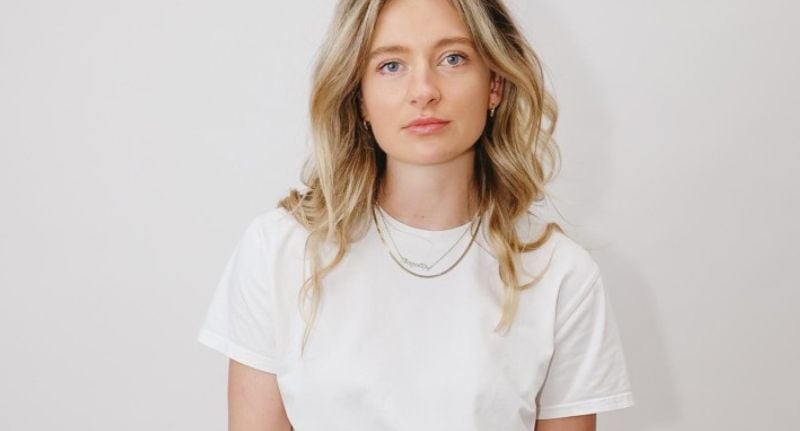 Lauren Sudeyko
When rest became the new hustle
A decade ago, sleep was the thing you sacrificed to prove you wanted it badly enough.
If you were tired, you were trying.
If you were exhausted, you were winning.
The 2010s turned burnout into a badge of honour - a culture built on 4am alarms, triple-shot coffees and LinkedIn confessionals about “grind.” Hustle culture didn’t just normalise exhaustion. It aestheticised it.
But somewhere between lockdowns, wearables, and a global mental health reckoning, the narrative flipped.
Sleep is no longer what you lose to succeed. It’s what you buy to prove you’ve made it, in turn creating one of the most lucrative lifestyle pivots of the decade.
Even Diary of a CEO founder Steven Bartlett - once the poster boy for hustle minimalism- posted a quiet admission on LinkedIn:
“The best self-care tool no one talks enough about is sleep. For the first 8 years of my career, I saw sleep as a negotiable… a good night's sleep was upstream from a good day.”
It is a modern rebrand in real time.
For Sudeyko, the real issue is how the category turns sleep into a moral test - something you either master or fail at.
“My biggest qualm with the sleep industry is that it is still on such a pedestal of, like, perfection and guilt and needing to have it all figured out.”
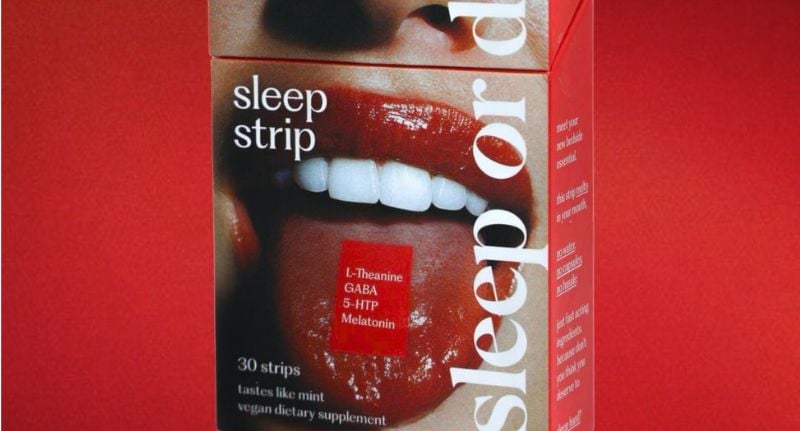 Sleep or Die's unique packaging.
Building the strip
Given that Sudeyko doesn't have a nutritional background, she spent “a lot of time learning and working with experts” to arrive at the formulation.
“It's all about using the best ingredients that have a high impact at a low dosage,” she said.
Once she arrived at the right dose, the next decision was format.
After rejecting pills, syrups and powders, she landed on a strip - think Listerine Breath Strips - that dissolves on the tongue.
But getting there wasn’t easy.
“That process, of creating a strip that didn’t ‘taste like thick cough syrup’ was another long road of trial and error,” she said.
“You kind of have to really experiment with products that are high impact at a lower dosage of ingredients,” she explained, adding that magnesium was ruled out “because you need it at around 300 milligrams dosage for it to have an effect on your system.”
Instead, the strips contain a mix of L-theanine, GABA, 5-HTP and melatonin.
“It’s the perfect group of amino acids plus melatonin that all work together to help get your body to get ready to go to bed.”
And, according to Sudeyko, the effect is nearly immediate.
“It's an extremely fast-acting sleep supplement because they go right into your bloodstream because it dissolves on the roof of your mouth or on your tongue.”
From PepsiCo to disruption
Before founding Sleep or Die, Sudeyko spent years inside some of the world’s biggest brands.
“After university, I went straight into corporate. I was at PepsiCo for five years after school. I was then the brand manager of Lay's for Canada, and then I worked at Walker's Crisps in the UK.”
She credits that experience with shaping how she now thinks about category disruption.
“I really loved the Walker's Crisps moment in the UK," she said.
"Working on something in a different culture at such a young age really kind of taught me that you really need to put yourself in a very different position from a marketing and category perspective to know what will make something break through.”
She later moved to Google.
“I was there for four years, loved it, learned a lot, but kind of found the same issue at the end of the day, the same problem.”
For now, Sleep or Die is entirely self-funded, with Sudeyko the sole backer after selling her Google shares.
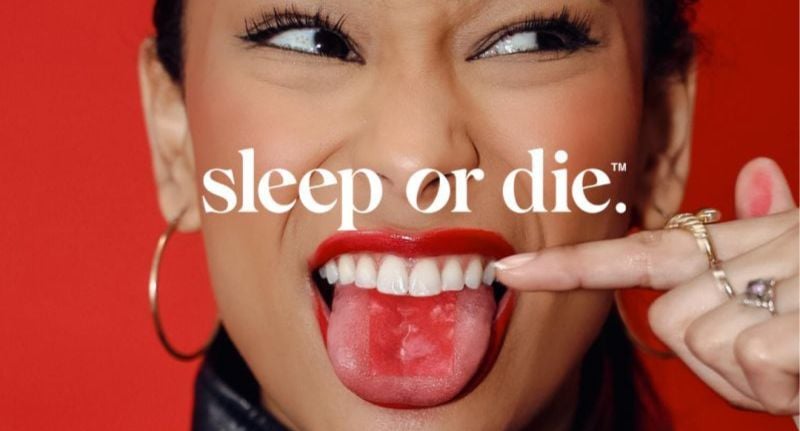
Design as disruption
Sleep or Die’s visual identity is not accidental - it is a deliberate rejection of how the sleep industry traditionally presents itself.
While most brands lean into soft pastels, calm language and aspirational perfection, Sudeyko set out to do the opposite.
“I thought about what the sleep industry does and did the opposite," she said, adding that framework has been behind every single decision she's made.
That philosophy first surfaced in the packaging.
“I had a different box originally - it just wouldn't stand up straight. And I swear if that box had stood up straight, I would have used that. But because it didn't, I had to go and look into something else.”
That “something else” became a cigarette-style pack.
“I think the cigarette box for me was like - I wanted customers to look at this and get it right away.”
The result is bold and arresting - more convenience-store provocation than wellness aisle calm. Certainly not the kind of product you’d expect to offer a strung-out mum, or even your grandma.
Yet this is exactly who Sudeyko hopes to attract.
The box is bright lipstick red and features the image of a woman on the front - her tongue exposed, the sleep strip placed right in the middle.
Despite its bolshy attitude, Sudeyko’s genius lies in staying a disruptor while giving the category a subtle wink. It’s cheeky. And it knows it.
For Sudeyko, the lesson is clear: weird works. All the product now has to do is earn that belief.
More from Mediaweek
The leading media trade publication in Australia.
Get our top stories straight to your inbox daily by signing up to our Newsletter
By providing your information, you agree to our Terms of Use and our Privacy Policy. We use vendors that may also process your information to help provide our services.


.jpg%3Fv%3D1785199754878&w=3840&q=75)
